


The Senior Engineer Mindset: Why Writing Less Code Is Often the Best Way to Ship
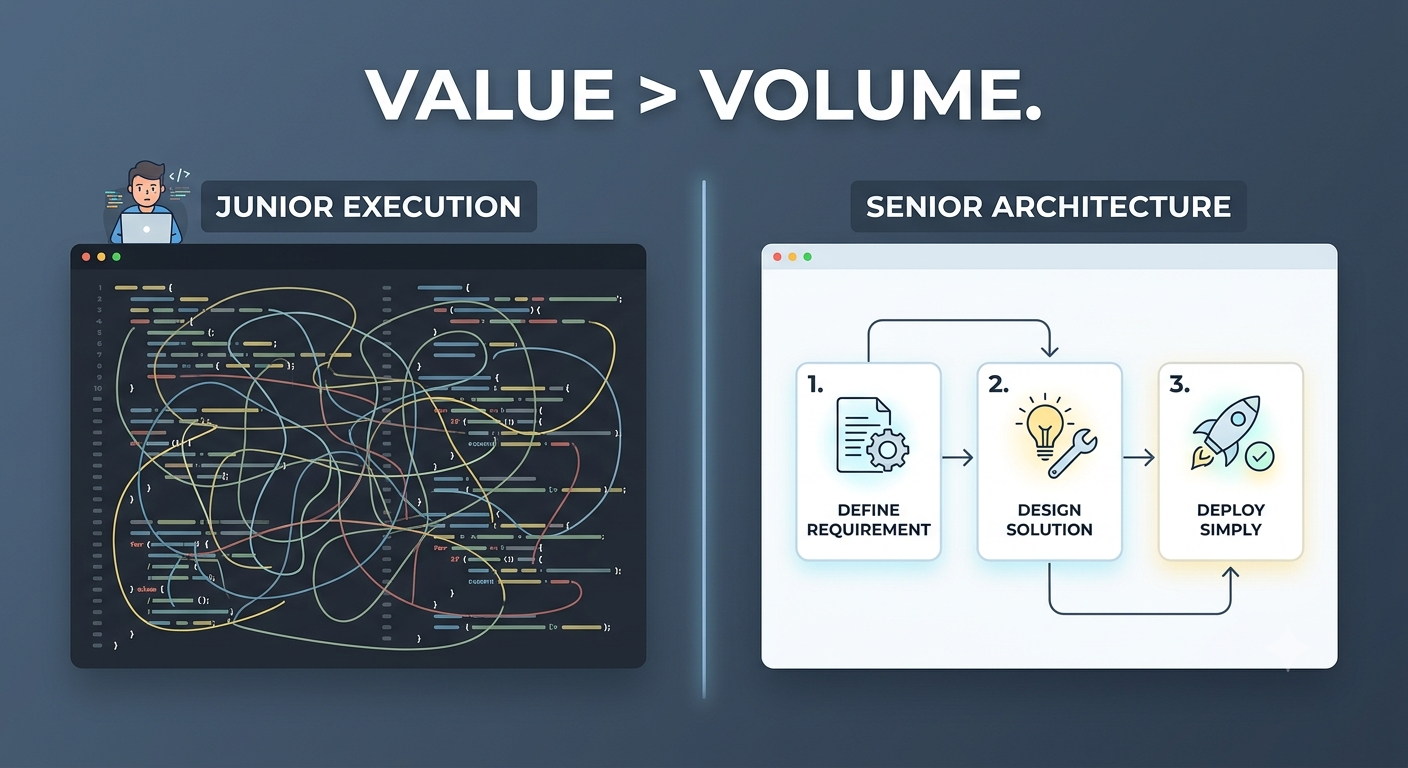
Early in your career, technical prowess is measured by execution speed and complex problem-solving. However, breaking through the mid-level barrier into senior positions requires a fundamental shift in how you evaluate impact.
Here are three mental models to help you level up your engineering strategy and stand out as a force multiplier on your team:
1. Default to the Smallest Effective Surface Area
Every line of custom code you deploy is a future liability—it requires testing, maintenance, and eventual refactoring. Before opening your IDE:
Ask: "Can this problem be solved by configuring an existing tool or tweaking an established pattern?"
Validate: Resist the urge to build custom utility libraries for problems that are already solved reliably in your framework’s ecosystem.
2. Solve for Maintenance, Not Just Execution
Code is read far more often than it is written. A clever one-liner might feel satisfying to commit, but if it takes a teammate 15 minutes to decipher during an incident, it’s a net loss for the team.
Prioritize explicit over clever.
Write code that communicates intent clearly so that future-you (and your peers) can debug it effortlessly at 2 AM.
3. Translate Technical Trade-offs into Risk and Time
Senior developers don't just present technical problems; they frame them in terms of trade-offs.
Instead of saying:
"We need to rewrite this service using microservices because the monolith is disorganized."
Frame it as: "Refactoring this core module will reduce our deployment cycle time from two days to 20 minutes and lower the risk of cascading failures during peak load."
When you tie engineering decisions to developer velocity, reliability, and risk, you instantly become a partner in product direction rather than just an execution unit.
Key Takeaways
Code is a liability, value is the asset: Measure your output by the problem solved, not the complexity of the solution.
Optimize for readability: Write straightforward code that lowers cognitive load for reviewers and maintainers.
Master trade-off communication: Articulate why a technical improvement matters in terms of time, risk, and stability.
CTA
Ready to elevate your engineering career and tackle real-world architecture challenges? Join Developers & Coding on Techawks today to connect with peers, get code reviews, and level up your software skills.
Early in your career, technical prowess is measured by execution speed and complex problem-solving. However, breaking through the mid-level barrier into senior positions requires a fundamental shift in how you evaluate impact.
Here are three mental models to help you level up your engineering strategy and stand out as a force multiplier on your team:
1. Default to the Smallest Effective Surface Area
Every line of custom code you deploy is a future liability—it requires testing, maintenance, and eventual refactoring. Before opening your IDE:
Ask: "Can this problem be solved by configuring an existing tool or tweaking an established pattern?"
Validate: Resist the urge to build custom utility libraries for problems that are already solved reliably in your framework’s ecosystem.
2. Solve for Maintenance, Not Just Execution
Code is read far more often than it is written. A clever one-liner might feel satisfying to commit, but if it takes a teammate 15 minutes to decipher during an incident, it’s a net loss for the team.
Prioritize explicit over clever.
Write code that communicates intent clearly so that future-you (and your peers) can debug it effortlessly at 2 AM.
3. Translate Technical Trade-offs into Risk and Time
Senior developers don't just present technical problems; they frame them in terms of trade-offs.
Instead of saying:
"We need to rewrite this service using microservices because the monolith is disorganized."
Frame it as: "Refactoring this core module will reduce our deployment cycle time from two days to 20 minutes and lower the risk of cascading failures during peak load."
When you tie engineering decisions to developer velocity, reliability, and risk, you instantly become a partner in product direction rather than just an execution unit.
Key Takeaways
Code is a liability, value is the asset: Measure your output by the problem solved, not the complexity of the solution.
Optimize for readability: Write straightforward code that lowers cognitive load for reviewers and maintainers.
Master trade-off communication: Articulate why a technical improvement matters in terms of time, risk, and stability.
CTA
Ready to elevate your engineering career and tackle real-world architecture challenges? Join Developers & Coding on Techawks today to connect with peers, get code reviews, and level up your software skills.
The Senior Engineer Mindset: Why Writing Less Code Is Often the Best Way to Ship
Early in your career, technical prowess is measured by execution speed and complex problem-solving. However, breaking through the mid-level barrier into senior positions requires a fundamental shift in how you evaluate impact.
Here are three mental models to help you level up your engineering strategy and stand out as a force multiplier on your team:
1. Default to the Smallest Effective Surface Area
Every line of custom code you deploy is a future liability—it requires testing, maintenance, and eventual refactoring. Before opening your IDE:
Ask: "Can this problem be solved by configuring an existing tool or tweaking an established pattern?"
Validate: Resist the urge to build custom utility libraries for problems that are already solved reliably in your framework’s ecosystem.
2. Solve for Maintenance, Not Just Execution
Code is read far more often than it is written. A clever one-liner might feel satisfying to commit, but if it takes a teammate 15 minutes to decipher during an incident, it’s a net loss for the team.
Prioritize explicit over clever.
Write code that communicates intent clearly so that future-you (and your peers) can debug it effortlessly at 2 AM.
3. Translate Technical Trade-offs into Risk and Time
Senior developers don't just present technical problems; they frame them in terms of trade-offs.
Instead of saying:
"We need to rewrite this service using microservices because the monolith is disorganized."
Frame it as: "Refactoring this core module will reduce our deployment cycle time from two days to 20 minutes and lower the risk of cascading failures during peak load."
When you tie engineering decisions to developer velocity, reliability, and risk, you instantly become a partner in product direction rather than just an execution unit.
Key Takeaways
Code is a liability, value is the asset: Measure your output by the problem solved, not the complexity of the solution.
Optimize for readability: Write straightforward code that lowers cognitive load for reviewers and maintainers.
Master trade-off communication: Articulate why a technical improvement matters in terms of time, risk, and stability.
CTA
Ready to elevate your engineering career and tackle real-world architecture challenges? Join Developers & Coding on Techawks today to connect with peers, get code reviews, and level up your software skills.

 English
 Arabic
 French
 Spanish
 Portuguese
 Turkish
 Dutch
Dutch
 Italiano
 Russian
 Romaian
 Portuguese (Brazil)
 Greek
Greek