


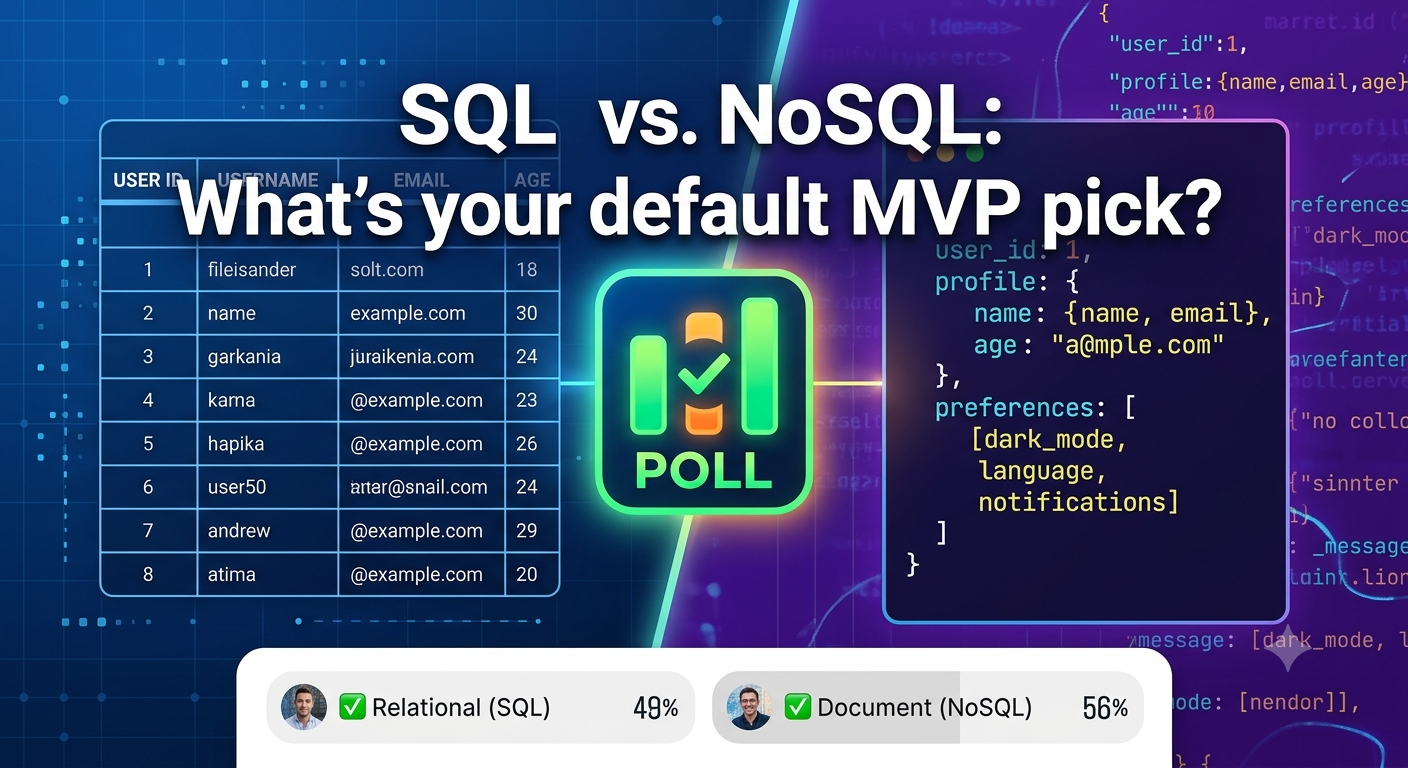
Database Selection Dilemma: Relational vs. Document Stores for New Projects
Choosing between a Relational DB (like PostgreSQL or MySQL) and a Document Store (like MongoDB) isn't about which technology is "better"—it's about matching your data access patterns to your domain logic.
Here is a quick framework to make the right call:
Choose a Relational DB (SQL) when:
Data integrity is non-negotiable: You require strict schema enforcement and full ACID compliance (e.g., financial transactions, inventory tracking).
Relationships are complex: Your domain involves heavy cross-referencing, multi-table joins, and normalized structures.
Query patterns are unpredictable: SQL allows you to run ad-hoc analytical queries without restructuring your entire dataset.
Choose a Document Store (NoSQL) when:
Schemas are fluid or evolving rapidly: You are prototyping rapidly or working with highly unstructured data where attributes vary per record.
High-write throughput & horizontal scale: You need to partition data across multiple nodes with low-latency reads for pre-aggregated documents.
Hierarchical data structures: Your entity contains nested arrays/objects that are naturally fetched and written together (e.g., user preferences or catalog items).
📊 Community Poll
When bootstrapping a brand-new production MVP today, what is your default database choice?
🟢 PostgreSQL (Reliable, rich feature set, JSON support)
🟡 MongoDB / Document DB (Flexible schema, rapid iteration)
🔵 SQLite / Embedded DB (Lightweight, simple deployment)
🟣 It depends entirely on the domain logic
(Cast your vote in the comments below with a brief reason why!)
Key Takeaways
Design for access patterns: Choose your database based on how you write and read data, not just framework defaults.
Postgres bridges the gap: Modern SQL databases handle JSON documents remarkably well, giving you flexibility alongside relational integrity.
Avoid premature optimization: Pick the tool that minimizes architectural complexity for your team's current velocity.
CTA
Debating system architecture choices for your next big build? Join Developers & Coding on Techawks today to discuss database strategies, get code feedback, and level up with fellow engineers.
Choosing between a Relational DB (like PostgreSQL or MySQL) and a Document Store (like MongoDB) isn't about which technology is "better"—it's about matching your data access patterns to your domain logic.
Here is a quick framework to make the right call:
Choose a Relational DB (SQL) when:
Data integrity is non-negotiable: You require strict schema enforcement and full ACID compliance (e.g., financial transactions, inventory tracking).
Relationships are complex: Your domain involves heavy cross-referencing, multi-table joins, and normalized structures.
Query patterns are unpredictable: SQL allows you to run ad-hoc analytical queries without restructuring your entire dataset.
Choose a Document Store (NoSQL) when:
Schemas are fluid or evolving rapidly: You are prototyping rapidly or working with highly unstructured data where attributes vary per record.
High-write throughput & horizontal scale: You need to partition data across multiple nodes with low-latency reads for pre-aggregated documents.
Hierarchical data structures: Your entity contains nested arrays/objects that are naturally fetched and written together (e.g., user preferences or catalog items).
📊 Community Poll
When bootstrapping a brand-new production MVP today, what is your default database choice?
🟢 PostgreSQL (Reliable, rich feature set, JSON support)
🟡 MongoDB / Document DB (Flexible schema, rapid iteration)
🔵 SQLite / Embedded DB (Lightweight, simple deployment)
🟣 It depends entirely on the domain logic
(Cast your vote in the comments below with a brief reason why!)
Key Takeaways
Design for access patterns: Choose your database based on how you write and read data, not just framework defaults.
Postgres bridges the gap: Modern SQL databases handle JSON documents remarkably well, giving you flexibility alongside relational integrity.
Avoid premature optimization: Pick the tool that minimizes architectural complexity for your team's current velocity.
CTA
Debating system architecture choices for your next big build? Join Developers & Coding on Techawks today to discuss database strategies, get code feedback, and level up with fellow engineers.
Database Selection Dilemma: Relational vs. Document Stores for New Projects
Choosing between a Relational DB (like PostgreSQL or MySQL) and a Document Store (like MongoDB) isn't about which technology is "better"—it's about matching your data access patterns to your domain logic.
Here is a quick framework to make the right call:
Choose a Relational DB (SQL) when:
Data integrity is non-negotiable: You require strict schema enforcement and full ACID compliance (e.g., financial transactions, inventory tracking).
Relationships are complex: Your domain involves heavy cross-referencing, multi-table joins, and normalized structures.
Query patterns are unpredictable: SQL allows you to run ad-hoc analytical queries without restructuring your entire dataset.
Choose a Document Store (NoSQL) when:
Schemas are fluid or evolving rapidly: You are prototyping rapidly or working with highly unstructured data where attributes vary per record.
High-write throughput & horizontal scale: You need to partition data across multiple nodes with low-latency reads for pre-aggregated documents.
Hierarchical data structures: Your entity contains nested arrays/objects that are naturally fetched and written together (e.g., user preferences or catalog items).
📊 Community Poll
When bootstrapping a brand-new production MVP today, what is your default database choice?
🟢 PostgreSQL (Reliable, rich feature set, JSON support)
🟡 MongoDB / Document DB (Flexible schema, rapid iteration)
🔵 SQLite / Embedded DB (Lightweight, simple deployment)
🟣 It depends entirely on the domain logic
(Cast your vote in the comments below with a brief reason why!)
Key Takeaways
Design for access patterns: Choose your database based on how you write and read data, not just framework defaults.
Postgres bridges the gap: Modern SQL databases handle JSON documents remarkably well, giving you flexibility alongside relational integrity.
Avoid premature optimization: Pick the tool that minimizes architectural complexity for your team's current velocity.
CTA
Debating system architecture choices for your next big build? Join Developers & Coding on Techawks today to discuss database strategies, get code feedback, and level up with fellow engineers.

 English
 Arabic
 French
 Spanish
 Portuguese
 Deutsch
 Turkish
 Dutch
Dutch
 Italiano
 Russian
 Romaian
 Portuguese (Brazil)