


Beating the ATS Black Hole: Why AI Resume Parsers Fail and How to Optimize Your Profile
Job seekers often assume a human reads their resume first. In reality, over 75% of large enterprises use automated ATS and AI embedding models to parse, rank, and filter resumes before a recruiter ever looks at them.
Enter AI-Driven Resume Parsers (Semantic Vector Matching):
Modern ATS tools don't just look for keyword matching anymore; they use vector embeddings to judge semantic similarity between your experience and the job description. Here is how you can beat the algorithm:
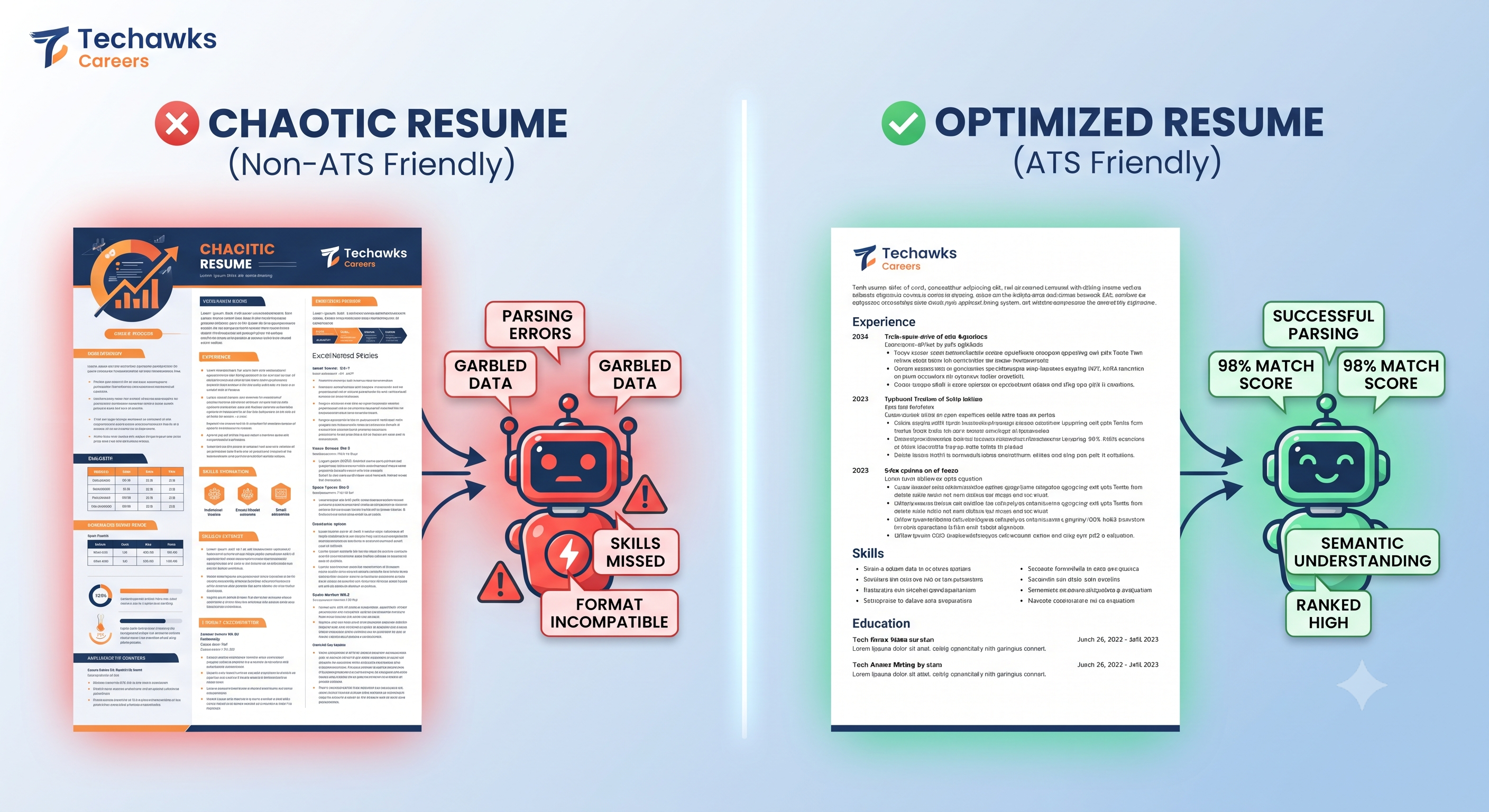
Structure for Parsers, Not Just Aesthetics: Avoid multi-column layouts, tables, text boxes, and graphic elements. Linear, clean Markdown or standard single-column PDF formatting ensures structural text extraction without data loss.
Map Experience to Core Competencies: Instead of hiding skills in dense paragraphs, use clear, standard industry headings (e.g., "Technical Skills", "Professional Experience") followed by bullet points detailing metrics and tools.
Mirror Relevant Terminology: Incorporate explicit tool names and methodologies from the job description naturally into your impact statements so the vector model scores your semantic proximity higher.
By understanding the technical pipeline of hiring software, you stop guessing and start engineering a resume that gets flagged for human review.
Discussion Question: Have you ever experimented with tailoring your resume format specifically for ATS algorithms, or do you prefer keeping it traditional? Let’s share strategies below! 👇
CTA (Join Tech Jobs & Opportunities): Ready to land your next big career milestone? Join our community of job seekers and professionals at Techawks to master the tools, resume strategies, and insights that matter.
Job seekers often assume a human reads their resume first. In reality, over 75% of large enterprises use automated ATS and AI embedding models to parse, rank, and filter resumes before a recruiter ever looks at them.
Enter AI-Driven Resume Parsers (Semantic Vector Matching):
Modern ATS tools don't just look for keyword matching anymore; they use vector embeddings to judge semantic similarity between your experience and the job description. Here is how you can beat the algorithm:
Structure for Parsers, Not Just Aesthetics: Avoid multi-column layouts, tables, text boxes, and graphic elements. Linear, clean Markdown or standard single-column PDF formatting ensures structural text extraction without data loss.
Map Experience to Core Competencies: Instead of hiding skills in dense paragraphs, use clear, standard industry headings (e.g., "Technical Skills", "Professional Experience") followed by bullet points detailing metrics and tools.
Mirror Relevant Terminology: Incorporate explicit tool names and methodologies from the job description naturally into your impact statements so the vector model scores your semantic proximity higher.
By understanding the technical pipeline of hiring software, you stop guessing and start engineering a resume that gets flagged for human review.
Discussion Question: Have you ever experimented with tailoring your resume format specifically for ATS algorithms, or do you prefer keeping it traditional? Let’s share strategies below! 👇
CTA (Join Tech Jobs & Opportunities): Ready to land your next big career milestone? Join our community of job seekers and professionals at Techawks to master the tools, resume strategies, and insights that matter.
Beating the ATS Black Hole: Why AI Resume Parsers Fail and How to Optimize Your Profile
Job seekers often assume a human reads their resume first. In reality, over 75% of large enterprises use automated ATS and AI embedding models to parse, rank, and filter resumes before a recruiter ever looks at them.
Enter AI-Driven Resume Parsers (Semantic Vector Matching):
Modern ATS tools don't just look for keyword matching anymore; they use vector embeddings to judge semantic similarity between your experience and the job description. Here is how you can beat the algorithm:
Structure for Parsers, Not Just Aesthetics: Avoid multi-column layouts, tables, text boxes, and graphic elements. Linear, clean Markdown or standard single-column PDF formatting ensures structural text extraction without data loss.
Map Experience to Core Competencies: Instead of hiding skills in dense paragraphs, use clear, standard industry headings (e.g., "Technical Skills", "Professional Experience") followed by bullet points detailing metrics and tools.
Mirror Relevant Terminology: Incorporate explicit tool names and methodologies from the job description naturally into your impact statements so the vector model scores your semantic proximity higher.
By understanding the technical pipeline of hiring software, you stop guessing and start engineering a resume that gets flagged for human review.
Discussion Question: Have you ever experimented with tailoring your resume format specifically for ATS algorithms, or do you prefer keeping it traditional? Let’s share strategies below! 👇
CTA (Join Tech Jobs & Opportunities): Ready to land your next big career milestone? Join our community of job seekers and professionals at Techawks to master the tools, resume strategies, and insights that matter.

 English
 Arabic
 French
 Portuguese
 Deutsch
 Turkish
 Dutch
Dutch
 Italiano
 Russian
 Romaian
 Portuguese (Brazil)
 Greek
Greek