


Scaling Beyond the Happy Path: Why Building on India Stack DPI Requires Resilient System Architecture
As developers and architects in India’s fast-moving tech ecosystem, we have unprecedented access to population-scale public rails like Aadhaar verification, UPI payments, and open commerce protocols. But treating these public APIs like standard vendor endpoints is a recipe for production failure.
Enter Resilient DPI Architecture (Handling Asynchronous Scale):
When designing apps that plug into India Stack components, your engineering mindset must shift toward fault-tolerant distributed systems:
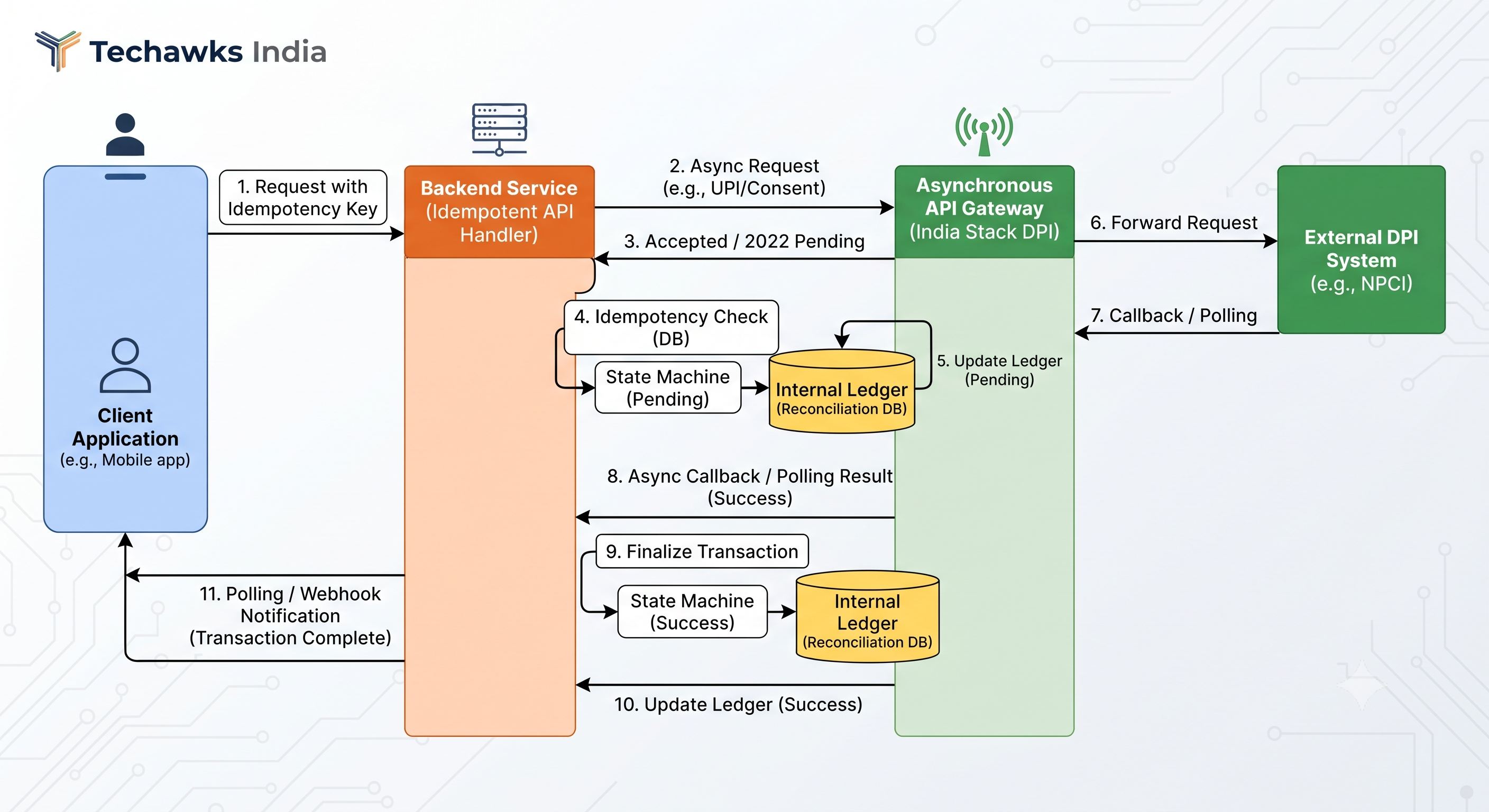
Implement Strict Idempotency Keys: Network timeouts happen. Ensure your transaction or request handlers include unique idempotency keys to prevent duplicate debits or multi-submit glitches when retrying failed calls.
Design for Asynchronous States: Never assume a transaction completes synchronously. Build robust state machines that gracefully handle intermediate limbo states (such as pending or timed-out responses) with clear polling or webhook fallback loops.
Isolate Internal Ledgers from Rail Dashboards: Never rely on a third-party payment gateway or aggregator dashboard as your source of truth. Maintain your own double-entry internal ledger to reconcile rail events against local states reliably.
By engineering resilience directly into your core backend logic, you turn public digital infrastructure into a powerful, reliable growth engine for your users.
Discussion Question: What is the trickiest edge case you’ve encountered when handling timeout states or retries on high-volume UPI or API integrations? Let’s talk code below! 👇
CTA (Join Techawks India): Ready to build world-class, population-scale systems for the Indian tech landscape? Join our community of developers and engineers at Techawks India to master the architectures that matter.
As developers and architects in India’s fast-moving tech ecosystem, we have unprecedented access to population-scale public rails like Aadhaar verification, UPI payments, and open commerce protocols. But treating these public APIs like standard vendor endpoints is a recipe for production failure.
Enter Resilient DPI Architecture (Handling Asynchronous Scale):
When designing apps that plug into India Stack components, your engineering mindset must shift toward fault-tolerant distributed systems:
Implement Strict Idempotency Keys: Network timeouts happen. Ensure your transaction or request handlers include unique idempotency keys to prevent duplicate debits or multi-submit glitches when retrying failed calls.
Design for Asynchronous States: Never assume a transaction completes synchronously. Build robust state machines that gracefully handle intermediate limbo states (such as pending or timed-out responses) with clear polling or webhook fallback loops.
Isolate Internal Ledgers from Rail Dashboards: Never rely on a third-party payment gateway or aggregator dashboard as your source of truth. Maintain your own double-entry internal ledger to reconcile rail events against local states reliably.
By engineering resilience directly into your core backend logic, you turn public digital infrastructure into a powerful, reliable growth engine for your users.
Discussion Question: What is the trickiest edge case you’ve encountered when handling timeout states or retries on high-volume UPI or API integrations? Let’s talk code below! 👇
CTA (Join Techawks India): Ready to build world-class, population-scale systems for the Indian tech landscape? Join our community of developers and engineers at Techawks India to master the architectures that matter.
Scaling Beyond the Happy Path: Why Building on India Stack DPI Requires Resilient System Architecture
As developers and architects in India’s fast-moving tech ecosystem, we have unprecedented access to population-scale public rails like Aadhaar verification, UPI payments, and open commerce protocols. But treating these public APIs like standard vendor endpoints is a recipe for production failure.
Enter Resilient DPI Architecture (Handling Asynchronous Scale):
When designing apps that plug into India Stack components, your engineering mindset must shift toward fault-tolerant distributed systems:
Implement Strict Idempotency Keys: Network timeouts happen. Ensure your transaction or request handlers include unique idempotency keys to prevent duplicate debits or multi-submit glitches when retrying failed calls.
Design for Asynchronous States: Never assume a transaction completes synchronously. Build robust state machines that gracefully handle intermediate limbo states (such as pending or timed-out responses) with clear polling or webhook fallback loops.
Isolate Internal Ledgers from Rail Dashboards: Never rely on a third-party payment gateway or aggregator dashboard as your source of truth. Maintain your own double-entry internal ledger to reconcile rail events against local states reliably.
By engineering resilience directly into your core backend logic, you turn public digital infrastructure into a powerful, reliable growth engine for your users.
Discussion Question: What is the trickiest edge case you’ve encountered when handling timeout states or retries on high-volume UPI or API integrations? Let’s talk code below! 👇
CTA (Join Techawks India): Ready to build world-class, population-scale systems for the Indian tech landscape? Join our community of developers and engineers at Techawks India to master the architectures that matter.

 English
 Arabic
 French
 Spanish
 Portuguese
 Turkish
 Dutch
Dutch
 Italiano
 Russian
 Romaian
 Portuguese (Brazil)
 Greek
Greek