


Navigating the UK GDPR Shift: Why Privacy-First Data Engineering and Synthetic Data Are Essential for British Startups
As engineering and product leaders in the UK tech ecosystem, protecting user privacy isn't just a legal checkbox under the Data Protection Act—it’s fundamental to retaining consumer trust. Yet, traditional data masking and anonymization techniques often leave loopholes or strip away the statistical variance your models and tests need.
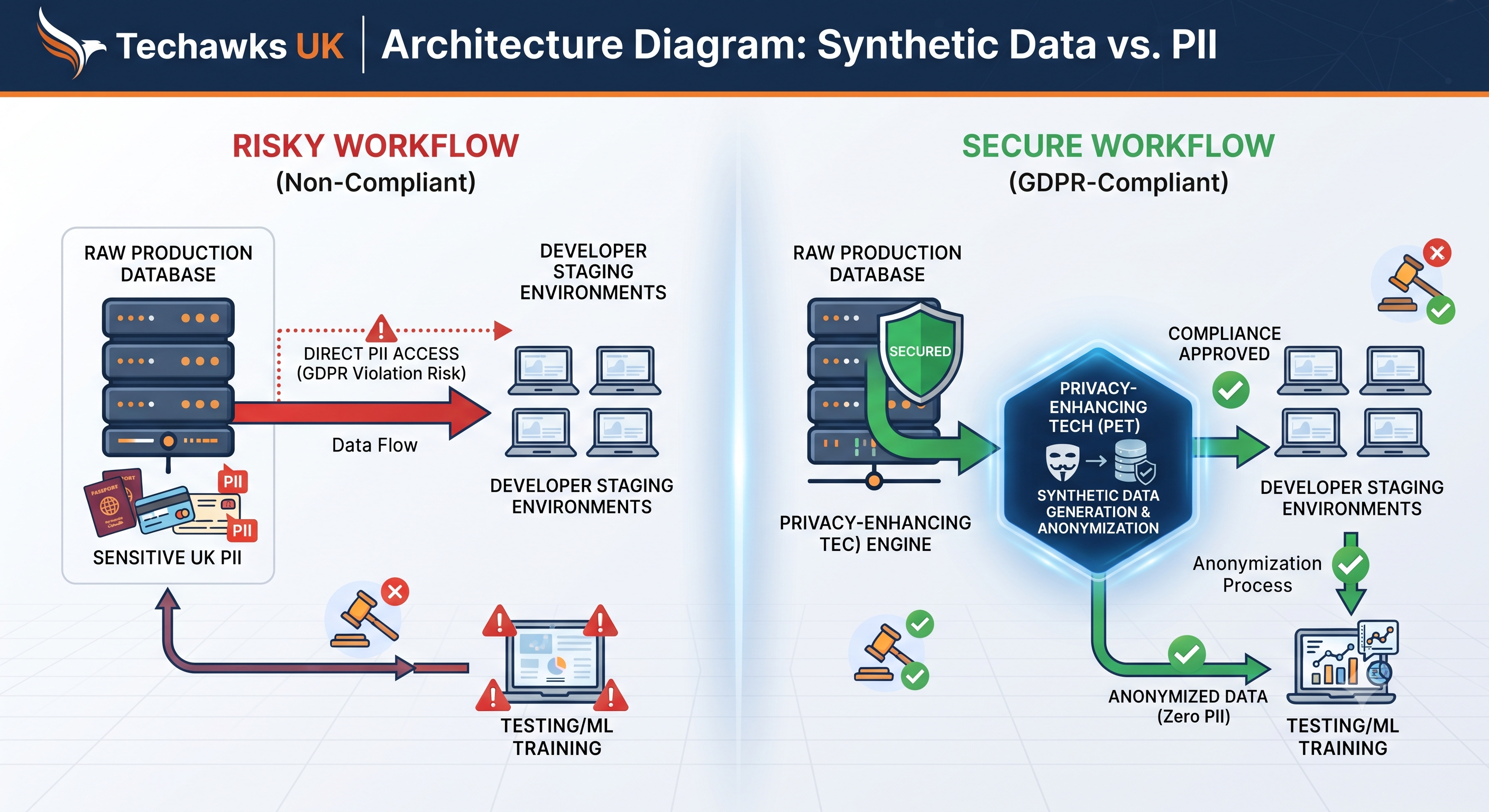
Enter Privacy-Enhancing Technologies (PETs) and Synthetic Data Generation:
Modern engineering teams are shifting toward cryptographic and generative approaches to handle sensitive British customer records:
Generate Statistically Valid Synthetic Data: Use tools like Gretel or MOSTLY AI to build synthetic datasets that mirror the exact correlations and distributions of your real data without containing a single identifiable personal record.
Implement Automated Data Minimization: Restrict production database access by default, leveraging role-based access controls and ephemeral preview environments that only expose masked or synthetic payloads to developers.
Align with ICO Guidelines: By decoupling your test environments from live Personally Identifiable Information (PII), you drastically reduce your attack surface and streamline regulatory audits.
By baking privacy-by-design into your data architecture, you protect your users, satisfy UK regulatory standards, and ship secure software faster.
Discussion Question: How does your engineering team handle staging data and compliance when building products for the UK market? Let’s share your privacy workflows below! 👇
CTA (Join Techawks UK): Ready to scale your tech career, engineering practices, and startup journey in the UK? Join our community of builders and professionals at Techawks UK to master the strategies that matter.
As engineering and product leaders in the UK tech ecosystem, protecting user privacy isn't just a legal checkbox under the Data Protection Act—it’s fundamental to retaining consumer trust. Yet, traditional data masking and anonymization techniques often leave loopholes or strip away the statistical variance your models and tests need.
Enter Privacy-Enhancing Technologies (PETs) and Synthetic Data Generation:
Modern engineering teams are shifting toward cryptographic and generative approaches to handle sensitive British customer records:
Generate Statistically Valid Synthetic Data: Use tools like Gretel or MOSTLY AI to build synthetic datasets that mirror the exact correlations and distributions of your real data without containing a single identifiable personal record.
Implement Automated Data Minimization: Restrict production database access by default, leveraging role-based access controls and ephemeral preview environments that only expose masked or synthetic payloads to developers.
Align with ICO Guidelines: By decoupling your test environments from live Personally Identifiable Information (PII), you drastically reduce your attack surface and streamline regulatory audits.
By baking privacy-by-design into your data architecture, you protect your users, satisfy UK regulatory standards, and ship secure software faster.
Discussion Question: How does your engineering team handle staging data and compliance when building products for the UK market? Let’s share your privacy workflows below! 👇
CTA (Join Techawks UK): Ready to scale your tech career, engineering practices, and startup journey in the UK? Join our community of builders and professionals at Techawks UK to master the strategies that matter.
Navigating the UK GDPR Shift: Why Privacy-First Data Engineering and Synthetic Data Are Essential for British Startups
As engineering and product leaders in the UK tech ecosystem, protecting user privacy isn't just a legal checkbox under the Data Protection Act—it’s fundamental to retaining consumer trust. Yet, traditional data masking and anonymization techniques often leave loopholes or strip away the statistical variance your models and tests need.
Enter Privacy-Enhancing Technologies (PETs) and Synthetic Data Generation:
Modern engineering teams are shifting toward cryptographic and generative approaches to handle sensitive British customer records:
Generate Statistically Valid Synthetic Data: Use tools like Gretel or MOSTLY AI to build synthetic datasets that mirror the exact correlations and distributions of your real data without containing a single identifiable personal record.
Implement Automated Data Minimization: Restrict production database access by default, leveraging role-based access controls and ephemeral preview environments that only expose masked or synthetic payloads to developers.
Align with ICO Guidelines: By decoupling your test environments from live Personally Identifiable Information (PII), you drastically reduce your attack surface and streamline regulatory audits.
By baking privacy-by-design into your data architecture, you protect your users, satisfy UK regulatory standards, and ship secure software faster.
Discussion Question: How does your engineering team handle staging data and compliance when building products for the UK market? Let’s share your privacy workflows below! 👇
CTA (Join Techawks UK): Ready to scale your tech career, engineering practices, and startup journey in the UK? Join our community of builders and professionals at Techawks UK to master the strategies that matter.

 English
 Arabic
 French
 Spanish
 Portuguese
 Deutsch
 Turkish
 Dutch
Dutch
 Russian
 Romaian
 Portuguese (Brazil)
 Greek
Greek