


Navigating Canadian Data Residency: Why In-Region AI Pinning and PII Redaction Matter for Local Tech
Hook: Deploying customer-facing AI agents or cloud workloads in Canada while piping raw user data through foreign model endpoints? With strict accountability standards under PIPEDA and tightening provincial privacy requirements, cross-border data leakage can derail enterprise procurement instantly. Let's look at how modern Canadian engineering teams build sovereign, compliant architectures.
Main Post:
As the Canadian tech ecosystem scales, product and engineering leaders face a crucial reality: treating data sovereignty and privacy compliance as an afterthought is no longer viable. When dealing with sensitive identifiers like Social Insurance Numbers (SIN), banking details, or provincial health records, using standard unmanaged multi-tenant AI pipelines introduces major regulatory friction.
Enter Regional Pinning and Ingest PII Redacting Tooling:
To harness modern AI and high-performance cloud tools while respecting Canadian regulatory expectations, engineering teams are shifting toward sovereign patterns:
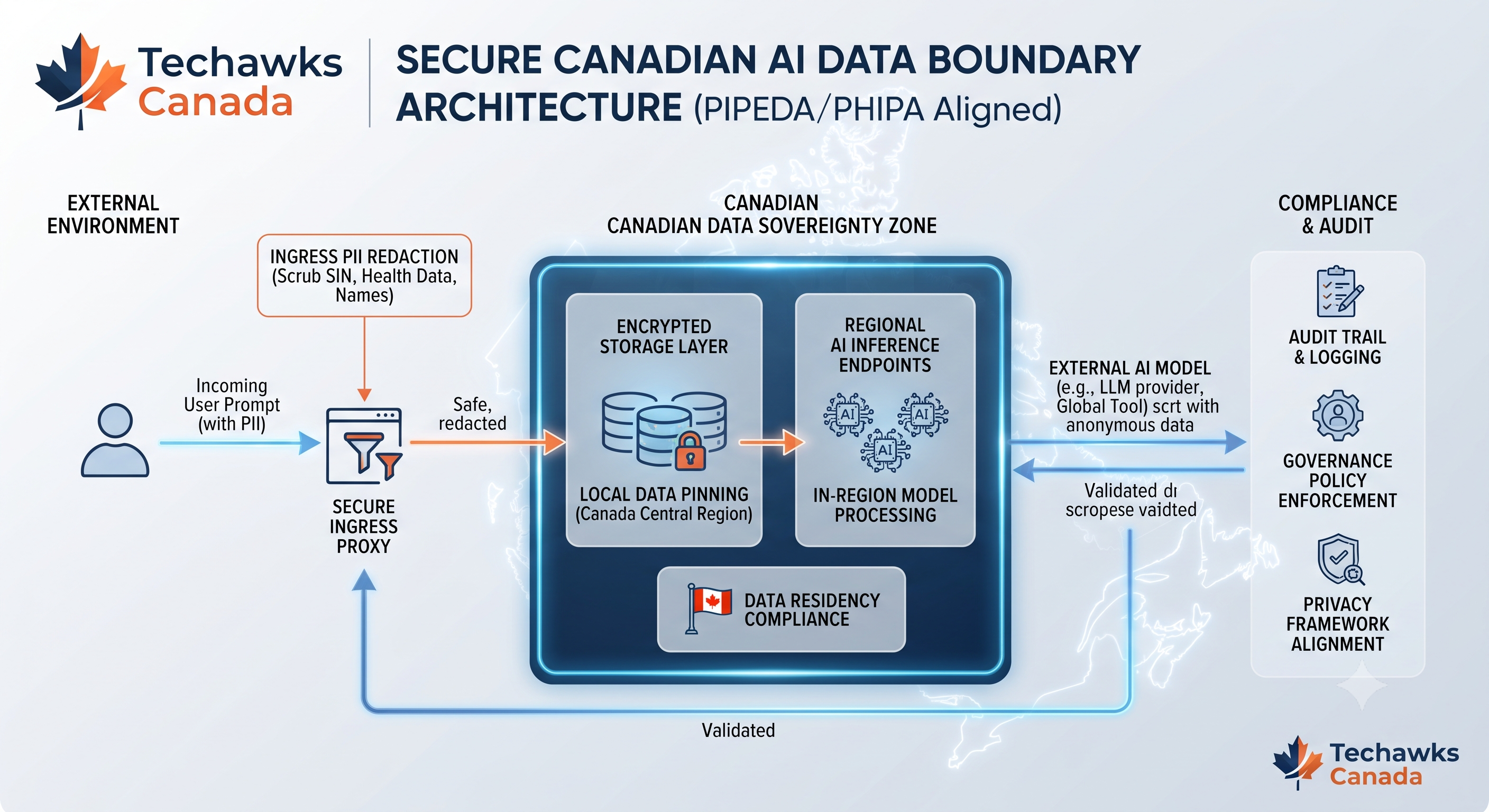
Enforce In-Region Model Inference and Storage: Use enterprise infrastructure and AI support layers that offer explicit regional pinning to keep data storage, model processing, and backups inside designated Canadian data zones.
Implement Always-On Ingress PII Redaction: Set up automated proxy layers that scrub personal identifiers before payloads ever touch external model endpoints or third-party vector databases.
Maintain Defensible Audit Trails: Build explicit logging mechanisms that tie automated actions or customer record updates back to documented compliance policies, satisfying privacy officers during security reviews.
By designing systems with built-in data residency and proactive PII protection from day one, you safeguard user trust, streamline procurement, and accelerate enterprise adoption across Canada.
Discussion Question: How is your team handling data residency and privacy compliance when integrating AI tools into your Canadian applications? Let’s share your architecture strategies below! 👇
CTA (Join Techawks Canada): Ready to build world-class, compliant technology systems for the growing Canadian tech market? Join our community of developers, engineers, and innovators at Techawks Canada to master the tools that matter.
Hook: Deploying customer-facing AI agents or cloud workloads in Canada while piping raw user data through foreign model endpoints? With strict accountability standards under PIPEDA and tightening provincial privacy requirements, cross-border data leakage can derail enterprise procurement instantly. Let's look at how modern Canadian engineering teams build sovereign, compliant architectures.
Main Post:
As the Canadian tech ecosystem scales, product and engineering leaders face a crucial reality: treating data sovereignty and privacy compliance as an afterthought is no longer viable. When dealing with sensitive identifiers like Social Insurance Numbers (SIN), banking details, or provincial health records, using standard unmanaged multi-tenant AI pipelines introduces major regulatory friction.
Enter Regional Pinning and Ingest PII Redacting Tooling:
To harness modern AI and high-performance cloud tools while respecting Canadian regulatory expectations, engineering teams are shifting toward sovereign patterns:
Enforce In-Region Model Inference and Storage: Use enterprise infrastructure and AI support layers that offer explicit regional pinning to keep data storage, model processing, and backups inside designated Canadian data zones.
Implement Always-On Ingress PII Redaction: Set up automated proxy layers that scrub personal identifiers before payloads ever touch external model endpoints or third-party vector databases.
Maintain Defensible Audit Trails: Build explicit logging mechanisms that tie automated actions or customer record updates back to documented compliance policies, satisfying privacy officers during security reviews.
By designing systems with built-in data residency and proactive PII protection from day one, you safeguard user trust, streamline procurement, and accelerate enterprise adoption across Canada.
Discussion Question: How is your team handling data residency and privacy compliance when integrating AI tools into your Canadian applications? Let’s share your architecture strategies below! 👇
CTA (Join Techawks Canada): Ready to build world-class, compliant technology systems for the growing Canadian tech market? Join our community of developers, engineers, and innovators at Techawks Canada to master the tools that matter.
Navigating Canadian Data Residency: Why In-Region AI Pinning and PII Redaction Matter for Local Tech
Hook: Deploying customer-facing AI agents or cloud workloads in Canada while piping raw user data through foreign model endpoints? With strict accountability standards under PIPEDA and tightening provincial privacy requirements, cross-border data leakage can derail enterprise procurement instantly. Let's look at how modern Canadian engineering teams build sovereign, compliant architectures.
Main Post:
As the Canadian tech ecosystem scales, product and engineering leaders face a crucial reality: treating data sovereignty and privacy compliance as an afterthought is no longer viable. When dealing with sensitive identifiers like Social Insurance Numbers (SIN), banking details, or provincial health records, using standard unmanaged multi-tenant AI pipelines introduces major regulatory friction.
Enter Regional Pinning and Ingest PII Redacting Tooling:
To harness modern AI and high-performance cloud tools while respecting Canadian regulatory expectations, engineering teams are shifting toward sovereign patterns:
Enforce In-Region Model Inference and Storage: Use enterprise infrastructure and AI support layers that offer explicit regional pinning to keep data storage, model processing, and backups inside designated Canadian data zones.
Implement Always-On Ingress PII Redaction: Set up automated proxy layers that scrub personal identifiers before payloads ever touch external model endpoints or third-party vector databases.
Maintain Defensible Audit Trails: Build explicit logging mechanisms that tie automated actions or customer record updates back to documented compliance policies, satisfying privacy officers during security reviews.
By designing systems with built-in data residency and proactive PII protection from day one, you safeguard user trust, streamline procurement, and accelerate enterprise adoption across Canada.
Discussion Question: How is your team handling data residency and privacy compliance when integrating AI tools into your Canadian applications? Let’s share your architecture strategies below! 👇
CTA (Join Techawks Canada): Ready to build world-class, compliant technology systems for the growing Canadian tech market? Join our community of developers, engineers, and innovators at Techawks Canada to master the tools that matter.

 Arabic
 French
 Spanish
 Portuguese
 Deutsch
 Turkish
 Dutch
Dutch
 Italiano
 Russian
 Romaian
 Portuguese (Brazil)
 Greek
Greek