


The Reverse-Engineering Method: How to Map Your Tech Career Backwards to Fast-Track Your Next Role
Navigating a career move in technology—whether transitioning into engineering, product management, or data analytics—can feel overwhelming due to endless skill lists and vague job descriptions.
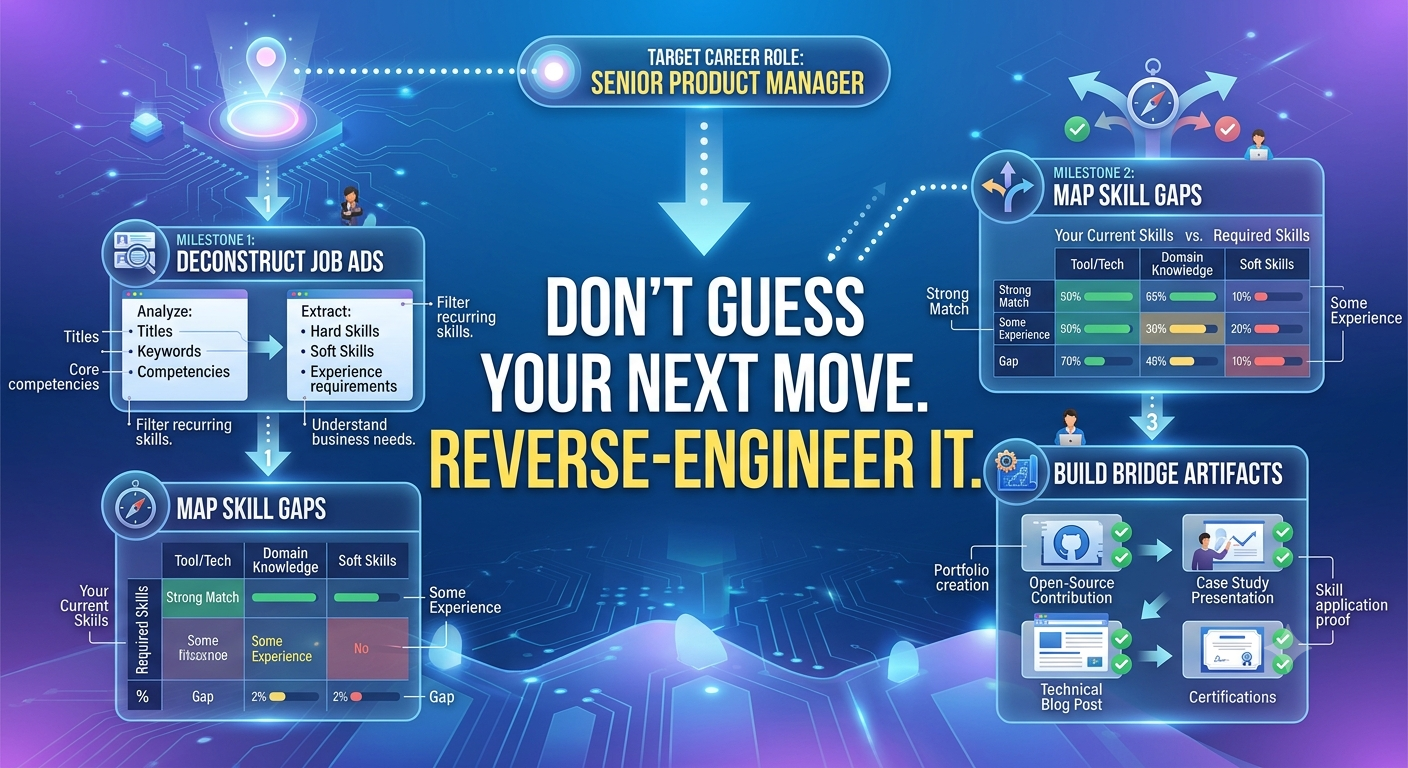
Instead of trying to learn everything, top candidates use reverse-engineering to streamline their preparation. Here is a 3-step framework to map your path with precision:
1. Aggregate a "Master Skills Matrix"
Collect 10 to 15 job postings for your desired role across different companies. Paste the requirements into a simple spreadsheet or document and highlight recurring themes:
Must-have core tech stack: Tools or languages mentioned in over 70% of the listings.
Secondary domain knowledge: Methodologies (e.g., Agile, CI/CD, A/B testing) or soft skills (e.g., cross-functional stakeholder management).
Key performance metrics: What outcomes do companies expect this person to drive?
2. Perform an Honest Gap Analysis
Compare your current background directly against the Master Skills Matrix. Group your qualifications into three distinct tiers:
Green (Proven): Skills you have applied in past projects with quantifiable outcomes.
Yellow (Theoretical): Concepts you understand, but haven't built or delivered in a professional environment.
Red (Missing): Critical skills or tools you haven't touched yet.
Your immediate focus should only be turning Yellow items into Green through focused, portfolio-backed execution—not trying to resolve every Red item at once.
3. Build "Bridge Artifacts"
Employers don't hire candidates based on course certificates; they hire based on proof of execution. Convert your "Yellow" skills into public proof:
If you lack professional experience in a required framework, build a fully deployed open-source project that solves a real-world problem using it.
If you lack stakeholder management experience, document how you coordinated cross-functional feedback during a side project or volunteer initiative.
When you present concrete artifacts alongside your resume, you bypass the guesswork and demonstrate readiness on day one.
Key Takeaways
Deconstruct the market: Build your strategy around real job descriptions, not generalized advice.
Prioritize bridging the gap: Focus on turning theoretical knowledge into verifiable proof of work.
Proof > Certification: A working project or documented problem-solving framework carries far more weight than a completion badge.
CTA
Looking for structured guidance on navigating tech recruitment, refining your application strategy, or discovering your next role? Join Tech Jobs & Opportunities on Techawks today to gain insights, get mentorship, and connect with active recruiters.
Navigating a career move in technology—whether transitioning into engineering, product management, or data analytics—can feel overwhelming due to endless skill lists and vague job descriptions.
Instead of trying to learn everything, top candidates use reverse-engineering to streamline their preparation. Here is a 3-step framework to map your path with precision:
1. Aggregate a "Master Skills Matrix"
Collect 10 to 15 job postings for your desired role across different companies. Paste the requirements into a simple spreadsheet or document and highlight recurring themes:
Must-have core tech stack: Tools or languages mentioned in over 70% of the listings.
Secondary domain knowledge: Methodologies (e.g., Agile, CI/CD, A/B testing) or soft skills (e.g., cross-functional stakeholder management).
Key performance metrics: What outcomes do companies expect this person to drive?
2. Perform an Honest Gap Analysis
Compare your current background directly against the Master Skills Matrix. Group your qualifications into three distinct tiers:
Green (Proven): Skills you have applied in past projects with quantifiable outcomes.
Yellow (Theoretical): Concepts you understand, but haven't built or delivered in a professional environment.
Red (Missing): Critical skills or tools you haven't touched yet.
Your immediate focus should only be turning Yellow items into Green through focused, portfolio-backed execution—not trying to resolve every Red item at once.
3. Build "Bridge Artifacts"
Employers don't hire candidates based on course certificates; they hire based on proof of execution. Convert your "Yellow" skills into public proof:
If you lack professional experience in a required framework, build a fully deployed open-source project that solves a real-world problem using it.
If you lack stakeholder management experience, document how you coordinated cross-functional feedback during a side project or volunteer initiative.
When you present concrete artifacts alongside your resume, you bypass the guesswork and demonstrate readiness on day one.
Key Takeaways
Deconstruct the market: Build your strategy around real job descriptions, not generalized advice.
Prioritize bridging the gap: Focus on turning theoretical knowledge into verifiable proof of work.
Proof > Certification: A working project or documented problem-solving framework carries far more weight than a completion badge.
CTA
Looking for structured guidance on navigating tech recruitment, refining your application strategy, or discovering your next role? Join Tech Jobs & Opportunities on Techawks today to gain insights, get mentorship, and connect with active recruiters.
The Reverse-Engineering Method: How to Map Your Tech Career Backwards to Fast-Track Your Next Role
Navigating a career move in technology—whether transitioning into engineering, product management, or data analytics—can feel overwhelming due to endless skill lists and vague job descriptions.
Instead of trying to learn everything, top candidates use reverse-engineering to streamline their preparation. Here is a 3-step framework to map your path with precision:
1. Aggregate a "Master Skills Matrix"
Collect 10 to 15 job postings for your desired role across different companies. Paste the requirements into a simple spreadsheet or document and highlight recurring themes:
Must-have core tech stack: Tools or languages mentioned in over 70% of the listings.
Secondary domain knowledge: Methodologies (e.g., Agile, CI/CD, A/B testing) or soft skills (e.g., cross-functional stakeholder management).
Key performance metrics: What outcomes do companies expect this person to drive?
2. Perform an Honest Gap Analysis
Compare your current background directly against the Master Skills Matrix. Group your qualifications into three distinct tiers:
Green (Proven): Skills you have applied in past projects with quantifiable outcomes.
Yellow (Theoretical): Concepts you understand, but haven't built or delivered in a professional environment.
Red (Missing): Critical skills or tools you haven't touched yet.
Your immediate focus should only be turning Yellow items into Green through focused, portfolio-backed execution—not trying to resolve every Red item at once.
3. Build "Bridge Artifacts"
Employers don't hire candidates based on course certificates; they hire based on proof of execution. Convert your "Yellow" skills into public proof:
If you lack professional experience in a required framework, build a fully deployed open-source project that solves a real-world problem using it.
If you lack stakeholder management experience, document how you coordinated cross-functional feedback during a side project or volunteer initiative.
When you present concrete artifacts alongside your resume, you bypass the guesswork and demonstrate readiness on day one.
Key Takeaways
Deconstruct the market: Build your strategy around real job descriptions, not generalized advice.
Prioritize bridging the gap: Focus on turning theoretical knowledge into verifiable proof of work.
Proof > Certification: A working project or documented problem-solving framework carries far more weight than a completion badge.
CTA
Looking for structured guidance on navigating tech recruitment, refining your application strategy, or discovering your next role? Join Tech Jobs & Opportunities on Techawks today to gain insights, get mentorship, and connect with active recruiters.

 English
 French
 Spanish
 Portuguese
 Deutsch
 Turkish
 Dutch
Dutch
 Italiano
 Russian
 Romaian
 Portuguese (Brazil)
 Greek
Greek