


From Feature Factory to Product Leader: 4 Skills That Standard PM & UX Frameworks Don't Teach
In many tech organizations, product managers and UX designers fall into the "feature factory" trap: shipping output after output without measuring actual business impact. Breaking out of this cycle is the single most effective way to accelerate your career trajectory.
Here is actionable advice on how to transition from managing deliverables to driving product strategy:
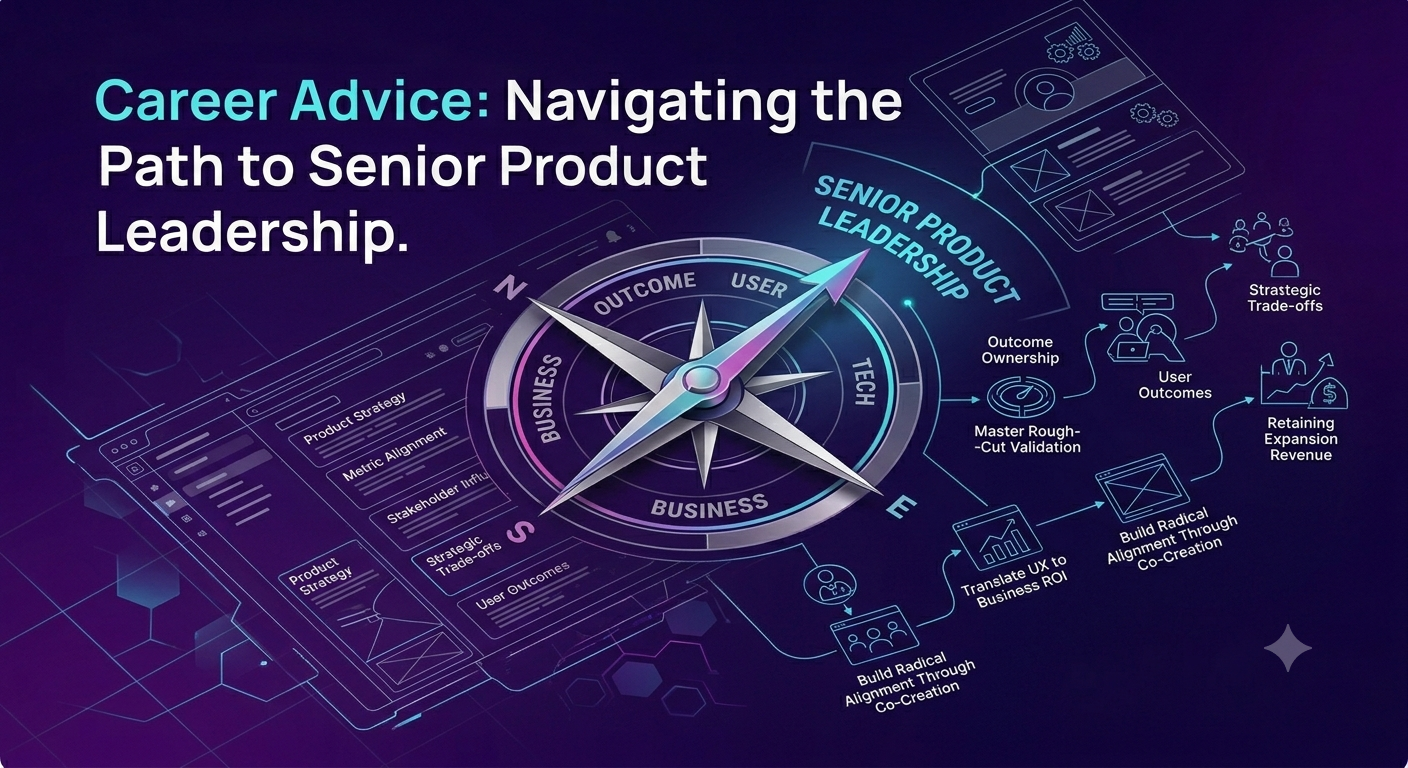
1. Own Outcomes, Not Output
The Shift: Stop measuring success by features shipped or sprint velocity. Measure success by shifts in user behavior and core business metrics (e.g., activation rate, retention, expansion revenue).
Action Item: Before starting any new initiative, define the single primary metric that success will be evaluated against, and establish a baseline before design work begins.
2. Master "Rough-Cut" Validation
The Shift: Don't wait for polished prototypes or full build-outs to test core hypotheses.
Action Item: Use low-fidelity wireframes, interactive paper sketches, or fake-door tests to validate demand and user intent within days rather than weeks. The faster you kill bad ideas, the more time you save for high-impact features.
3. Translate UX Decisions into Business ROI
The Shift: Senior leaders rarely push back on design decisions because of aesthetics; they push back because of resource constraints and business priorities.
Action Item: Frame design changes in terms of business trade-offs. Instead of saying, "This checkout flow offers a cleaner user experience," say, "Reducing this flow from 4 steps to 2 addresses our 35% drop-off rate, directly impacting conversion revenue."
4. Build Radical Alignment Through Co-Creation
The Shift: Handing off completed PRDs or Figma files over the fence to engineering creates friction and rework.
Action Item: Invite lead engineers and key stakeholders into early discovery sessions. When developers help uncover user problems, technical constraints are identified upfront, and team buy-in increases dramatically.
Key Takeaways
Business acumen matters: High-performing product professionals bridge the gap between user needs and business metrics.
Fail fast in discovery: Validate assumptions with low-fidelity prototypes before committing engineering resources.
Co-create with engineering: Involve technical partners early in problem framing to prevent friction during execution.
CTA
Looking to level up your product thinking and build products that drive real business impact?
👉 Join our Product, UX & Design community today to connect with industry leaders, access practical frameworks, and elevate your career!
In many tech organizations, product managers and UX designers fall into the "feature factory" trap: shipping output after output without measuring actual business impact. Breaking out of this cycle is the single most effective way to accelerate your career trajectory.
Here is actionable advice on how to transition from managing deliverables to driving product strategy:
1. Own Outcomes, Not Output
The Shift: Stop measuring success by features shipped or sprint velocity. Measure success by shifts in user behavior and core business metrics (e.g., activation rate, retention, expansion revenue).
Action Item: Before starting any new initiative, define the single primary metric that success will be evaluated against, and establish a baseline before design work begins.
2. Master "Rough-Cut" Validation
The Shift: Don't wait for polished prototypes or full build-outs to test core hypotheses.
Action Item: Use low-fidelity wireframes, interactive paper sketches, or fake-door tests to validate demand and user intent within days rather than weeks. The faster you kill bad ideas, the more time you save for high-impact features.
3. Translate UX Decisions into Business ROI
The Shift: Senior leaders rarely push back on design decisions because of aesthetics; they push back because of resource constraints and business priorities.
Action Item: Frame design changes in terms of business trade-offs. Instead of saying, "This checkout flow offers a cleaner user experience," say, "Reducing this flow from 4 steps to 2 addresses our 35% drop-off rate, directly impacting conversion revenue."
4. Build Radical Alignment Through Co-Creation
The Shift: Handing off completed PRDs or Figma files over the fence to engineering creates friction and rework.
Action Item: Invite lead engineers and key stakeholders into early discovery sessions. When developers help uncover user problems, technical constraints are identified upfront, and team buy-in increases dramatically.
Key Takeaways
Business acumen matters: High-performing product professionals bridge the gap between user needs and business metrics.
Fail fast in discovery: Validate assumptions with low-fidelity prototypes before committing engineering resources.
Co-create with engineering: Involve technical partners early in problem framing to prevent friction during execution.
CTA
Looking to level up your product thinking and build products that drive real business impact?
👉 Join our Product, UX & Design community today to connect with industry leaders, access practical frameworks, and elevate your career!
From Feature Factory to Product Leader: 4 Skills That Standard PM & UX Frameworks Don't Teach
In many tech organizations, product managers and UX designers fall into the "feature factory" trap: shipping output after output without measuring actual business impact. Breaking out of this cycle is the single most effective way to accelerate your career trajectory.
Here is actionable advice on how to transition from managing deliverables to driving product strategy:
1. Own Outcomes, Not Output
The Shift: Stop measuring success by features shipped or sprint velocity. Measure success by shifts in user behavior and core business metrics (e.g., activation rate, retention, expansion revenue).
Action Item: Before starting any new initiative, define the single primary metric that success will be evaluated against, and establish a baseline before design work begins.
2. Master "Rough-Cut" Validation
The Shift: Don't wait for polished prototypes or full build-outs to test core hypotheses.
Action Item: Use low-fidelity wireframes, interactive paper sketches, or fake-door tests to validate demand and user intent within days rather than weeks. The faster you kill bad ideas, the more time you save for high-impact features.
3. Translate UX Decisions into Business ROI
The Shift: Senior leaders rarely push back on design decisions because of aesthetics; they push back because of resource constraints and business priorities.
Action Item: Frame design changes in terms of business trade-offs. Instead of saying, "This checkout flow offers a cleaner user experience," say, "Reducing this flow from 4 steps to 2 addresses our 35% drop-off rate, directly impacting conversion revenue."
4. Build Radical Alignment Through Co-Creation
The Shift: Handing off completed PRDs or Figma files over the fence to engineering creates friction and rework.
Action Item: Invite lead engineers and key stakeholders into early discovery sessions. When developers help uncover user problems, technical constraints are identified upfront, and team buy-in increases dramatically.
Key Takeaways
Business acumen matters: High-performing product professionals bridge the gap between user needs and business metrics.
Fail fast in discovery: Validate assumptions with low-fidelity prototypes before committing engineering resources.
Co-create with engineering: Involve technical partners early in problem framing to prevent friction during execution.
CTA
Looking to level up your product thinking and build products that drive real business impact?
👉 Join our Product, UX & Design community today to connect with industry leaders, access practical frameworks, and elevate your career!

 Arabic
 French
 Spanish
 Portuguese
 Deutsch
 Turkish
 Dutch
Dutch
 Italiano
 Russian
 Romaian
 Portuguese (Brazil)
 Greek
Greek