


Designing for Autonomy: The UX Shift from Static Workflows to Agentic Supervision
Product management and UX design are undergoing a monumental paradigm shift. As AI applications evolve from simple conversational assistants into autonomous agents that can plan, execute, and self-correct across complex tasks, the core job of the designer changes. We are moving away from designing rigid, linear user journeys toward crafting agentic supervision loops.
Why It Matters
Users quickly reject products where autonomous AI takes complete, opaque control without visibility or checkpoints. Industry research and enterprise deployment data highlight that unmanaged autonomous systems face high rollback rates due to governance and trust gaps. Great product design in an AI-first world isn't about hiding complexity; it's about making probabilistic, multi-step actions legible, interruptible, and safe for the user.
What You Need to Know (The Product Playbook)
To design high-trust, resilient AI products that users actually rely on, master these three design patterns:
Design the Brief, Not Just the Form: Create intuitive interfaces that allow users to clearly specify goals, set constraints, and brief autonomous agents before execution begins.
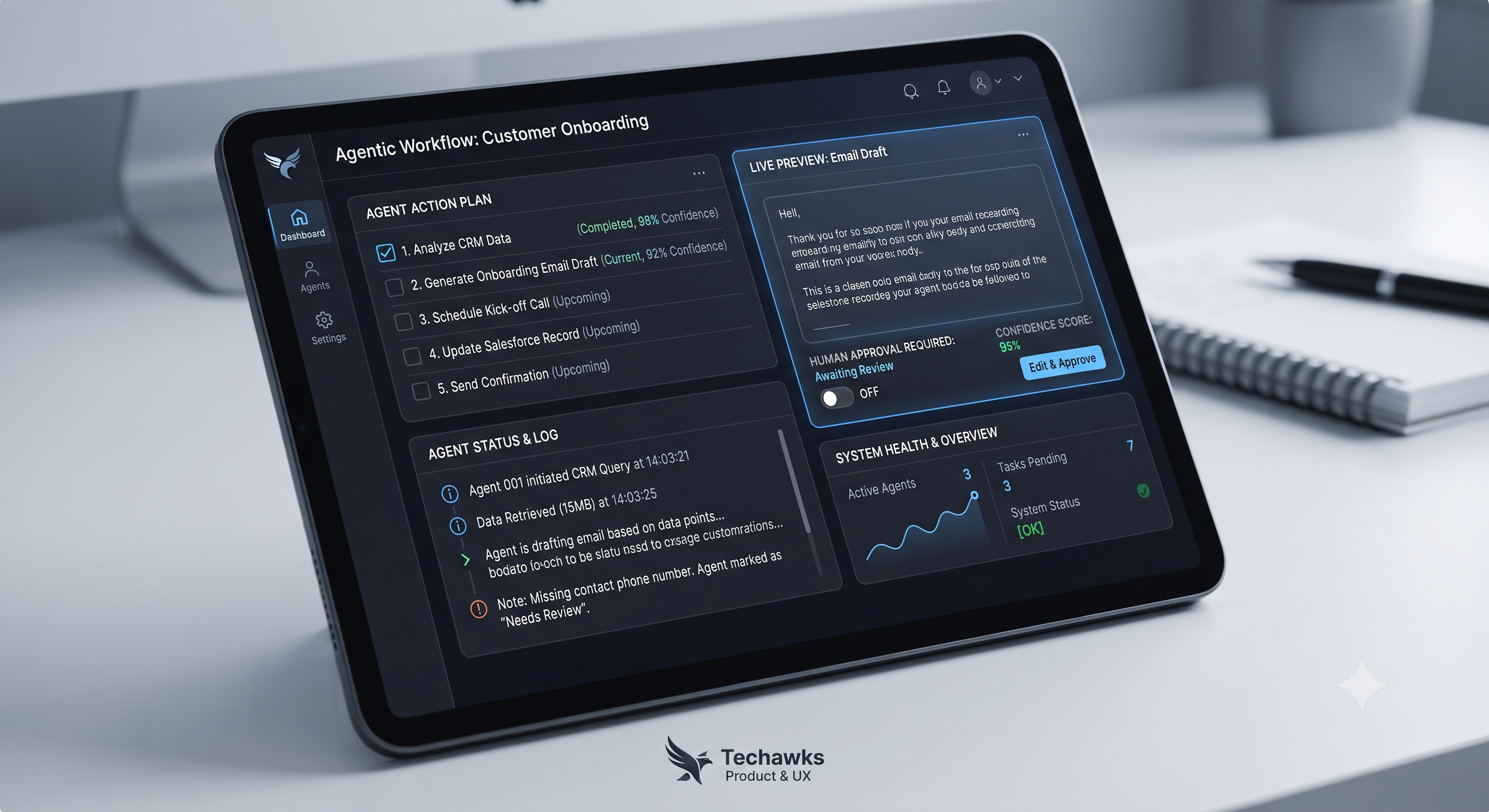
Build Explicit Human-in-the-Loop Checkpoints: Give users clear windows to preview, edit, approve, or halt multi-step agent actions in real time. Never let the system run entirely as a black box.
Incorporate Transparency and Trust Cues: Expose confidence scores, underlying data sources, and clear citation or fallback paths so users can easily verify why an AI agent made a specific decision.
Discussion Question
How is your product team designing for AI autonomy? Are you finding it challenging to balance seamless automation with user control and trust? Let's discuss below! 👇
CTA (Join Product, UX & Design)
Want to master modern product strategy, design systems, and AI-native UX patterns? Join Product, UX & Design today to collaborate with global creators and shape the future of user experience!
Product management and UX design are undergoing a monumental paradigm shift. As AI applications evolve from simple conversational assistants into autonomous agents that can plan, execute, and self-correct across complex tasks, the core job of the designer changes. We are moving away from designing rigid, linear user journeys toward crafting agentic supervision loops.
Why It Matters
Users quickly reject products where autonomous AI takes complete, opaque control without visibility or checkpoints. Industry research and enterprise deployment data highlight that unmanaged autonomous systems face high rollback rates due to governance and trust gaps. Great product design in an AI-first world isn't about hiding complexity; it's about making probabilistic, multi-step actions legible, interruptible, and safe for the user.
What You Need to Know (The Product Playbook)
To design high-trust, resilient AI products that users actually rely on, master these three design patterns:
Design the Brief, Not Just the Form: Create intuitive interfaces that allow users to clearly specify goals, set constraints, and brief autonomous agents before execution begins.
Build Explicit Human-in-the-Loop Checkpoints: Give users clear windows to preview, edit, approve, or halt multi-step agent actions in real time. Never let the system run entirely as a black box.
Incorporate Transparency and Trust Cues: Expose confidence scores, underlying data sources, and clear citation or fallback paths so users can easily verify why an AI agent made a specific decision.
Discussion Question
How is your product team designing for AI autonomy? Are you finding it challenging to balance seamless automation with user control and trust? Let's discuss below! 👇
CTA (Join Product, UX & Design)
Want to master modern product strategy, design systems, and AI-native UX patterns? Join Product, UX & Design today to collaborate with global creators and shape the future of user experience!
Designing for Autonomy: The UX Shift from Static Workflows to Agentic Supervision
Product management and UX design are undergoing a monumental paradigm shift. As AI applications evolve from simple conversational assistants into autonomous agents that can plan, execute, and self-correct across complex tasks, the core job of the designer changes. We are moving away from designing rigid, linear user journeys toward crafting agentic supervision loops.
Why It Matters
Users quickly reject products where autonomous AI takes complete, opaque control without visibility or checkpoints. Industry research and enterprise deployment data highlight that unmanaged autonomous systems face high rollback rates due to governance and trust gaps. Great product design in an AI-first world isn't about hiding complexity; it's about making probabilistic, multi-step actions legible, interruptible, and safe for the user.
What You Need to Know (The Product Playbook)
To design high-trust, resilient AI products that users actually rely on, master these three design patterns:
Design the Brief, Not Just the Form: Create intuitive interfaces that allow users to clearly specify goals, set constraints, and brief autonomous agents before execution begins.
Build Explicit Human-in-the-Loop Checkpoints: Give users clear windows to preview, edit, approve, or halt multi-step agent actions in real time. Never let the system run entirely as a black box.
Incorporate Transparency and Trust Cues: Expose confidence scores, underlying data sources, and clear citation or fallback paths so users can easily verify why an AI agent made a specific decision.
Discussion Question
How is your product team designing for AI autonomy? Are you finding it challenging to balance seamless automation with user control and trust? Let's discuss below! 👇
CTA (Join Product, UX & Design)
Want to master modern product strategy, design systems, and AI-native UX patterns? Join Product, UX & Design today to collaborate with global creators and shape the future of user experience!

 English
 Arabic
 French
 Portuguese
 Deutsch
 Turkish
 Dutch
Dutch
 Italiano
 Russian
 Romaian
 Portuguese (Brazil)
 Greek
Greek