


The Infrastructure Reckoning: Why Inference Economics Are Rewriting the U.S. Tech Playbook
The U.S. technology sector is experiencing a foundational infrastructure reckoning. While token costs have plummeted dramatically over recent years, overall corporate usage has exploded so fast that monthly infrastructure bills are reaching unprecedented heights for modern enterprises. Data centers, grid capacity, and specialized hardware constraints mean that engineering leaders across Silicon Valley, New York, and tech hubs nationwide can no longer treat compute capacity as a simple procurement task—it is now a core strategic bottleneck.
Why It Matters
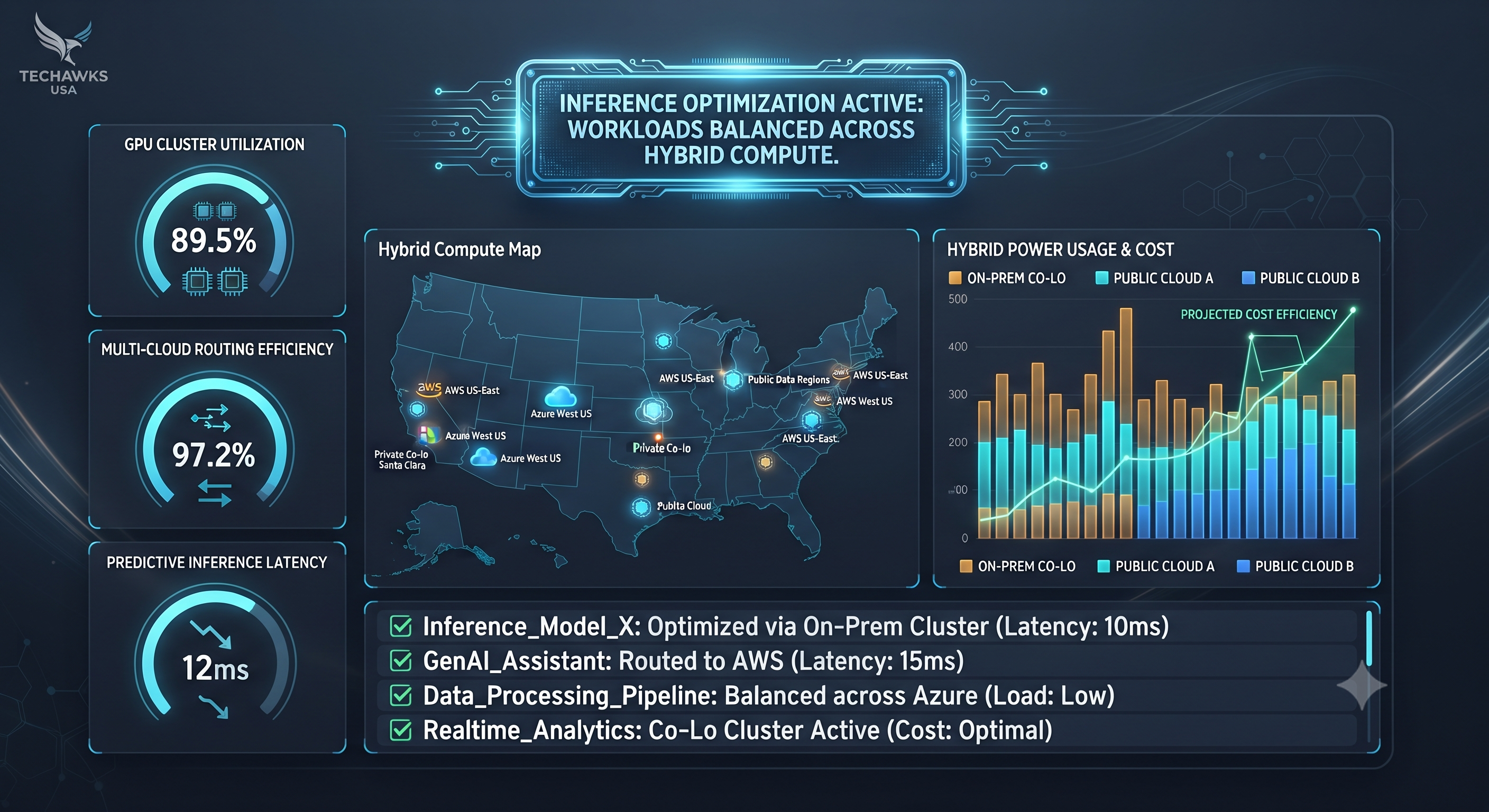
When scaling AI applications from experimental pilots to production-grade enterprise deployment, inefficient resource allocation or unoptimized workload routing can leave expensive GPU clusters underutilized while destroying profit margins. Organizations are realizing that winning in today's market requires more than just deploying powerful foundation models; it demands an architectural shift toward intelligent workload orchestration, specialized hybrid hosting, and rigorous cost-to-performance governance.
What You Need to Know (The Infrastructure Playbook)
To future-proof your tech stack and optimize your engineering operations for the age of inference, focus on three critical practices:
Adopt Strategic Hybrid Infrastructure: Balance public cloud elasticity for variable spikes with on-premises or co-located hardware for consistent, high-volume workloads to maintain predictable cost structures.
Implement Intelligent Workload Routing: Optimize runtime costs by routing requests dynamically across different models and accelerators based on exact performance requirements, latency needs, and budget thresholds.
Treat Power and Capacity as Core Metrics: Factor grid availability, utility rates, energy efficiency, and geographical data residency constraints directly into your software architecture and deployment planning.
Discussion Question
How is your organization navigating the cost and capacity pressures of running AI inference at scale? Are you adjusting your cloud strategy or investing in custom workload routing? Let's discuss below! 👇
CTA (Join Techawks USA)
Want to connect with leading U.S. technologists, engineers, and founders tackling the toughest infrastructure and AI scaling challenges? Join Techawks USA today to share insights and elevate your technical strategy!
The U.S. technology sector is experiencing a foundational infrastructure reckoning. While token costs have plummeted dramatically over recent years, overall corporate usage has exploded so fast that monthly infrastructure bills are reaching unprecedented heights for modern enterprises. Data centers, grid capacity, and specialized hardware constraints mean that engineering leaders across Silicon Valley, New York, and tech hubs nationwide can no longer treat compute capacity as a simple procurement task—it is now a core strategic bottleneck.
Why It Matters
When scaling AI applications from experimental pilots to production-grade enterprise deployment, inefficient resource allocation or unoptimized workload routing can leave expensive GPU clusters underutilized while destroying profit margins. Organizations are realizing that winning in today's market requires more than just deploying powerful foundation models; it demands an architectural shift toward intelligent workload orchestration, specialized hybrid hosting, and rigorous cost-to-performance governance.
What You Need to Know (The Infrastructure Playbook)
To future-proof your tech stack and optimize your engineering operations for the age of inference, focus on three critical practices:
Adopt Strategic Hybrid Infrastructure: Balance public cloud elasticity for variable spikes with on-premises or co-located hardware for consistent, high-volume workloads to maintain predictable cost structures.
Implement Intelligent Workload Routing: Optimize runtime costs by routing requests dynamically across different models and accelerators based on exact performance requirements, latency needs, and budget thresholds.
Treat Power and Capacity as Core Metrics: Factor grid availability, utility rates, energy efficiency, and geographical data residency constraints directly into your software architecture and deployment planning.
Discussion Question
How is your organization navigating the cost and capacity pressures of running AI inference at scale? Are you adjusting your cloud strategy or investing in custom workload routing? Let's discuss below! 👇
CTA (Join Techawks USA)
Want to connect with leading U.S. technologists, engineers, and founders tackling the toughest infrastructure and AI scaling challenges? Join Techawks USA today to share insights and elevate your technical strategy!
The Infrastructure Reckoning: Why Inference Economics Are Rewriting the U.S. Tech Playbook
The U.S. technology sector is experiencing a foundational infrastructure reckoning. While token costs have plummeted dramatically over recent years, overall corporate usage has exploded so fast that monthly infrastructure bills are reaching unprecedented heights for modern enterprises. Data centers, grid capacity, and specialized hardware constraints mean that engineering leaders across Silicon Valley, New York, and tech hubs nationwide can no longer treat compute capacity as a simple procurement task—it is now a core strategic bottleneck.
Why It Matters
When scaling AI applications from experimental pilots to production-grade enterprise deployment, inefficient resource allocation or unoptimized workload routing can leave expensive GPU clusters underutilized while destroying profit margins. Organizations are realizing that winning in today's market requires more than just deploying powerful foundation models; it demands an architectural shift toward intelligent workload orchestration, specialized hybrid hosting, and rigorous cost-to-performance governance.
What You Need to Know (The Infrastructure Playbook)
To future-proof your tech stack and optimize your engineering operations for the age of inference, focus on three critical practices:
Adopt Strategic Hybrid Infrastructure: Balance public cloud elasticity for variable spikes with on-premises or co-located hardware for consistent, high-volume workloads to maintain predictable cost structures.
Implement Intelligent Workload Routing: Optimize runtime costs by routing requests dynamically across different models and accelerators based on exact performance requirements, latency needs, and budget thresholds.
Treat Power and Capacity as Core Metrics: Factor grid availability, utility rates, energy efficiency, and geographical data residency constraints directly into your software architecture and deployment planning.
Discussion Question
How is your organization navigating the cost and capacity pressures of running AI inference at scale? Are you adjusting your cloud strategy or investing in custom workload routing? Let's discuss below! 👇
CTA (Join Techawks USA)
Want to connect with leading U.S. technologists, engineers, and founders tackling the toughest infrastructure and AI scaling challenges? Join Techawks USA today to share insights and elevate your technical strategy!

 English
 Arabic
 French
 Spanish
 Portuguese
 Deutsch
 Dutch
Dutch
 Italiano
 Russian
 Romaian
 Portuguese (Brazil)
 Greek
Greek