


Which Product Discovery Method Yields Your Best User Insights? (Vote & Discuss)
Great product strategy relies on balancing qualitative understanding (why users act) with quantitative validation (what users do). Cast your vote below, then check out the practical guidance on when to deploy each discovery technique:
📊 Poll Question:
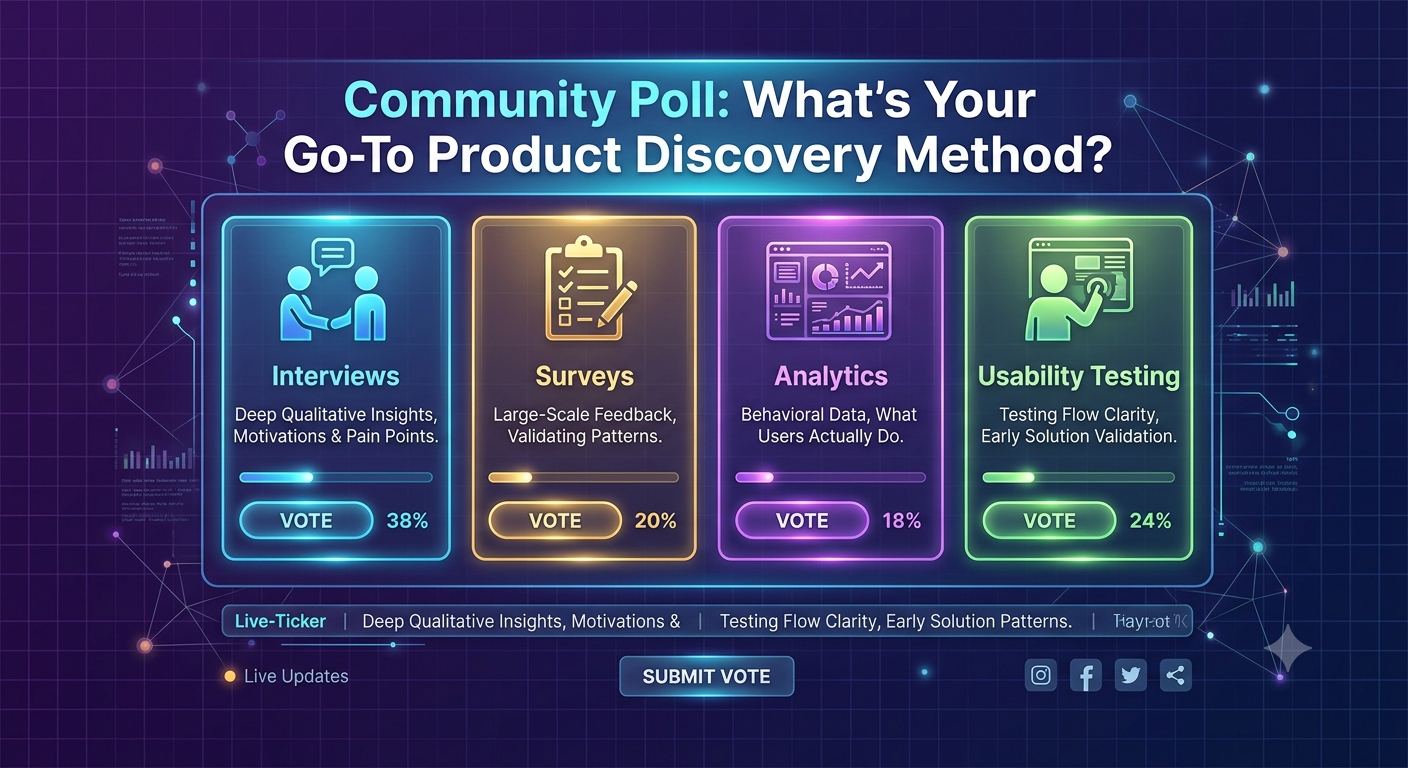
When starting a new feature discovery phase, what is your team's primary go-to method for gathering user insights?
Option A: 1-on-1 User Interviews (Qualitative)
Option B: Quantitative Surveys & In-App Polls
Option C: Product Analytics & Behavioral Data (e.g., Mixpanel, Amplitude)
Option D: Rapid Usability Testing with Low-Fi Prototypes
💡 When to Use Each Discovery Method:
If you chose A (1-on-1 Interviews): Best for understanding underlying motivations, emotional friction, and mental models during early problem exploration. Tip: Focus on past behavior rather than hypothetical future actions—ask "Tell me about the last time you..." instead of "Would you use..."
If you chose B (Surveys & In-App Polls): Great for validating patterns at scale after qualitative research has identified the key hypotheses. Tip: Keep in-app micro-surveys under 3 questions to maximize response rates without interrupting key user workflows.
If you chose C (Behavioral Analytics): Unbeatable for revealing what users actually do vs. what they say they do. Tip: Look for drop-off points in key conversion funnels or unexpected navigation patterns to generate new research questions.
If you chose D (Rapid Usability Testing): Ideal for testing execution logic and UI clarity before committing engineering sprint cycles. Tip: Test with 5–6 users per iteration; research shows this catches up to 85% of usability issues.
Key Takeaways
Triangulate your data: Combine qualitative insights (interviews) with quantitative data (analytics) to validate both the problem and the solution.
Beware of hypothetical feedback: Users are notoriously poor at predicting their future behavior; focus on real past experiences.
Iterate before code: Use low-fidelity prototypes early to catch usability friction while changes are still fast and cheap to make.
CTA
Want to sharpen your product discovery framework and collaborate with top UX strategists?
👉 Join our Product, UX & Design community today to participate in weekly teardowns, share discovery frameworks, and elevate your product craft!
Great product strategy relies on balancing qualitative understanding (why users act) with quantitative validation (what users do). Cast your vote below, then check out the practical guidance on when to deploy each discovery technique:
📊 Poll Question:
When starting a new feature discovery phase, what is your team's primary go-to method for gathering user insights?
Option A: 1-on-1 User Interviews (Qualitative)
Option B: Quantitative Surveys & In-App Polls
Option C: Product Analytics & Behavioral Data (e.g., Mixpanel, Amplitude)
Option D: Rapid Usability Testing with Low-Fi Prototypes
💡 When to Use Each Discovery Method:
If you chose A (1-on-1 Interviews): Best for understanding underlying motivations, emotional friction, and mental models during early problem exploration. Tip: Focus on past behavior rather than hypothetical future actions—ask "Tell me about the last time you..." instead of "Would you use..."
If you chose B (Surveys & In-App Polls): Great for validating patterns at scale after qualitative research has identified the key hypotheses. Tip: Keep in-app micro-surveys under 3 questions to maximize response rates without interrupting key user workflows.
If you chose C (Behavioral Analytics): Unbeatable for revealing what users actually do vs. what they say they do. Tip: Look for drop-off points in key conversion funnels or unexpected navigation patterns to generate new research questions.
If you chose D (Rapid Usability Testing): Ideal for testing execution logic and UI clarity before committing engineering sprint cycles. Tip: Test with 5–6 users per iteration; research shows this catches up to 85% of usability issues.
Key Takeaways
Triangulate your data: Combine qualitative insights (interviews) with quantitative data (analytics) to validate both the problem and the solution.
Beware of hypothetical feedback: Users are notoriously poor at predicting their future behavior; focus on real past experiences.
Iterate before code: Use low-fidelity prototypes early to catch usability friction while changes are still fast and cheap to make.
CTA
Want to sharpen your product discovery framework and collaborate with top UX strategists?
👉 Join our Product, UX & Design community today to participate in weekly teardowns, share discovery frameworks, and elevate your product craft!
Which Product Discovery Method Yields Your Best User Insights? (Vote & Discuss)
Great product strategy relies on balancing qualitative understanding (why users act) with quantitative validation (what users do). Cast your vote below, then check out the practical guidance on when to deploy each discovery technique:
📊 Poll Question:
When starting a new feature discovery phase, what is your team's primary go-to method for gathering user insights?
Option A: 1-on-1 User Interviews (Qualitative)
Option B: Quantitative Surveys & In-App Polls
Option C: Product Analytics & Behavioral Data (e.g., Mixpanel, Amplitude)
Option D: Rapid Usability Testing with Low-Fi Prototypes
💡 When to Use Each Discovery Method:
If you chose A (1-on-1 Interviews): Best for understanding underlying motivations, emotional friction, and mental models during early problem exploration. Tip: Focus on past behavior rather than hypothetical future actions—ask "Tell me about the last time you..." instead of "Would you use..."
If you chose B (Surveys & In-App Polls): Great for validating patterns at scale after qualitative research has identified the key hypotheses. Tip: Keep in-app micro-surveys under 3 questions to maximize response rates without interrupting key user workflows.
If you chose C (Behavioral Analytics): Unbeatable for revealing what users actually do vs. what they say they do. Tip: Look for drop-off points in key conversion funnels or unexpected navigation patterns to generate new research questions.
If you chose D (Rapid Usability Testing): Ideal for testing execution logic and UI clarity before committing engineering sprint cycles. Tip: Test with 5–6 users per iteration; research shows this catches up to 85% of usability issues.
Key Takeaways
Triangulate your data: Combine qualitative insights (interviews) with quantitative data (analytics) to validate both the problem and the solution.
Beware of hypothetical feedback: Users are notoriously poor at predicting their future behavior; focus on real past experiences.
Iterate before code: Use low-fidelity prototypes early to catch usability friction while changes are still fast and cheap to make.
CTA
Want to sharpen your product discovery framework and collaborate with top UX strategists?
👉 Join our Product, UX & Design community today to participate in weekly teardowns, share discovery frameworks, and elevate your product craft!

 Arabic
 French
 Spanish
 Portuguese
 Deutsch
 Turkish
 Dutch
Dutch
 Italiano
 Russian
 Romaian
 Portuguese (Brazil)
 Greek
Greek