


System Design: How Do You Handle Database Writes During Flash Sales in India?
The Big Question:
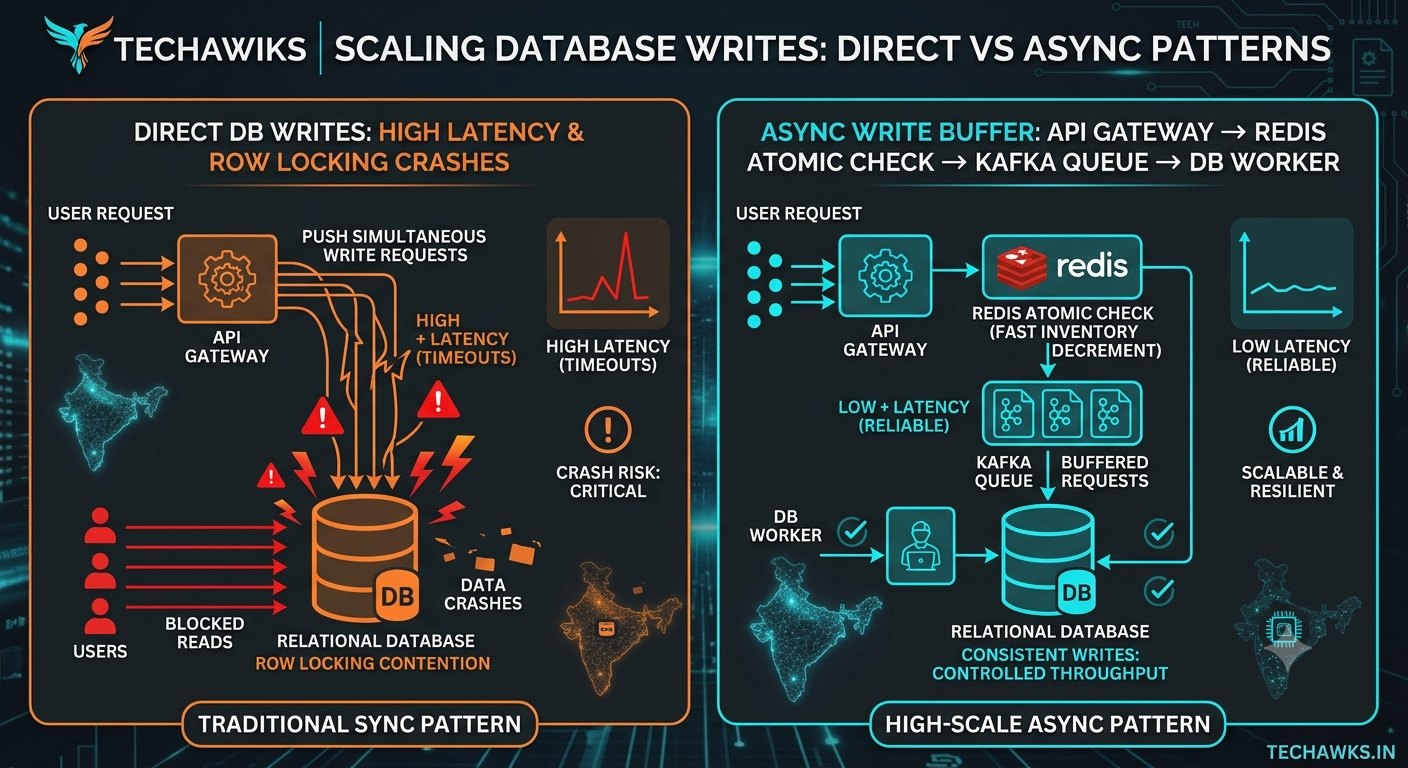
When designing high-throughput systems for Indian scale—like festival sales or flash ticket drops—direct database writes will instantly bottleneck your connection pool and lock rows.
🗳️ POLL:
Which pattern do you use to absorb massive write spikes?
🔴 A) Message Queue Buffering (Kafka/RabbitMQ $\to$ Async Worker $\to$ DB)
🔵 B) Redis Atomic In-Memory Locks (INCRBY / Lua Scripts $\to$ Sync later)
🟡 C) Database Sharding & Row Locking (Pessimistic/Optimistic Locks)
🟢 D) Rate Limiting at API Gateway (Throttle traffic before it hits backend)
💡 The Engineering Breakdown
Why Option A & B are Preferred for Scale:Redis Atomic Operations (Option B):
How it works: Instead of querying PostgreSQL/MySQL to check stock > 0, maintain the counter in Redis. Use atomic Lua scripts to decrement inventory instantly in RAM (<1\text{ ms})
Why it wins: Prevents database lock contention while guaranteeing zero double-selling.Message Queue Buffering (Option A):How it works: Accept the order, push the payload into Kafka or RabbitMQ, and return an immediate 202 Accepted response to the user.Why it wins: Decouples API availability from database write throughput. Background workers process database writes at a controlled, steady pace.
Why Option C Fails Under Heavy Concurrency:
Row Lock Bottlenecks: Holding a pessimistic lock (SELECT FOR UPDATE) across hundreds of concurrent database connections will quickly exhaust DB pool limits and cause widespread timeout errors (HTTP 504).
Key Takeaways
Decouple Writes: Never write directly to relational databases during extreme traffic surges.
Leverage In-Memory Speed: Use Redis for fast, atomic inventory checks before persisting state.
Async User Experience: Return fast "order processing" receipts to users and process actual stock allocation asynchronously via queues.
CTA
🇮🇳 Designing distributed systems for Indian enterprise scale?
Get deep-dive architecture breakdowns, practical trade-off analyses, and real-world system design guides.
👉 Join Techawks India to connect with senior architects and tech leads building resilient software!
The Big Question:
When designing high-throughput systems for Indian scale—like festival sales or flash ticket drops—direct database writes will instantly bottleneck your connection pool and lock rows.
🗳️ POLL:
Which pattern do you use to absorb massive write spikes?
🔴 A) Message Queue Buffering (Kafka/RabbitMQ $\to$ Async Worker $\to$ DB)
🔵 B) Redis Atomic In-Memory Locks (INCRBY / Lua Scripts $\to$ Sync later)
🟡 C) Database Sharding & Row Locking (Pessimistic/Optimistic Locks)
🟢 D) Rate Limiting at API Gateway (Throttle traffic before it hits backend)
💡 The Engineering Breakdown
Why Option A & B are Preferred for Scale:Redis Atomic Operations (Option B):
How it works: Instead of querying PostgreSQL/MySQL to check stock > 0, maintain the counter in Redis. Use atomic Lua scripts to decrement inventory instantly in RAM (<1\text{ ms})
Why it wins: Prevents database lock contention while guaranteeing zero double-selling.Message Queue Buffering (Option A):How it works: Accept the order, push the payload into Kafka or RabbitMQ, and return an immediate 202 Accepted response to the user.Why it wins: Decouples API availability from database write throughput. Background workers process database writes at a controlled, steady pace.
Why Option C Fails Under Heavy Concurrency:
Row Lock Bottlenecks: Holding a pessimistic lock (SELECT FOR UPDATE) across hundreds of concurrent database connections will quickly exhaust DB pool limits and cause widespread timeout errors (HTTP 504).
Key Takeaways
Decouple Writes: Never write directly to relational databases during extreme traffic surges.
Leverage In-Memory Speed: Use Redis for fast, atomic inventory checks before persisting state.
Async User Experience: Return fast "order processing" receipts to users and process actual stock allocation asynchronously via queues.
CTA
🇮🇳 Designing distributed systems for Indian enterprise scale?
Get deep-dive architecture breakdowns, practical trade-off analyses, and real-world system design guides.
👉 Join Techawks India to connect with senior architects and tech leads building resilient software!
System Design: How Do You Handle Database Writes During Flash Sales in India?
The Big Question:
When designing high-throughput systems for Indian scale—like festival sales or flash ticket drops—direct database writes will instantly bottleneck your connection pool and lock rows.
🗳️ POLL:
Which pattern do you use to absorb massive write spikes?
🔴 A) Message Queue Buffering (Kafka/RabbitMQ $\to$ Async Worker $\to$ DB)
🔵 B) Redis Atomic In-Memory Locks (INCRBY / Lua Scripts $\to$ Sync later)
🟡 C) Database Sharding & Row Locking (Pessimistic/Optimistic Locks)
🟢 D) Rate Limiting at API Gateway (Throttle traffic before it hits backend)
💡 The Engineering Breakdown
Why Option A & B are Preferred for Scale:Redis Atomic Operations (Option B):
How it works: Instead of querying PostgreSQL/MySQL to check stock > 0, maintain the counter in Redis. Use atomic Lua scripts to decrement inventory instantly in RAM (<1\text{ ms})
Why it wins: Prevents database lock contention while guaranteeing zero double-selling.Message Queue Buffering (Option A):How it works: Accept the order, push the payload into Kafka or RabbitMQ, and return an immediate 202 Accepted response to the user.Why it wins: Decouples API availability from database write throughput. Background workers process database writes at a controlled, steady pace.
Why Option C Fails Under Heavy Concurrency:
Row Lock Bottlenecks: Holding a pessimistic lock (SELECT FOR UPDATE) across hundreds of concurrent database connections will quickly exhaust DB pool limits and cause widespread timeout errors (HTTP 504).
Key Takeaways
Decouple Writes: Never write directly to relational databases during extreme traffic surges.
Leverage In-Memory Speed: Use Redis for fast, atomic inventory checks before persisting state.
Async User Experience: Return fast "order processing" receipts to users and process actual stock allocation asynchronously via queues.
CTA
🇮🇳 Designing distributed systems for Indian enterprise scale?
Get deep-dive architecture breakdowns, practical trade-off analyses, and real-world system design guides.
👉 Join Techawks India to connect with senior architects and tech leads building resilient software!

 English
 Arabic
 French
 Spanish
 Portuguese
 Deutsch
 Turkish
 Dutch
Dutch
 Italiano
 Russian
 Romaian
 Greek
Greek