


Staff Engineer Mindset: How to Move from Local Problem-Solver to Organizational Force Multiplier
The Industry Realignment:
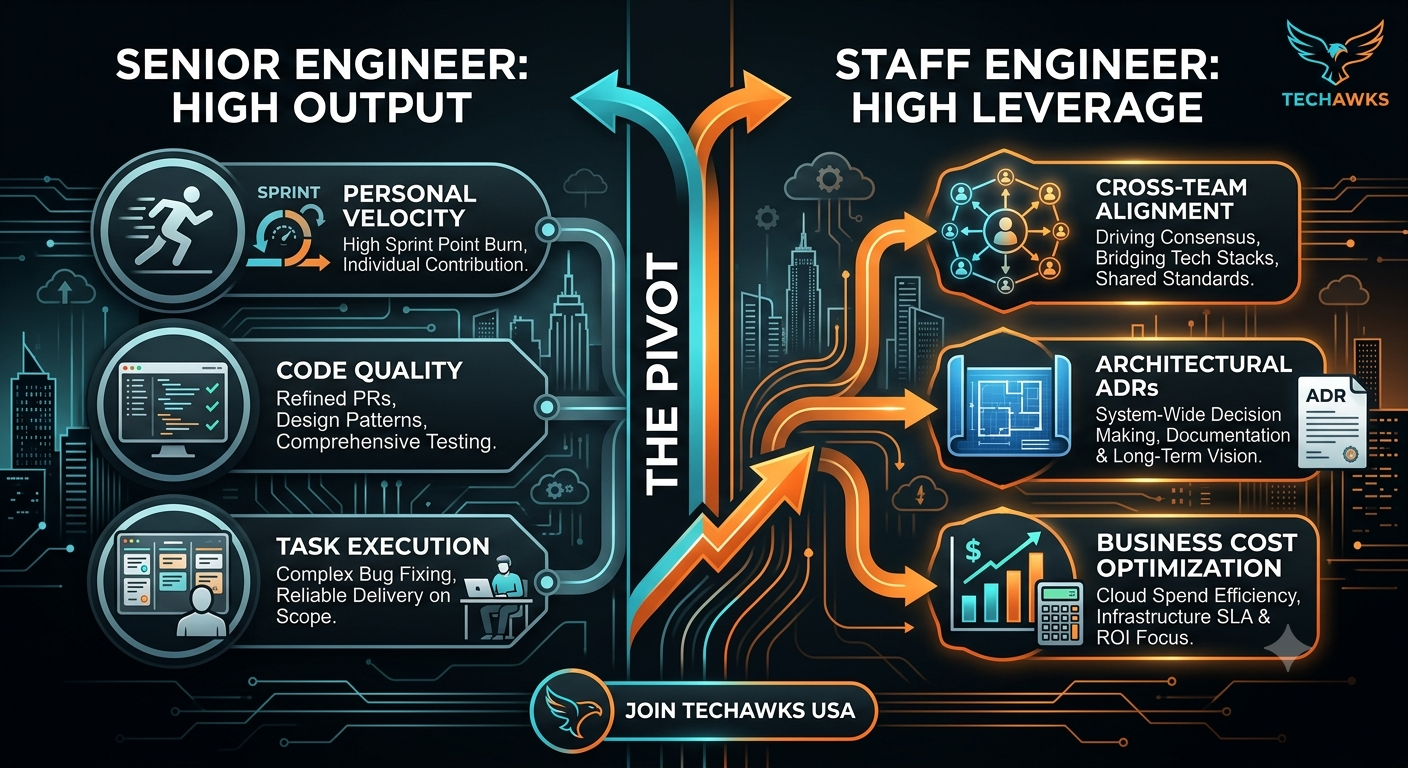
At top-tier US tech companies and fast-scaling startups, the transition to Staff Engineer isn't awarded for submitting more pull requests or solving complex bugs faster. It is awarded when an engineer systematically reduces complexity across multiple pods and aligns technical choices with company revenues.
🚀 3 Strategic Mindset Shifts for Aspiring Staff Engineers
1. Focus on "Technical Leverage" over Personal Velocity
The Shift: Stop measuring your worth by personal throughput (Jira story points burned). Start measuring it by how much faster you make the entire 20-person engineering organization move.
Action Item: Identify common friction points across engineering teams—such as fragile local dev setups, high CI build times, or unstandardized microservice templates—and build reusable internal platform tooling to eliminate them.
2. Master the Art of Architectural Alignment (RFCs & ADRs)
The Shift: Writing great code is easy; getting 5 conflicting engineering teams to agree on a single system architecture is hard.
Action Item: Author Architectural Decision Records (ADRs) and Requests for Comments (RFCs) that do not just detail tech stacks, but explicitly address trade-offs, operational overhead, cost implications, and migration paths.
3. Quantify Systems in Cost, Reliability, and SLA Terms
The Shift: Directors and VPs don't evaluate projects in terms of "clean code" or "pure functional paradigms." They evaluate them in risk reduction and financial efficiency.
Action Item: Frame technical initiatives using business metrics:
❌ Senior Engineer: "We refactored our caching layer to use Redis Cluster."
✅ Staff Engineer: "We reduced p99 latency by 35% during peak US trading hours, saving $120k/year in cloud compute costs while maintaining 99.99% uptime."
🛠️ Your 30-Day Executive Action Plan
Audit Cross-Team Friction: Interview leads from adjacent pods to pinpoint their top 3 technical bottlenecks.
Draft a High-Leverage RFC: Write a 2-page proposal solving one shared systemic issue.
Sponsor an Initiative: Lead cross-functional architecture reviews and mentor mid-level engineers through execution.
Key Takeaways
Leverage > Volume: Shift focus from individual code output to organizational developer productivity.
Alignment through ADRs: Drive consensus on architectural trade-offs across distributed US engineering teams.
Business Fluency: Translate complex technical refactors into cloud cost savings, SLA uptime, and risk mitigation.
CTA
🇺🇸 Navigating your tech career toward Staff & Principal Engineering in the US market?
Get enterprise architecture roadmaps, executive career strategies, and peer discussions with tech leads.
👉 Join Techawks USA to elevate your engineering impact and build scalable systems!
The Industry Realignment:
At top-tier US tech companies and fast-scaling startups, the transition to Staff Engineer isn't awarded for submitting more pull requests or solving complex bugs faster. It is awarded when an engineer systematically reduces complexity across multiple pods and aligns technical choices with company revenues.
🚀 3 Strategic Mindset Shifts for Aspiring Staff Engineers
1. Focus on "Technical Leverage" over Personal Velocity
The Shift: Stop measuring your worth by personal throughput (Jira story points burned). Start measuring it by how much faster you make the entire 20-person engineering organization move.
Action Item: Identify common friction points across engineering teams—such as fragile local dev setups, high CI build times, or unstandardized microservice templates—and build reusable internal platform tooling to eliminate them.
2. Master the Art of Architectural Alignment (RFCs & ADRs)
The Shift: Writing great code is easy; getting 5 conflicting engineering teams to agree on a single system architecture is hard.
Action Item: Author Architectural Decision Records (ADRs) and Requests for Comments (RFCs) that do not just detail tech stacks, but explicitly address trade-offs, operational overhead, cost implications, and migration paths.
3. Quantify Systems in Cost, Reliability, and SLA Terms
The Shift: Directors and VPs don't evaluate projects in terms of "clean code" or "pure functional paradigms." They evaluate them in risk reduction and financial efficiency.
Action Item: Frame technical initiatives using business metrics:
❌ Senior Engineer: "We refactored our caching layer to use Redis Cluster."
✅ Staff Engineer: "We reduced p99 latency by 35% during peak US trading hours, saving $120k/year in cloud compute costs while maintaining 99.99% uptime."
🛠️ Your 30-Day Executive Action Plan
Audit Cross-Team Friction: Interview leads from adjacent pods to pinpoint their top 3 technical bottlenecks.
Draft a High-Leverage RFC: Write a 2-page proposal solving one shared systemic issue.
Sponsor an Initiative: Lead cross-functional architecture reviews and mentor mid-level engineers through execution.
Key Takeaways
Leverage > Volume: Shift focus from individual code output to organizational developer productivity.
Alignment through ADRs: Drive consensus on architectural trade-offs across distributed US engineering teams.
Business Fluency: Translate complex technical refactors into cloud cost savings, SLA uptime, and risk mitigation.
CTA
🇺🇸 Navigating your tech career toward Staff & Principal Engineering in the US market?
Get enterprise architecture roadmaps, executive career strategies, and peer discussions with tech leads.
👉 Join Techawks USA to elevate your engineering impact and build scalable systems!
Staff Engineer Mindset: How to Move from Local Problem-Solver to Organizational Force Multiplier
The Industry Realignment:
At top-tier US tech companies and fast-scaling startups, the transition to Staff Engineer isn't awarded for submitting more pull requests or solving complex bugs faster. It is awarded when an engineer systematically reduces complexity across multiple pods and aligns technical choices with company revenues.
🚀 3 Strategic Mindset Shifts for Aspiring Staff Engineers
1. Focus on "Technical Leverage" over Personal Velocity
The Shift: Stop measuring your worth by personal throughput (Jira story points burned). Start measuring it by how much faster you make the entire 20-person engineering organization move.
Action Item: Identify common friction points across engineering teams—such as fragile local dev setups, high CI build times, or unstandardized microservice templates—and build reusable internal platform tooling to eliminate them.
2. Master the Art of Architectural Alignment (RFCs & ADRs)
The Shift: Writing great code is easy; getting 5 conflicting engineering teams to agree on a single system architecture is hard.
Action Item: Author Architectural Decision Records (ADRs) and Requests for Comments (RFCs) that do not just detail tech stacks, but explicitly address trade-offs, operational overhead, cost implications, and migration paths.
3. Quantify Systems in Cost, Reliability, and SLA Terms
The Shift: Directors and VPs don't evaluate projects in terms of "clean code" or "pure functional paradigms." They evaluate them in risk reduction and financial efficiency.
Action Item: Frame technical initiatives using business metrics:
❌ Senior Engineer: "We refactored our caching layer to use Redis Cluster."
✅ Staff Engineer: "We reduced p99 latency by 35% during peak US trading hours, saving $120k/year in cloud compute costs while maintaining 99.99% uptime."
🛠️ Your 30-Day Executive Action Plan
Audit Cross-Team Friction: Interview leads from adjacent pods to pinpoint their top 3 technical bottlenecks.
Draft a High-Leverage RFC: Write a 2-page proposal solving one shared systemic issue.
Sponsor an Initiative: Lead cross-functional architecture reviews and mentor mid-level engineers through execution.
Key Takeaways
Leverage > Volume: Shift focus from individual code output to organizational developer productivity.
Alignment through ADRs: Drive consensus on architectural trade-offs across distributed US engineering teams.
Business Fluency: Translate complex technical refactors into cloud cost savings, SLA uptime, and risk mitigation.
CTA
🇺🇸 Navigating your tech career toward Staff & Principal Engineering in the US market?
Get enterprise architecture roadmaps, executive career strategies, and peer discussions with tech leads.
👉 Join Techawks USA to elevate your engineering impact and build scalable systems!

 English
 Arabic
 French
 Spanish
 Portuguese
 Deutsch
 Turkish
 Dutch
Dutch
 Russian
 Romaian
 Portuguese (Brazil)
 Greek
Greek