


System Architecture Poll: How Do You Enforce API Microservice Resilience at Scale?
The Big Challenge:
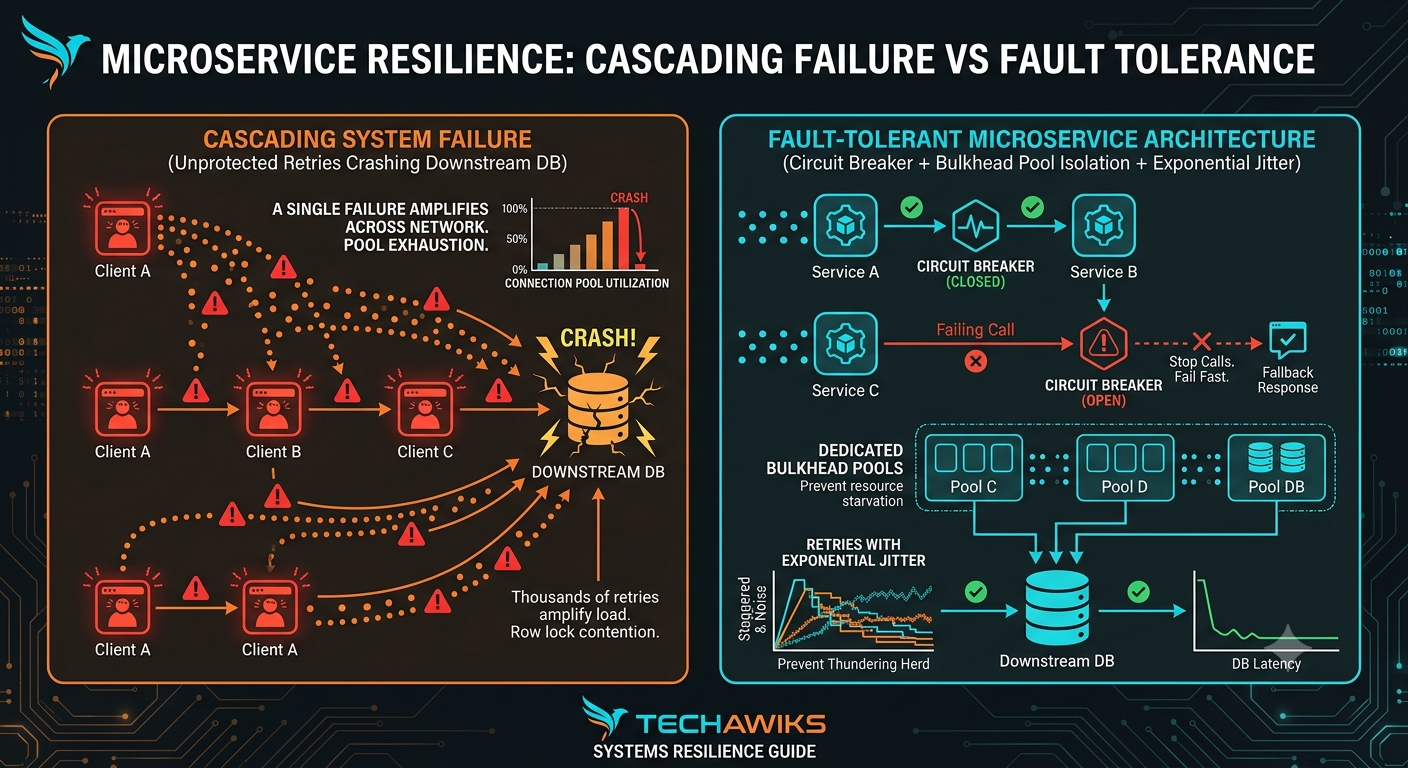
In distributed cloud architecture, partial network failures are inevitable. When service A calls service B, a delayed response or timeout can quickly back up thread pools, consume CPU/memory resources, and trigger catastrophic failure across your entire system.
🗳️ POLL:Which design pattern is your primary defense against cascading microservice failures?
🔴 A) Circuit Breakers (e.g., Resilience4j, Envoy — Stop calls when error thresholds are crossed)
🔵 B) Exponential Backoff & Jitter (Retry requests with randomized, increasing delays)
🟡 C) Bulkheads & Isolation (Isolate thread/connection pools per downstream dependency)
🟢 D) Rate Limiting & Shedding (Throttle or drop excess incoming requests at the edge API gateway)
💡 The Architectural Breakdown
1. Circuit Breakers (Option A): Preventing Resource Exhaustion
How it works: Tracks response failure rates over a sliding window. When failures exceed a threshold, the breaker transitions to an Open State, failing fast immediately without making network calls.
Why it wins: Prevents failing services from being overwhelmed while freeing up threads and memory on caller pods.
2. Exponential Backoff with Jitter (Option B): Mitigating Thundering Herds
How it works: Retries failed requests with exponentially increasing delays (e.g., $100\text{ ms}$, $200\text{ ms}$, $400\text{ ms}$) added with randomized noise (jitter).
Why it wins: Prevents thousands of retry attempts from hitting a recovering downstream database or service all at the exact same millisecond.
3. Bulkheads (Option C): Containing Explosive Blast Radii
How it works: Allocates dedicated thread pools and connection limits for each distinct dependency.
Why it wins: If payment gateway integration slows down, it only exhausts its allocated pool without starving product catalog or user profile services.
Key Takeaways
Fail Fast: Use Circuit Breakers to stop sending requests to degraded downstream dependencies.
Randomize Retries: Always add jitter to exponential backoff algorithms to prevent retry stampedes.
Isolate Resources: Implement Bulkhead patterns to limit the blast radius of slow or failing internal APIs.
CTA
🇺🇸 Architecting resilient, distributed systems for US enterprise environments?Get hands-on fault-tolerance patterns, cloud infrastructure strategies, and expert engineering insights.👉 Join Techawks USA to connect with principal architects and build reliable cloud systems!
The Big Challenge:
In distributed cloud architecture, partial network failures are inevitable. When service A calls service B, a delayed response or timeout can quickly back up thread pools, consume CPU/memory resources, and trigger catastrophic failure across your entire system.
🗳️ POLL:Which design pattern is your primary defense against cascading microservice failures?
🔴 A) Circuit Breakers (e.g., Resilience4j, Envoy — Stop calls when error thresholds are crossed)
🔵 B) Exponential Backoff & Jitter (Retry requests with randomized, increasing delays)
🟡 C) Bulkheads & Isolation (Isolate thread/connection pools per downstream dependency)
🟢 D) Rate Limiting & Shedding (Throttle or drop excess incoming requests at the edge API gateway)
💡 The Architectural Breakdown
1. Circuit Breakers (Option A): Preventing Resource Exhaustion
How it works: Tracks response failure rates over a sliding window. When failures exceed a threshold, the breaker transitions to an Open State, failing fast immediately without making network calls.
Why it wins: Prevents failing services from being overwhelmed while freeing up threads and memory on caller pods.
2. Exponential Backoff with Jitter (Option B): Mitigating Thundering Herds
How it works: Retries failed requests with exponentially increasing delays (e.g., $100\text{ ms}$, $200\text{ ms}$, $400\text{ ms}$) added with randomized noise (jitter).
Why it wins: Prevents thousands of retry attempts from hitting a recovering downstream database or service all at the exact same millisecond.
3. Bulkheads (Option C): Containing Explosive Blast Radii
How it works: Allocates dedicated thread pools and connection limits for each distinct dependency.
Why it wins: If payment gateway integration slows down, it only exhausts its allocated pool without starving product catalog or user profile services.
Key Takeaways
Fail Fast: Use Circuit Breakers to stop sending requests to degraded downstream dependencies.
Randomize Retries: Always add jitter to exponential backoff algorithms to prevent retry stampedes.
Isolate Resources: Implement Bulkhead patterns to limit the blast radius of slow or failing internal APIs.
CTA
🇺🇸 Architecting resilient, distributed systems for US enterprise environments?Get hands-on fault-tolerance patterns, cloud infrastructure strategies, and expert engineering insights.👉 Join Techawks USA to connect with principal architects and build reliable cloud systems!
System Architecture Poll: How Do You Enforce API Microservice Resilience at Scale?
The Big Challenge:
In distributed cloud architecture, partial network failures are inevitable. When service A calls service B, a delayed response or timeout can quickly back up thread pools, consume CPU/memory resources, and trigger catastrophic failure across your entire system.
🗳️ POLL:Which design pattern is your primary defense against cascading microservice failures?
🔴 A) Circuit Breakers (e.g., Resilience4j, Envoy — Stop calls when error thresholds are crossed)
🔵 B) Exponential Backoff & Jitter (Retry requests with randomized, increasing delays)
🟡 C) Bulkheads & Isolation (Isolate thread/connection pools per downstream dependency)
🟢 D) Rate Limiting & Shedding (Throttle or drop excess incoming requests at the edge API gateway)
💡 The Architectural Breakdown
1. Circuit Breakers (Option A): Preventing Resource Exhaustion
How it works: Tracks response failure rates over a sliding window. When failures exceed a threshold, the breaker transitions to an Open State, failing fast immediately without making network calls.
Why it wins: Prevents failing services from being overwhelmed while freeing up threads and memory on caller pods.
2. Exponential Backoff with Jitter (Option B): Mitigating Thundering Herds
How it works: Retries failed requests with exponentially increasing delays (e.g., $100\text{ ms}$, $200\text{ ms}$, $400\text{ ms}$) added with randomized noise (jitter).
Why it wins: Prevents thousands of retry attempts from hitting a recovering downstream database or service all at the exact same millisecond.
3. Bulkheads (Option C): Containing Explosive Blast Radii
How it works: Allocates dedicated thread pools and connection limits for each distinct dependency.
Why it wins: If payment gateway integration slows down, it only exhausts its allocated pool without starving product catalog or user profile services.
Key Takeaways
Fail Fast: Use Circuit Breakers to stop sending requests to degraded downstream dependencies.
Randomize Retries: Always add jitter to exponential backoff algorithms to prevent retry stampedes.
Isolate Resources: Implement Bulkhead patterns to limit the blast radius of slow or failing internal APIs.
CTA
🇺🇸 Architecting resilient, distributed systems for US enterprise environments?Get hands-on fault-tolerance patterns, cloud infrastructure strategies, and expert engineering insights.👉 Join Techawks USA to connect with principal architects and build reliable cloud systems!

 English
 French
 Spanish
 Portuguese
 Deutsch
 Turkish
 Dutch
Dutch
 Italiano
 Russian
 Romaian
 Portuguese (Brazil)
 Greek
Greek