


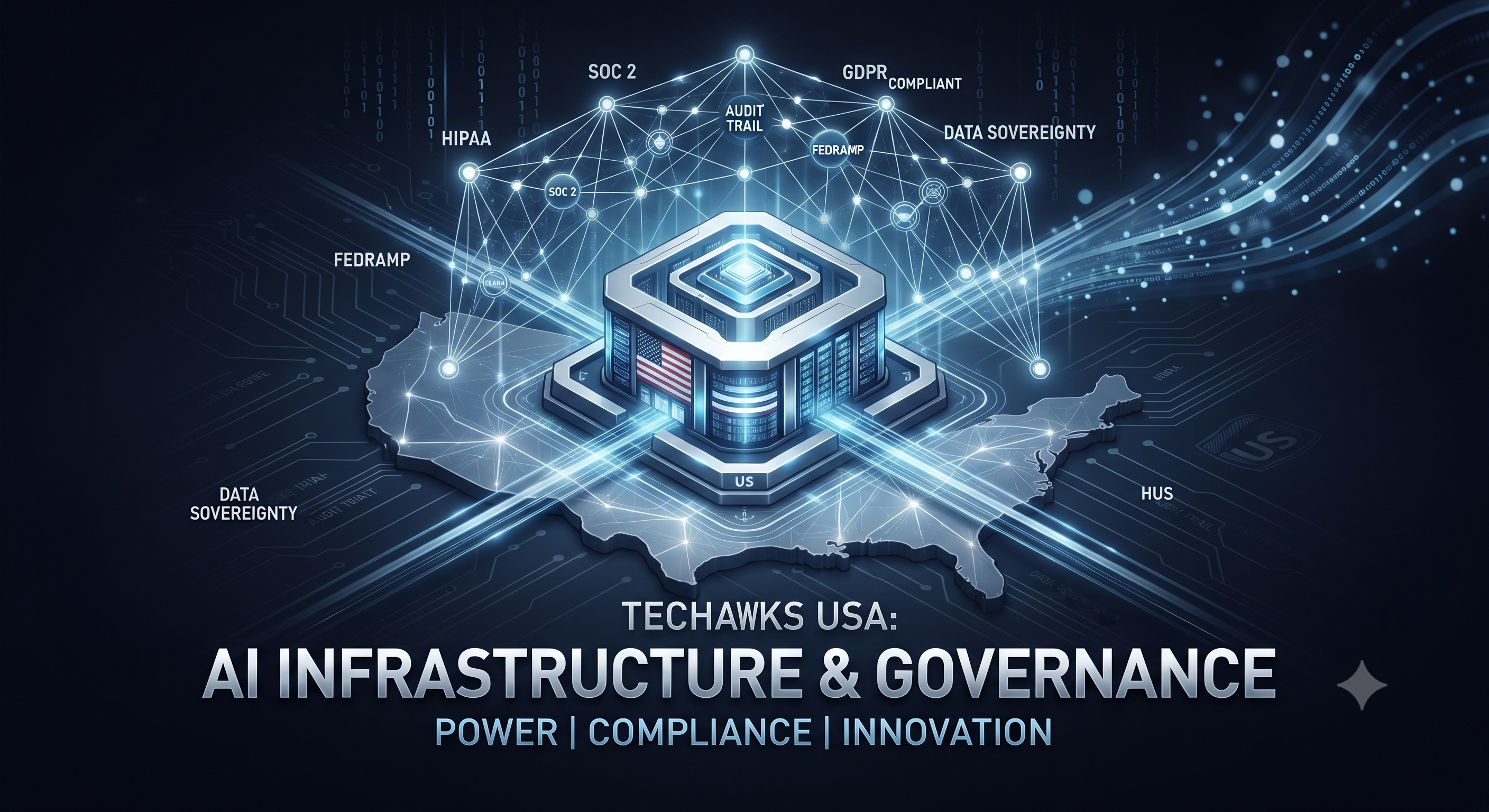
From Power Constraints to Policy: Why US Infrastructure and Governance Define the Next Era of AI
As recent industry data highlights, venture investments in US AI data center infrastructure have skyrocketed past $33.5 billion, with the vast majority of capital laser-focused on power supply, hardware acceleration, and computing efficiency.
Simultaneously, enterprise leaders and policy makers are confronting a massive governance vacuum. Recent calls for binding safety frameworks, independent audits, and emergency brakes on autonomous models highlight a stark reality: building advanced AI is no longer just a technical engineering challenge—it is an operational, regulatory, and infrastructural puzzle. Organizations can no longer rely on unguided scaling; long-term survival demands resilient data foundations, predictable power economics, and proactive compliance.
What you need to know to navigate the evolving US tech landscape:
Energy-Aware Architecture: Treat power consumption and compute efficiency as primary architectural constraints, just like memory leaks or latency.
Governance as a Growth Accelerator: Effective data governance and transparent lineage protocols are no longer compliance hurdles—they are the core trust layer required to move AI out of the pilot stage and into enterprise production.
Anticipating Regulatory Standards: With growing pressure for mandatory incident reporting and rigorous pre-release evaluations, engineering teams must build auditable logging and strict guardrails into their systems from day one.
Discussion Question
How is your US-based team factoring grid constraints, data governance, and potential regulatory shifts into your infrastructure planning for the year ahead?
CTA (Join Techawks USA)
Want to connect with engineering leaders, startup founders, and technologists across the US building the future of scalable tech? Join the Techawks USA community today and stay ahead of the curve.
As recent industry data highlights, venture investments in US AI data center infrastructure have skyrocketed past $33.5 billion, with the vast majority of capital laser-focused on power supply, hardware acceleration, and computing efficiency.
Simultaneously, enterprise leaders and policy makers are confronting a massive governance vacuum. Recent calls for binding safety frameworks, independent audits, and emergency brakes on autonomous models highlight a stark reality: building advanced AI is no longer just a technical engineering challenge—it is an operational, regulatory, and infrastructural puzzle. Organizations can no longer rely on unguided scaling; long-term survival demands resilient data foundations, predictable power economics, and proactive compliance.
What you need to know to navigate the evolving US tech landscape:
Energy-Aware Architecture: Treat power consumption and compute efficiency as primary architectural constraints, just like memory leaks or latency.
Governance as a Growth Accelerator: Effective data governance and transparent lineage protocols are no longer compliance hurdles—they are the core trust layer required to move AI out of the pilot stage and into enterprise production.
Anticipating Regulatory Standards: With growing pressure for mandatory incident reporting and rigorous pre-release evaluations, engineering teams must build auditable logging and strict guardrails into their systems from day one.
Discussion Question
How is your US-based team factoring grid constraints, data governance, and potential regulatory shifts into your infrastructure planning for the year ahead?
CTA (Join Techawks USA)
Want to connect with engineering leaders, startup founders, and technologists across the US building the future of scalable tech? Join the Techawks USA community today and stay ahead of the curve.
From Power Constraints to Policy: Why US Infrastructure and Governance Define the Next Era of AI
As recent industry data highlights, venture investments in US AI data center infrastructure have skyrocketed past $33.5 billion, with the vast majority of capital laser-focused on power supply, hardware acceleration, and computing efficiency.
Simultaneously, enterprise leaders and policy makers are confronting a massive governance vacuum. Recent calls for binding safety frameworks, independent audits, and emergency brakes on autonomous models highlight a stark reality: building advanced AI is no longer just a technical engineering challenge—it is an operational, regulatory, and infrastructural puzzle. Organizations can no longer rely on unguided scaling; long-term survival demands resilient data foundations, predictable power economics, and proactive compliance.
What you need to know to navigate the evolving US tech landscape:
Energy-Aware Architecture: Treat power consumption and compute efficiency as primary architectural constraints, just like memory leaks or latency.
Governance as a Growth Accelerator: Effective data governance and transparent lineage protocols are no longer compliance hurdles—they are the core trust layer required to move AI out of the pilot stage and into enterprise production.
Anticipating Regulatory Standards: With growing pressure for mandatory incident reporting and rigorous pre-release evaluations, engineering teams must build auditable logging and strict guardrails into their systems from day one.
Discussion Question
How is your US-based team factoring grid constraints, data governance, and potential regulatory shifts into your infrastructure planning for the year ahead?
CTA (Join Techawks USA)
Want to connect with engineering leaders, startup founders, and technologists across the US building the future of scalable tech? Join the Techawks USA community today and stay ahead of the curve.

 English
 Arabic
 Spanish
 Portuguese
 Deutsch
 Turkish
 Dutch
Dutch
 Italiano
 Russian
 Romaian
 Portuguese (Brazil)
 Greek
Greek