


Poll: What Is Your Team’s Biggest Bottleneck to Shipping Fast?
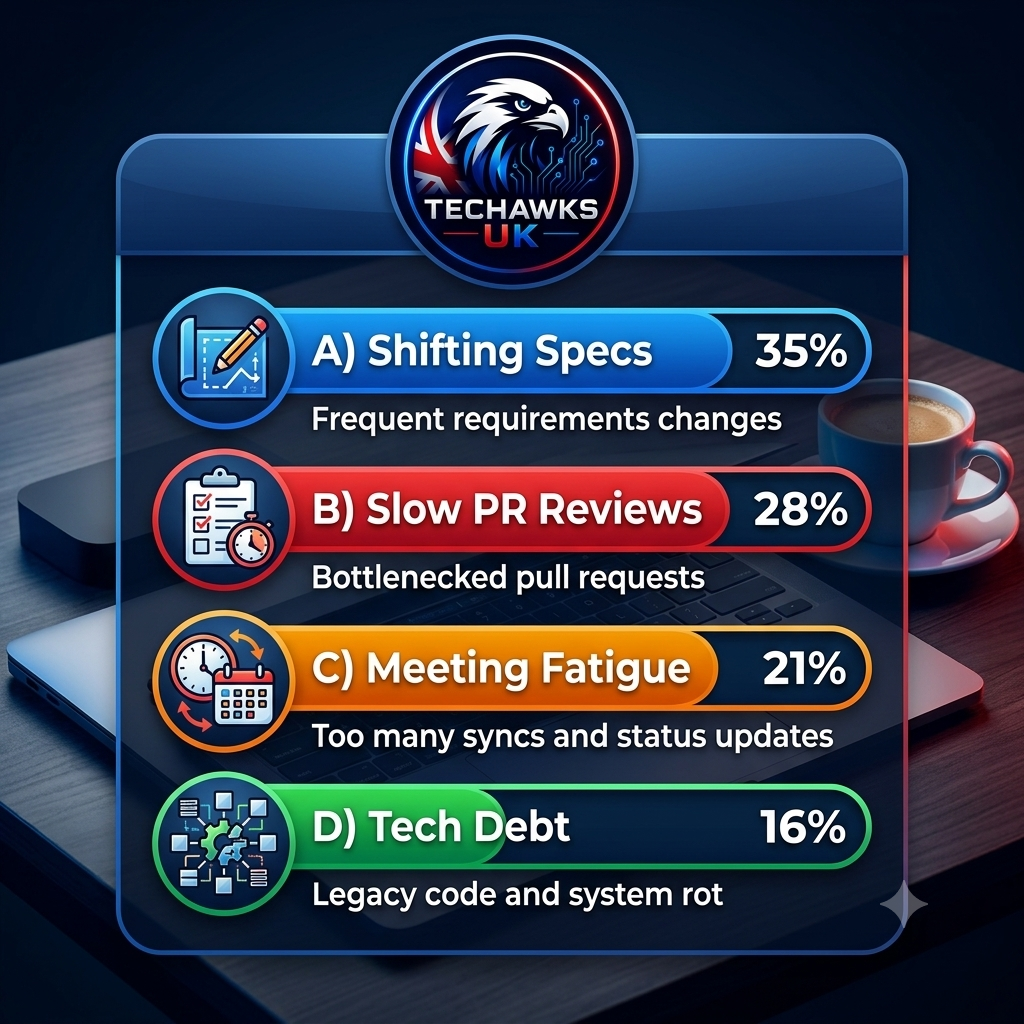
Speed in tech isn't just about writing code faster; it’s about reducing the friction between an idea and its deployment. When engineering, product, and design teams get stuck in slow delivery cycles, the root cause usually falls into one of four core operational areas:
Unclear or Changing Requirements: Specs that shift halfway through a sprint, forcing rework.
Slow Code Reviews & QA: PRs sitting in review queues for days while context fades.
Meeting Overload: Context-switching every 45 minutes, destroying deep-work state.
Technical Debt: Legacy architecture and flaky test suites breaking pipeline builds.
Identifying your team's primary bottleneck is the first step toward building a sustainable engineering pace.
📊 Quick Poll for the UK Tech Community
Which of these is currently the biggest obstacle to your team’s delivery speed?
🔴 A) Moving goalposts & shifting requirements
🟠 B) PR queues & slow QA loops
🟡 C) Too many sync meetings & calendar fragmentation
🟢 D) Tech debt & flaky CI/CD pipelines
(Drop your answer A, B, C, or D in the comments below!)
Key Takeaways
Audit Your Process: Take time each quarter to identify which single bottleneck is draining your team's velocity the most.
Batch Code Reviews: Set dedicated async review windows (e.g., first thing in the morning and right after lunch) so PRs don't stall for days.
Protect Focus Blocks: Implement 3- to 4-hour "no-meeting" focus blocks so developers can write complex code without interruption.
CTA (Join Techawks UK)
Want to benchmark your engineering processes against top tech teams across the UK?
👉 [Join Techawks UK Today] to exchange operational playbooks, join technical roundtables, and network with local tech leaders.
Speed in tech isn't just about writing code faster; it’s about reducing the friction between an idea and its deployment. When engineering, product, and design teams get stuck in slow delivery cycles, the root cause usually falls into one of four core operational areas:
Unclear or Changing Requirements: Specs that shift halfway through a sprint, forcing rework.
Slow Code Reviews & QA: PRs sitting in review queues for days while context fades.
Meeting Overload: Context-switching every 45 minutes, destroying deep-work state.
Technical Debt: Legacy architecture and flaky test suites breaking pipeline builds.
Identifying your team's primary bottleneck is the first step toward building a sustainable engineering pace.
📊 Quick Poll for the UK Tech Community
Which of these is currently the biggest obstacle to your team’s delivery speed?
🔴 A) Moving goalposts & shifting requirements
🟠 B) PR queues & slow QA loops
🟡 C) Too many sync meetings & calendar fragmentation
🟢 D) Tech debt & flaky CI/CD pipelines
(Drop your answer A, B, C, or D in the comments below!)
Key Takeaways
Audit Your Process: Take time each quarter to identify which single bottleneck is draining your team's velocity the most.
Batch Code Reviews: Set dedicated async review windows (e.g., first thing in the morning and right after lunch) so PRs don't stall for days.
Protect Focus Blocks: Implement 3- to 4-hour "no-meeting" focus blocks so developers can write complex code without interruption.
CTA (Join Techawks UK)
Want to benchmark your engineering processes against top tech teams across the UK?
👉 [Join Techawks UK Today] to exchange operational playbooks, join technical roundtables, and network with local tech leaders.
Poll: What Is Your Team’s Biggest Bottleneck to Shipping Fast?
Speed in tech isn't just about writing code faster; it’s about reducing the friction between an idea and its deployment. When engineering, product, and design teams get stuck in slow delivery cycles, the root cause usually falls into one of four core operational areas:
Unclear or Changing Requirements: Specs that shift halfway through a sprint, forcing rework.
Slow Code Reviews & QA: PRs sitting in review queues for days while context fades.
Meeting Overload: Context-switching every 45 minutes, destroying deep-work state.
Technical Debt: Legacy architecture and flaky test suites breaking pipeline builds.
Identifying your team's primary bottleneck is the first step toward building a sustainable engineering pace.
📊 Quick Poll for the UK Tech Community
Which of these is currently the biggest obstacle to your team’s delivery speed?
🔴 A) Moving goalposts & shifting requirements
🟠 B) PR queues & slow QA loops
🟡 C) Too many sync meetings & calendar fragmentation
🟢 D) Tech debt & flaky CI/CD pipelines
(Drop your answer A, B, C, or D in the comments below!)
Key Takeaways
Audit Your Process: Take time each quarter to identify which single bottleneck is draining your team's velocity the most.
Batch Code Reviews: Set dedicated async review windows (e.g., first thing in the morning and right after lunch) so PRs don't stall for days.
Protect Focus Blocks: Implement 3- to 4-hour "no-meeting" focus blocks so developers can write complex code without interruption.
CTA (Join Techawks UK)
Want to benchmark your engineering processes against top tech teams across the UK?
👉 [Join Techawks UK Today] to exchange operational playbooks, join technical roundtables, and network with local tech leaders.

 English
 Arabic
 French
 Spanish
 Portuguese
 Deutsch
 Turkish
 Italiano
 Russian
 Romaian
 Portuguese (Brazil)
 Greek
Greek