


3 Essential Tools for Managing Coast-to-Coast Tech Teams in Canada
Canada’s tech ecosystem is defined by highly distributed innovation. With engineering hubs spread across Toronto’s AI and fintech sectors, Vancouver’s cloud software scene, and Montreal’s deep-tech clusters, local companies frequently hire top talent nationwide.
However, relying on constant live syncs across provincial time zones drains developer energy and stalls delivery. To build a resilient workflow across Canada, engineering and product leaders need tools built for asynchronous context-sharing and centralized knowledge.
Here are three core tools and actionable strategies to optimize your coast-to-coast operations:
1. Loom: For Asynchronous Video Code & Spec Reviews
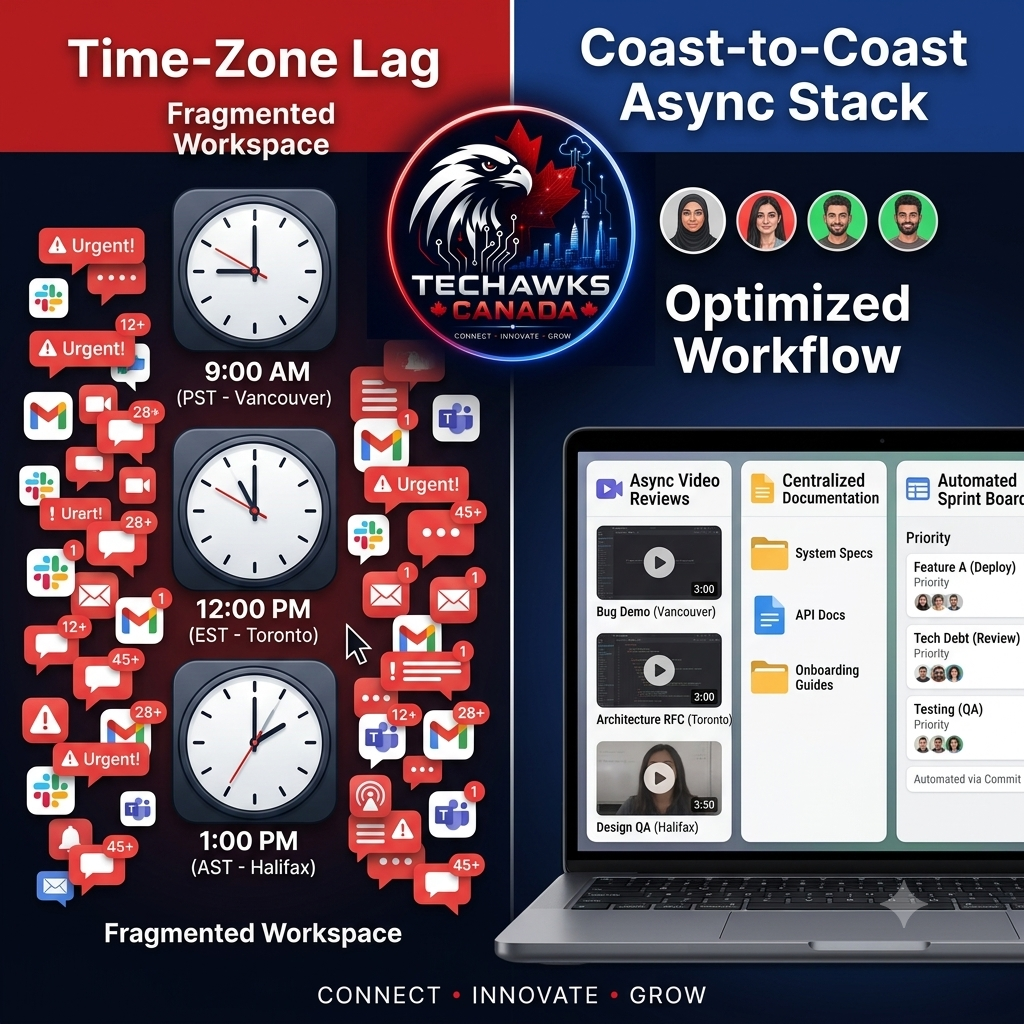
When it's 9:00 AM in Vancouver, it's already 12:00 PM in Toronto and 1:00 PM in Halifax. Waiting for a schedule overlap just to walk through a pull request or product mockup adds half a day of friction.
Actionable Advice: Record a 2- to 3-minute video recording explaining the technical context of your PR or spec. Open with the core problem, highlight key visual or code changes, and tag teammates with a clear call-to-action for async feedback.
2. Notion: For Single-Source System Architecture & Documentation
Important decisions buried in Slack channels or scattered across regional drives create massive knowledge gaps between teams in different provinces. Notion serves as a single, searchable repository for technical specs, Architecture Decision Records (ADRs), and onboarding guides.
Actionable Advice: Build standardized templates for feature proposals and ADRs. Establish a rule that all architectural changes must be documented in Notion with a 24-hour async comment period before implementation starts.
3. Linear: For High-Velocity Issue & Sprint Tracking
Traditional, heavy project management tools often require endless status syncs to keep track of sprint progress. Linear offers a lightweight, keyboard-first issue tracker that connects developer commits directly to project boards.
Actionable Advice: Enable GitHub/GitLab automation in Linear. Teach developers to link issues directly in commit messages so cards update status automatically as PRs are created, reviewed, and merged—zero status meetings required.
Key Takeaways
Protect Focus Windows: Replace routine status calls with short, high-context video walkthroughs.
Centralize Team Knowledge: Document system design and project specs in Notion so distributed teams can self-serve context on demand.
Automate Status Tracking: Sync issue management with code repositories to track sprint velocity without manual updates.
CTA (Join Techawks Canada)
Looking to optimize your team's engineering stack and connect with top developers, CTOs, and tech leaders from coast to coast?
👉 [Join Techawks Canada Today] to access regional playbooks, peer mentorship, and community-led technical discussions across the country.
Canada’s tech ecosystem is defined by highly distributed innovation. With engineering hubs spread across Toronto’s AI and fintech sectors, Vancouver’s cloud software scene, and Montreal’s deep-tech clusters, local companies frequently hire top talent nationwide.
However, relying on constant live syncs across provincial time zones drains developer energy and stalls delivery. To build a resilient workflow across Canada, engineering and product leaders need tools built for asynchronous context-sharing and centralized knowledge.
Here are three core tools and actionable strategies to optimize your coast-to-coast operations:
1. Loom: For Asynchronous Video Code & Spec Reviews
When it's 9:00 AM in Vancouver, it's already 12:00 PM in Toronto and 1:00 PM in Halifax. Waiting for a schedule overlap just to walk through a pull request or product mockup adds half a day of friction.
Actionable Advice: Record a 2- to 3-minute video recording explaining the technical context of your PR or spec. Open with the core problem, highlight key visual or code changes, and tag teammates with a clear call-to-action for async feedback.
2. Notion: For Single-Source System Architecture & Documentation
Important decisions buried in Slack channels or scattered across regional drives create massive knowledge gaps between teams in different provinces. Notion serves as a single, searchable repository for technical specs, Architecture Decision Records (ADRs), and onboarding guides.
Actionable Advice: Build standardized templates for feature proposals and ADRs. Establish a rule that all architectural changes must be documented in Notion with a 24-hour async comment period before implementation starts.
3. Linear: For High-Velocity Issue & Sprint Tracking
Traditional, heavy project management tools often require endless status syncs to keep track of sprint progress. Linear offers a lightweight, keyboard-first issue tracker that connects developer commits directly to project boards.
Actionable Advice: Enable GitHub/GitLab automation in Linear. Teach developers to link issues directly in commit messages so cards update status automatically as PRs are created, reviewed, and merged—zero status meetings required.
Key Takeaways
Protect Focus Windows: Replace routine status calls with short, high-context video walkthroughs.
Centralize Team Knowledge: Document system design and project specs in Notion so distributed teams can self-serve context on demand.
Automate Status Tracking: Sync issue management with code repositories to track sprint velocity without manual updates.
CTA (Join Techawks Canada)
Looking to optimize your team's engineering stack and connect with top developers, CTOs, and tech leaders from coast to coast?
👉 [Join Techawks Canada Today] to access regional playbooks, peer mentorship, and community-led technical discussions across the country.
3 Essential Tools for Managing Coast-to-Coast Tech Teams in Canada
Canada’s tech ecosystem is defined by highly distributed innovation. With engineering hubs spread across Toronto’s AI and fintech sectors, Vancouver’s cloud software scene, and Montreal’s deep-tech clusters, local companies frequently hire top talent nationwide.
However, relying on constant live syncs across provincial time zones drains developer energy and stalls delivery. To build a resilient workflow across Canada, engineering and product leaders need tools built for asynchronous context-sharing and centralized knowledge.
Here are three core tools and actionable strategies to optimize your coast-to-coast operations:
1. Loom: For Asynchronous Video Code & Spec Reviews
When it's 9:00 AM in Vancouver, it's already 12:00 PM in Toronto and 1:00 PM in Halifax. Waiting for a schedule overlap just to walk through a pull request or product mockup adds half a day of friction.
Actionable Advice: Record a 2- to 3-minute video recording explaining the technical context of your PR or spec. Open with the core problem, highlight key visual or code changes, and tag teammates with a clear call-to-action for async feedback.
2. Notion: For Single-Source System Architecture & Documentation
Important decisions buried in Slack channels or scattered across regional drives create massive knowledge gaps between teams in different provinces. Notion serves as a single, searchable repository for technical specs, Architecture Decision Records (ADRs), and onboarding guides.
Actionable Advice: Build standardized templates for feature proposals and ADRs. Establish a rule that all architectural changes must be documented in Notion with a 24-hour async comment period before implementation starts.
3. Linear: For High-Velocity Issue & Sprint Tracking
Traditional, heavy project management tools often require endless status syncs to keep track of sprint progress. Linear offers a lightweight, keyboard-first issue tracker that connects developer commits directly to project boards.
Actionable Advice: Enable GitHub/GitLab automation in Linear. Teach developers to link issues directly in commit messages so cards update status automatically as PRs are created, reviewed, and merged—zero status meetings required.
Key Takeaways
Protect Focus Windows: Replace routine status calls with short, high-context video walkthroughs.
Centralize Team Knowledge: Document system design and project specs in Notion so distributed teams can self-serve context on demand.
Automate Status Tracking: Sync issue management with code repositories to track sprint velocity without manual updates.
CTA (Join Techawks Canada)
Looking to optimize your team's engineering stack and connect with top developers, CTOs, and tech leaders from coast to coast?
👉 [Join Techawks Canada Today] to access regional playbooks, peer mentorship, and community-led technical discussions across the country.

 Arabic
 French
 Spanish
 Portuguese
 Deutsch
 Turkish
 Dutch
Dutch
 Italiano
 Russian
 Romaian
 Portuguese (Brazil)
 Greek
Greek