


Poll: What is the Single Largest Challenge Facing Distributed Canadian Tech Teams?
Building and scaling tech companies in Canada requires balancing provincial talent pools, time-zone spreads, and hybrid work expectations. While distributed setups unlock nationwide talent, they also introduce coordination friction that can slow down product releases if left unaddressed.
We want to hear from engineering managers, product leads, and developers across the Canadian tech ecosystem:
Which operational challenge creates the biggest bottleneck in your team’s daily workflow?
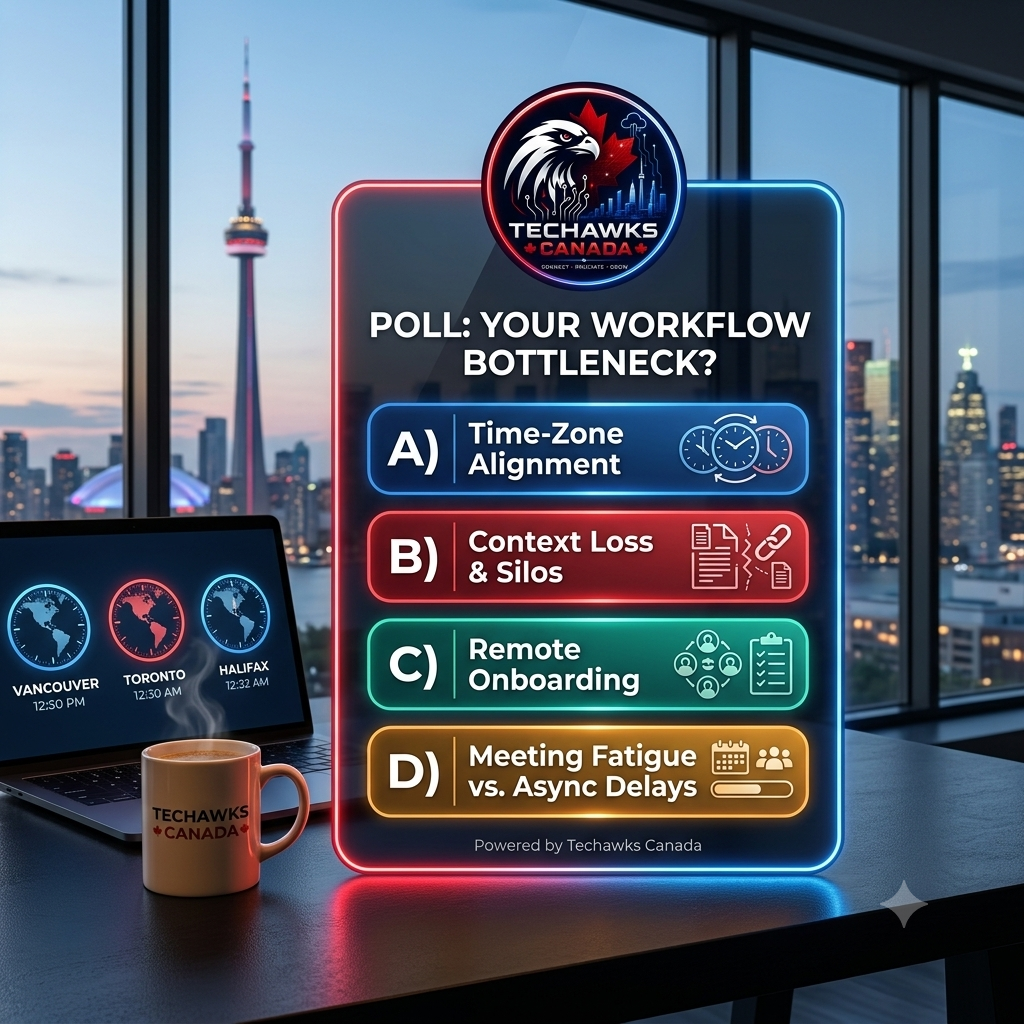
A) Time-Zone Alignment: Managing real-time collaboration across PST, EST, and AST without overwhelming team calendars.
B) Context Loss & Silos: Keeping documentation updated across Slack, Jira, and Notion without losing critical architectural decisions.
C) Remote Onboarding & Mentorship: Integrating junior developers and new hires into complex codebases without in-person shadow sessions.
D) Meeting Fatigue vs. Async Delays: Balancing the friction of endless status calls against 24-hour review delays on pull requests.
Actionable Advice for Each Workflow Bottleneck
If you selected A or D: Establish strict 2-hour core overlap windows (e.g., 1:00 PM – 3:00 PM EST) for synchronous alignment, leaving the rest of the day for uninterrupted focus work and asynchronous video updates.
If you selected B: Implement Architecture Decision Records (ADRs) within your repository. Require a brief written spec before code is written, ensuring knowledge stays attached to the codebase rather than fading in chat threads.
If you selected C: Pair new hires with a dedicated technical mentor for the first month and utilize recorded async walkthroughs for system architecture onboarding.
Key Takeaways
Identify the Bottleneck: Isolate whether your team's friction stems from schedule overlap, documentation gaps, or onboarding friction.
Adopt Async Discipline: Reduce calendar dependency by shifting code walkthroughs and status updates to documented, asynchronous formats.
Standardize Workflows: Establish explicit team agreements around core communication hours and pull request response times across provinces.
CTA (Join Techawks Canada)
Looking to benchmark your team's processes against top engineering leaders across the country?
👉 [Join Techawks Canada Today] to participate in live industry discussions, access exclusive engineering playbooks, and connect with technical leaders from coast to coast.
Building and scaling tech companies in Canada requires balancing provincial talent pools, time-zone spreads, and hybrid work expectations. While distributed setups unlock nationwide talent, they also introduce coordination friction that can slow down product releases if left unaddressed.
We want to hear from engineering managers, product leads, and developers across the Canadian tech ecosystem:
Which operational challenge creates the biggest bottleneck in your team’s daily workflow?
A) Time-Zone Alignment: Managing real-time collaboration across PST, EST, and AST without overwhelming team calendars.
B) Context Loss & Silos: Keeping documentation updated across Slack, Jira, and Notion without losing critical architectural decisions.
C) Remote Onboarding & Mentorship: Integrating junior developers and new hires into complex codebases without in-person shadow sessions.
D) Meeting Fatigue vs. Async Delays: Balancing the friction of endless status calls against 24-hour review delays on pull requests.
Actionable Advice for Each Workflow Bottleneck
If you selected A or D: Establish strict 2-hour core overlap windows (e.g., 1:00 PM – 3:00 PM EST) for synchronous alignment, leaving the rest of the day for uninterrupted focus work and asynchronous video updates.
If you selected B: Implement Architecture Decision Records (ADRs) within your repository. Require a brief written spec before code is written, ensuring knowledge stays attached to the codebase rather than fading in chat threads.
If you selected C: Pair new hires with a dedicated technical mentor for the first month and utilize recorded async walkthroughs for system architecture onboarding.
Key Takeaways
Identify the Bottleneck: Isolate whether your team's friction stems from schedule overlap, documentation gaps, or onboarding friction.
Adopt Async Discipline: Reduce calendar dependency by shifting code walkthroughs and status updates to documented, asynchronous formats.
Standardize Workflows: Establish explicit team agreements around core communication hours and pull request response times across provinces.
CTA (Join Techawks Canada)
Looking to benchmark your team's processes against top engineering leaders across the country?
👉 [Join Techawks Canada Today] to participate in live industry discussions, access exclusive engineering playbooks, and connect with technical leaders from coast to coast.
Poll: What is the Single Largest Challenge Facing Distributed Canadian Tech Teams?
Building and scaling tech companies in Canada requires balancing provincial talent pools, time-zone spreads, and hybrid work expectations. While distributed setups unlock nationwide talent, they also introduce coordination friction that can slow down product releases if left unaddressed.
We want to hear from engineering managers, product leads, and developers across the Canadian tech ecosystem:
Which operational challenge creates the biggest bottleneck in your team’s daily workflow?
A) Time-Zone Alignment: Managing real-time collaboration across PST, EST, and AST without overwhelming team calendars.
B) Context Loss & Silos: Keeping documentation updated across Slack, Jira, and Notion without losing critical architectural decisions.
C) Remote Onboarding & Mentorship: Integrating junior developers and new hires into complex codebases without in-person shadow sessions.
D) Meeting Fatigue vs. Async Delays: Balancing the friction of endless status calls against 24-hour review delays on pull requests.
Actionable Advice for Each Workflow Bottleneck
If you selected A or D: Establish strict 2-hour core overlap windows (e.g., 1:00 PM – 3:00 PM EST) for synchronous alignment, leaving the rest of the day for uninterrupted focus work and asynchronous video updates.
If you selected B: Implement Architecture Decision Records (ADRs) within your repository. Require a brief written spec before code is written, ensuring knowledge stays attached to the codebase rather than fading in chat threads.
If you selected C: Pair new hires with a dedicated technical mentor for the first month and utilize recorded async walkthroughs for system architecture onboarding.
Key Takeaways
Identify the Bottleneck: Isolate whether your team's friction stems from schedule overlap, documentation gaps, or onboarding friction.
Adopt Async Discipline: Reduce calendar dependency by shifting code walkthroughs and status updates to documented, asynchronous formats.
Standardize Workflows: Establish explicit team agreements around core communication hours and pull request response times across provinces.
CTA (Join Techawks Canada)
Looking to benchmark your team's processes against top engineering leaders across the country?
👉 [Join Techawks Canada Today] to participate in live industry discussions, access exclusive engineering playbooks, and connect with technical leaders from coast to coast.

 English
 Arabic
 French
 Spanish
 Portuguese
 Deutsch
 Turkish
 Dutch
Dutch
 Russian
 Romaian
 Portuguese (Brazil)
 Greek
Greek