


Navigating UK GDPR & AI Accountability: The 4-Step Compliance Audit Checklist
As the UK Government and sector regulators—including the Information Commissioner's Office (ICO) and the Competition and Markets Authority (CMA)—ramp up scrutiny on advanced AI models and autonomous systems, tech companies can no longer rely on light-touch assumptions. UK GDPR applies directly to every AI system that handles personal data, and transparency is a non-negotiable legal baseline.
Whether you are building bespoke foundation models or integrating third-party agentic workflows, accountability stays with you.
Use this 4-step checklist to audit your UK tech stack for compliance readiness:
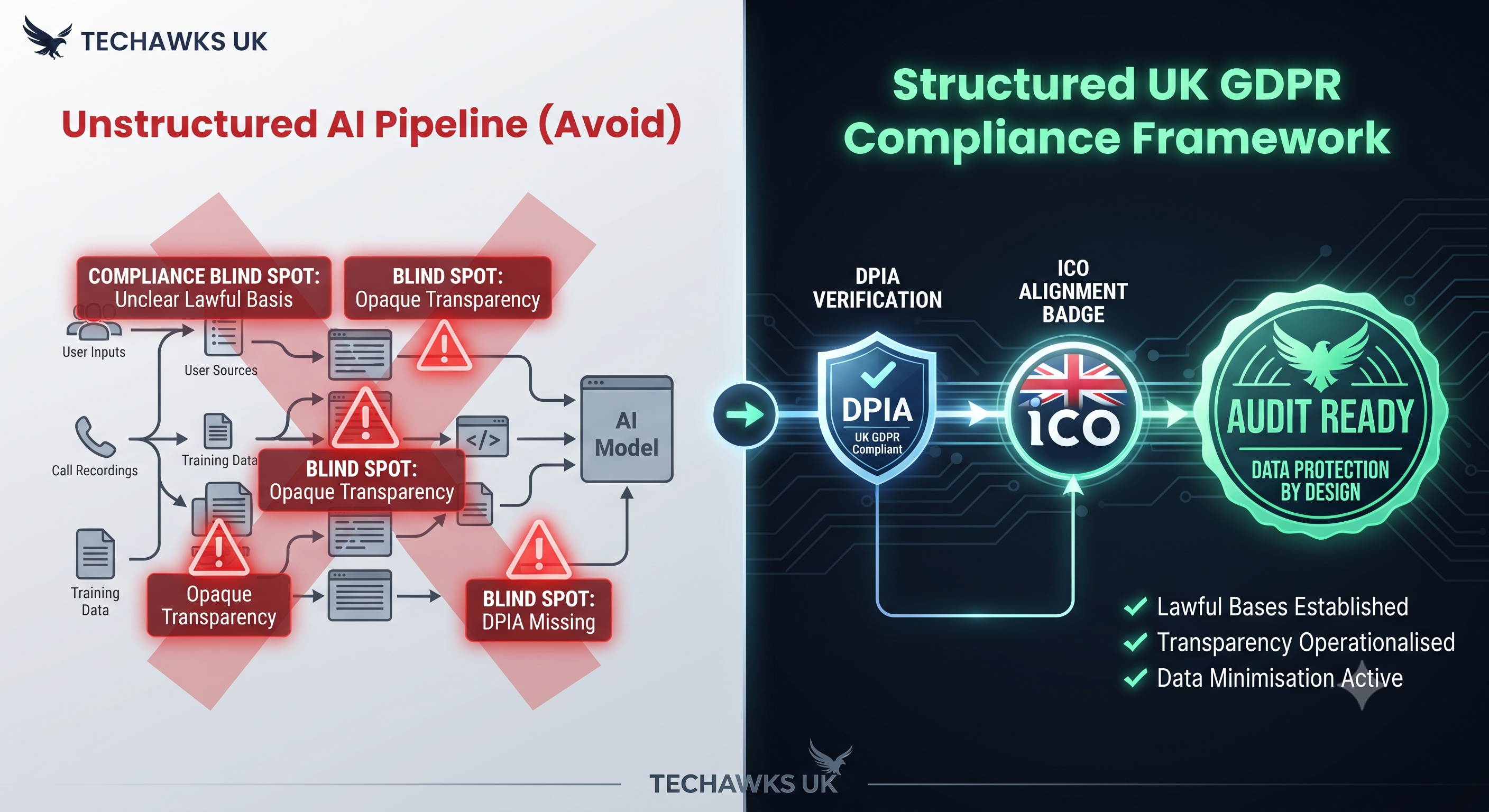
Conduct Rigorous Data Protection Impact Assessments (DPIAs): For any innovative technology or automated processing that creates high risks for individuals, a DPIA is a mandatory legal requirement under UK GDPR—not an optional afterthought.
Establish Lawful Bases and Purpose Limitation: Document your processing grounds clearly (such as legitimate interests under Article 6) and ensure training data or user inputs do not deviate from their original stated purpose.
Operationalise Transparency Obligations: Clearly inform users and callers when they are interacting with an AI system or automated decision-making tool, eliminating hidden logic loops.
Build Data Protection by Design: Implement strict technical controls from day one—minimizing data collection, restricting access to call recordings or PII vectors, and retaining data only for the absolute minimum necessary period.
Discussion Question: How is your UK-based team adapting documentation and governance to meet growing ICO expectations around AI and automated decision-making? Let’s discuss below!
CTA (Join Techawks UK): Want to connect with UK tech leaders, software engineers, and regulatory experts navigating modern compliance and architecture? Join the Techawks UK community
As the UK Government and sector regulators—including the Information Commissioner's Office (ICO) and the Competition and Markets Authority (CMA)—ramp up scrutiny on advanced AI models and autonomous systems, tech companies can no longer rely on light-touch assumptions. UK GDPR applies directly to every AI system that handles personal data, and transparency is a non-negotiable legal baseline.
Whether you are building bespoke foundation models or integrating third-party agentic workflows, accountability stays with you.
Use this 4-step checklist to audit your UK tech stack for compliance readiness:
Conduct Rigorous Data Protection Impact Assessments (DPIAs): For any innovative technology or automated processing that creates high risks for individuals, a DPIA is a mandatory legal requirement under UK GDPR—not an optional afterthought.
Establish Lawful Bases and Purpose Limitation: Document your processing grounds clearly (such as legitimate interests under Article 6) and ensure training data or user inputs do not deviate from their original stated purpose.
Operationalise Transparency Obligations: Clearly inform users and callers when they are interacting with an AI system or automated decision-making tool, eliminating hidden logic loops.
Build Data Protection by Design: Implement strict technical controls from day one—minimizing data collection, restricting access to call recordings or PII vectors, and retaining data only for the absolute minimum necessary period.
Discussion Question: How is your UK-based team adapting documentation and governance to meet growing ICO expectations around AI and automated decision-making? Let’s discuss below!
CTA (Join Techawks UK): Want to connect with UK tech leaders, software engineers, and regulatory experts navigating modern compliance and architecture? Join the Techawks UK community
Navigating UK GDPR & AI Accountability: The 4-Step Compliance Audit Checklist
As the UK Government and sector regulators—including the Information Commissioner's Office (ICO) and the Competition and Markets Authority (CMA)—ramp up scrutiny on advanced AI models and autonomous systems, tech companies can no longer rely on light-touch assumptions. UK GDPR applies directly to every AI system that handles personal data, and transparency is a non-negotiable legal baseline.
Whether you are building bespoke foundation models or integrating third-party agentic workflows, accountability stays with you.
Use this 4-step checklist to audit your UK tech stack for compliance readiness:
Conduct Rigorous Data Protection Impact Assessments (DPIAs): For any innovative technology or automated processing that creates high risks for individuals, a DPIA is a mandatory legal requirement under UK GDPR—not an optional afterthought.
Establish Lawful Bases and Purpose Limitation: Document your processing grounds clearly (such as legitimate interests under Article 6) and ensure training data or user inputs do not deviate from their original stated purpose.
Operationalise Transparency Obligations: Clearly inform users and callers when they are interacting with an AI system or automated decision-making tool, eliminating hidden logic loops.
Build Data Protection by Design: Implement strict technical controls from day one—minimizing data collection, restricting access to call recordings or PII vectors, and retaining data only for the absolute minimum necessary period.
Discussion Question: How is your UK-based team adapting documentation and governance to meet growing ICO expectations around AI and automated decision-making? Let’s discuss below!
CTA (Join Techawks UK): Want to connect with UK tech leaders, software engineers, and regulatory experts navigating modern compliance and architecture? Join the Techawks UK community

 Arabic
 French
 Spanish
 Portuguese
 Deutsch
 Turkish
 Dutch
Dutch
 Italiano
 Russian
 Romaian
 Portuguese (Brazil)
 Greek
Greek