


The Illusion of Idempotency: Why Your API Retries Are Secretly Corrupting Your Database
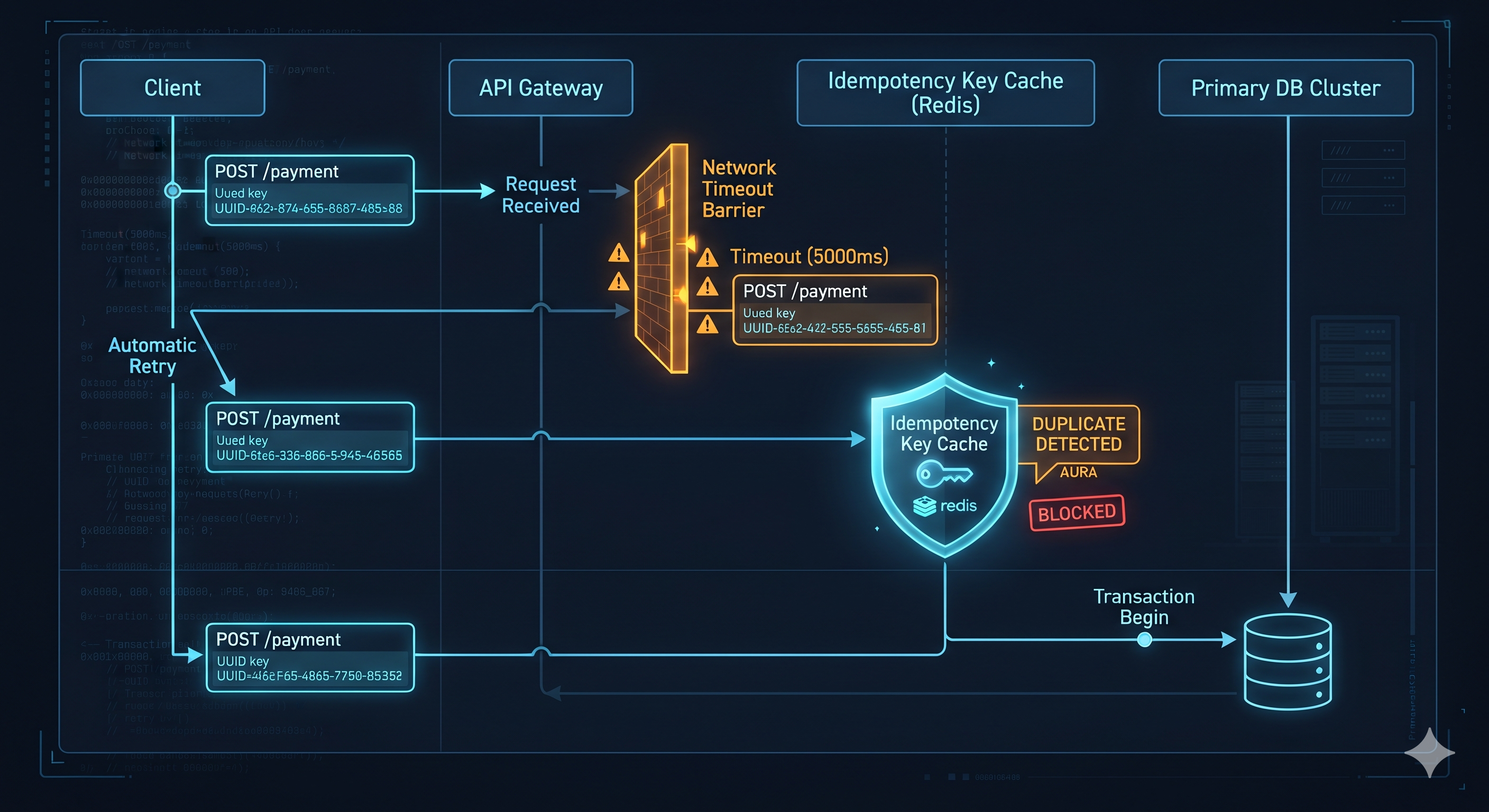
With distributed systems handling massive concurrent workloads, building fault-tolerant applications requires more than just wrapping network calls in a try/catch block or throwing a exponential backoff wrapper around an API client. When packets vanish or timeouts occur in transit, the client doesn't know if the server failed before processing the request or after executing it successfully.
Why It Matters
If your API endpoints accept mutations (like creating a resource or transferring funds) without strict idempotency enforcement, automatic retries will inevitably result in duplicate data, ghost records, and financial discrepancies. Relying on auto-generated database IDs on the server side is no longer enough when distributed networks guarantee packet duplication and out-of-order delivery.
What You Need to Know: Engineering True Idempotency
To write rock-solid APIs that survive network partitions and client retries, implement these architectural patterns:
Idempotency Keys via Headers: Require clients to generate and send a unique cryptographic identifier (like a UUID v4) in a custom header (e.g., X-Idempotency-Key) for every mutating request.
Atomic State Tracking: Store the incoming idempotency key in a high-speed transactional store (such as Redis) with a strict Time-To-Live (TTL) alongside a status flag (PROCESSING, COMPLETED, FAILED).
Optimistic Locking & Unique Constraints: Leverage database-level unique constraints on natural business keys to ensure that even if cache layers fail, the database rejects duplicate writes at the storage layer.
Discussion Question
How do you currently handle idempotency in your microservices? Are you managing state locks at the API gateway layer or handling uniqueness strictly inside your database constraints?
CTA (Join Developers & Coding)
Want to level up your backend architecture, master distributed systems, and write production-grade code that never breaks under pressure? Join Developers & Coding to connect with global engineers solving hard problems every day.
With distributed systems handling massive concurrent workloads, building fault-tolerant applications requires more than just wrapping network calls in a try/catch block or throwing a exponential backoff wrapper around an API client. When packets vanish or timeouts occur in transit, the client doesn't know if the server failed before processing the request or after executing it successfully.
Why It Matters
If your API endpoints accept mutations (like creating a resource or transferring funds) without strict idempotency enforcement, automatic retries will inevitably result in duplicate data, ghost records, and financial discrepancies. Relying on auto-generated database IDs on the server side is no longer enough when distributed networks guarantee packet duplication and out-of-order delivery.
What You Need to Know: Engineering True Idempotency
To write rock-solid APIs that survive network partitions and client retries, implement these architectural patterns:
Idempotency Keys via Headers: Require clients to generate and send a unique cryptographic identifier (like a UUID v4) in a custom header (e.g., X-Idempotency-Key) for every mutating request.
Atomic State Tracking: Store the incoming idempotency key in a high-speed transactional store (such as Redis) with a strict Time-To-Live (TTL) alongside a status flag (PROCESSING, COMPLETED, FAILED).
Optimistic Locking & Unique Constraints: Leverage database-level unique constraints on natural business keys to ensure that even if cache layers fail, the database rejects duplicate writes at the storage layer.
Discussion Question
How do you currently handle idempotency in your microservices? Are you managing state locks at the API gateway layer or handling uniqueness strictly inside your database constraints?
CTA (Join Developers & Coding)
Want to level up your backend architecture, master distributed systems, and write production-grade code that never breaks under pressure? Join Developers & Coding to connect with global engineers solving hard problems every day.
The Illusion of Idempotency: Why Your API Retries Are Secretly Corrupting Your Database
With distributed systems handling massive concurrent workloads, building fault-tolerant applications requires more than just wrapping network calls in a try/catch block or throwing a exponential backoff wrapper around an API client. When packets vanish or timeouts occur in transit, the client doesn't know if the server failed before processing the request or after executing it successfully.
Why It Matters
If your API endpoints accept mutations (like creating a resource or transferring funds) without strict idempotency enforcement, automatic retries will inevitably result in duplicate data, ghost records, and financial discrepancies. Relying on auto-generated database IDs on the server side is no longer enough when distributed networks guarantee packet duplication and out-of-order delivery.
What You Need to Know: Engineering True Idempotency
To write rock-solid APIs that survive network partitions and client retries, implement these architectural patterns:
Idempotency Keys via Headers: Require clients to generate and send a unique cryptographic identifier (like a UUID v4) in a custom header (e.g., X-Idempotency-Key) for every mutating request.
Atomic State Tracking: Store the incoming idempotency key in a high-speed transactional store (such as Redis) with a strict Time-To-Live (TTL) alongside a status flag (PROCESSING, COMPLETED, FAILED).
Optimistic Locking & Unique Constraints: Leverage database-level unique constraints on natural business keys to ensure that even if cache layers fail, the database rejects duplicate writes at the storage layer.
Discussion Question
How do you currently handle idempotency in your microservices? Are you managing state locks at the API gateway layer or handling uniqueness strictly inside your database constraints?
CTA (Join Developers & Coding)
Want to level up your backend architecture, master distributed systems, and write production-grade code that never breaks under pressure? Join Developers & Coding to connect with global engineers solving hard problems every day.

 English
 Arabic
 French
 Spanish
 Portuguese
 Deutsch
 Turkish
 Italiano
 Russian
 Romaian
 Portuguese (Brazil)
 Greek
Greek