


The Black-Box Trap: Why Designing AI Interfaces Like SaaS Dashboards Destroys User Trust
With software rapidly evolving from static forms into autonomous, multi-step agentic workflows, product managers and UX designers face a profound paradigm shift. Traditional UI was built on predictability: click a button, get a guaranteed state change. AI systems, however, are probabilistic. When design systems fail to account for non-determinism, opacity, and confidence gaps, users experience profound cognitive friction and quickly lose trust.
Why It Matters
Industry data shows that the vast majority of AI product drop-offs stem not from model capability limitations, but from poor interface design that fails to communicate system intent. If your interface acts like an oracle instead of a transparent collaborator, users cannot calibrate their trust. Products that fail to expose model confidence, provide granular feedback loops, or offer graceful failure-state recovery will always struggle with long-term retention.
What You Need to Know: Core UX Patterns for AI-Native Products
To build products that users actually trust and adopt, modern product teams must master these interaction patterns:
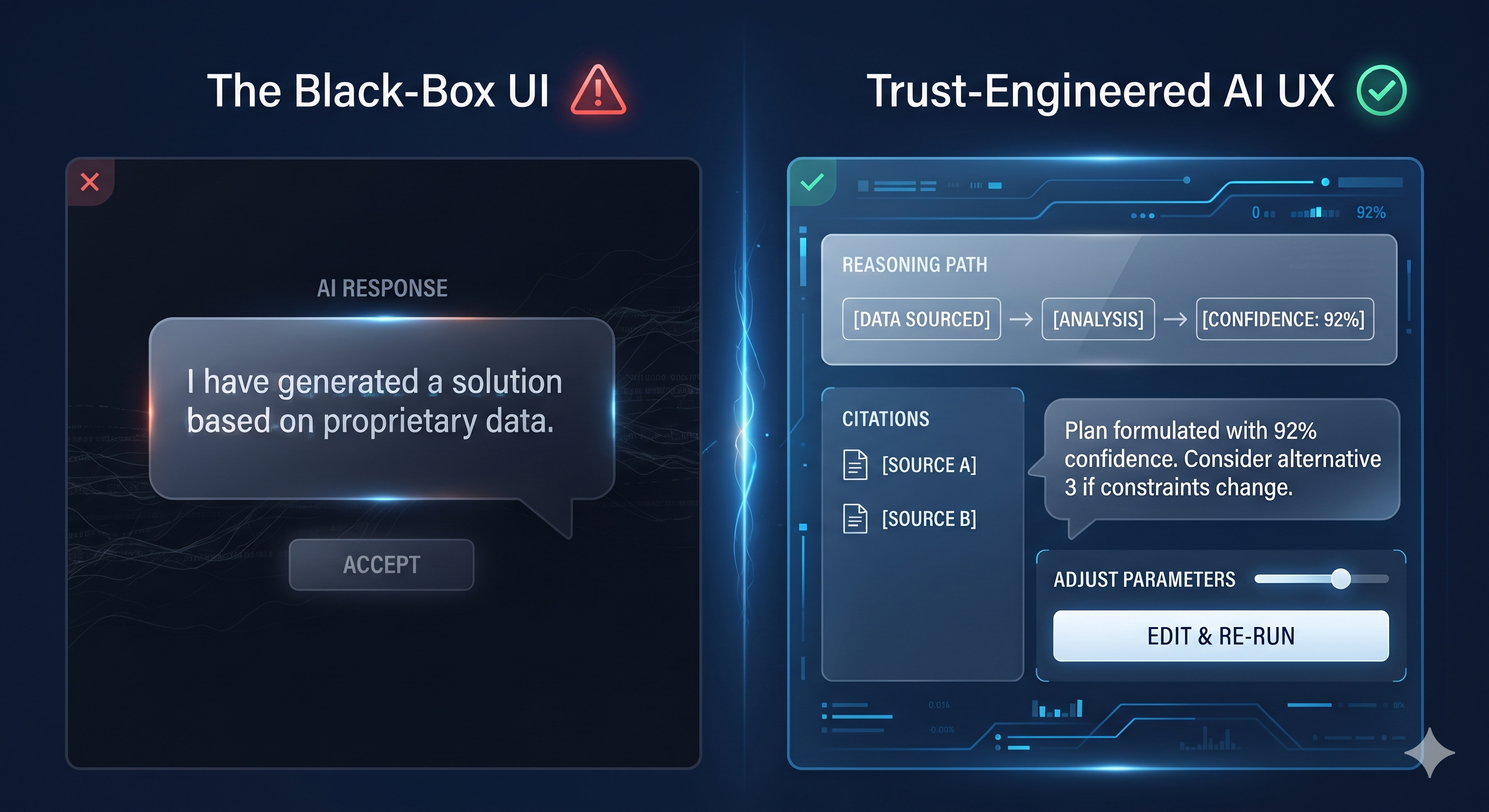
Design Transparency as an Interface: Never present AI output as an absolute, opaque fact. Surface confidence indicators, underlying data sources, and reasoning steps directly in the UI so users can verify decisions at a glance.
Build Explicit Guardrails & Reversal Paths: Give users immediate, low-friction control to edit, roll back, or override autonomous actions. Never trap a user in an automated loop without a manual escape hatch.
Design for Probabilistic Failure States: Traditional apps show error banners when code crashes. AI apps need graceful recovery states for when the model's output is ambiguous, incomplete, or logically flawed.
Discussion Question
How is your product team currently designing for AI transparency and failure recovery? Are you surfacing model confidence cues, or leaving users in the dark?
CTA (Join Product, UX & Design)
Want to master AI-native product strategy, modern UX frameworks, and user psychology for complex systems? Join Product, UX & Design to connect with global product leaders shaping the future of software.
With software rapidly evolving from static forms into autonomous, multi-step agentic workflows, product managers and UX designers face a profound paradigm shift. Traditional UI was built on predictability: click a button, get a guaranteed state change. AI systems, however, are probabilistic. When design systems fail to account for non-determinism, opacity, and confidence gaps, users experience profound cognitive friction and quickly lose trust.
Why It Matters
Industry data shows that the vast majority of AI product drop-offs stem not from model capability limitations, but from poor interface design that fails to communicate system intent. If your interface acts like an oracle instead of a transparent collaborator, users cannot calibrate their trust. Products that fail to expose model confidence, provide granular feedback loops, or offer graceful failure-state recovery will always struggle with long-term retention.
What You Need to Know: Core UX Patterns for AI-Native Products
To build products that users actually trust and adopt, modern product teams must master these interaction patterns:
Design Transparency as an Interface: Never present AI output as an absolute, opaque fact. Surface confidence indicators, underlying data sources, and reasoning steps directly in the UI so users can verify decisions at a glance.
Build Explicit Guardrails & Reversal Paths: Give users immediate, low-friction control to edit, roll back, or override autonomous actions. Never trap a user in an automated loop without a manual escape hatch.
Design for Probabilistic Failure States: Traditional apps show error banners when code crashes. AI apps need graceful recovery states for when the model's output is ambiguous, incomplete, or logically flawed.
Discussion Question
How is your product team currently designing for AI transparency and failure recovery? Are you surfacing model confidence cues, or leaving users in the dark?
CTA (Join Product, UX & Design)
Want to master AI-native product strategy, modern UX frameworks, and user psychology for complex systems? Join Product, UX & Design to connect with global product leaders shaping the future of software.
The Black-Box Trap: Why Designing AI Interfaces Like SaaS Dashboards Destroys User Trust
With software rapidly evolving from static forms into autonomous, multi-step agentic workflows, product managers and UX designers face a profound paradigm shift. Traditional UI was built on predictability: click a button, get a guaranteed state change. AI systems, however, are probabilistic. When design systems fail to account for non-determinism, opacity, and confidence gaps, users experience profound cognitive friction and quickly lose trust.
Why It Matters
Industry data shows that the vast majority of AI product drop-offs stem not from model capability limitations, but from poor interface design that fails to communicate system intent. If your interface acts like an oracle instead of a transparent collaborator, users cannot calibrate their trust. Products that fail to expose model confidence, provide granular feedback loops, or offer graceful failure-state recovery will always struggle with long-term retention.
What You Need to Know: Core UX Patterns for AI-Native Products
To build products that users actually trust and adopt, modern product teams must master these interaction patterns:
Design Transparency as an Interface: Never present AI output as an absolute, opaque fact. Surface confidence indicators, underlying data sources, and reasoning steps directly in the UI so users can verify decisions at a glance.
Build Explicit Guardrails & Reversal Paths: Give users immediate, low-friction control to edit, roll back, or override autonomous actions. Never trap a user in an automated loop without a manual escape hatch.
Design for Probabilistic Failure States: Traditional apps show error banners when code crashes. AI apps need graceful recovery states for when the model's output is ambiguous, incomplete, or logically flawed.
Discussion Question
How is your product team currently designing for AI transparency and failure recovery? Are you surfacing model confidence cues, or leaving users in the dark?
CTA (Join Product, UX & Design)
Want to master AI-native product strategy, modern UX frameworks, and user psychology for complex systems? Join Product, UX & Design to connect with global product leaders shaping the future of software.

 English
 Arabic
 French
 Spanish
 Portuguese
 Deutsch
 Turkish
 Dutch
Dutch
 Russian
 Romaian
 Portuguese (Brazil)
 Greek
Greek