


The Billion-Scale Bottleneck: Why Your System Architecture Crumbles Under India’s Traffic Spikes
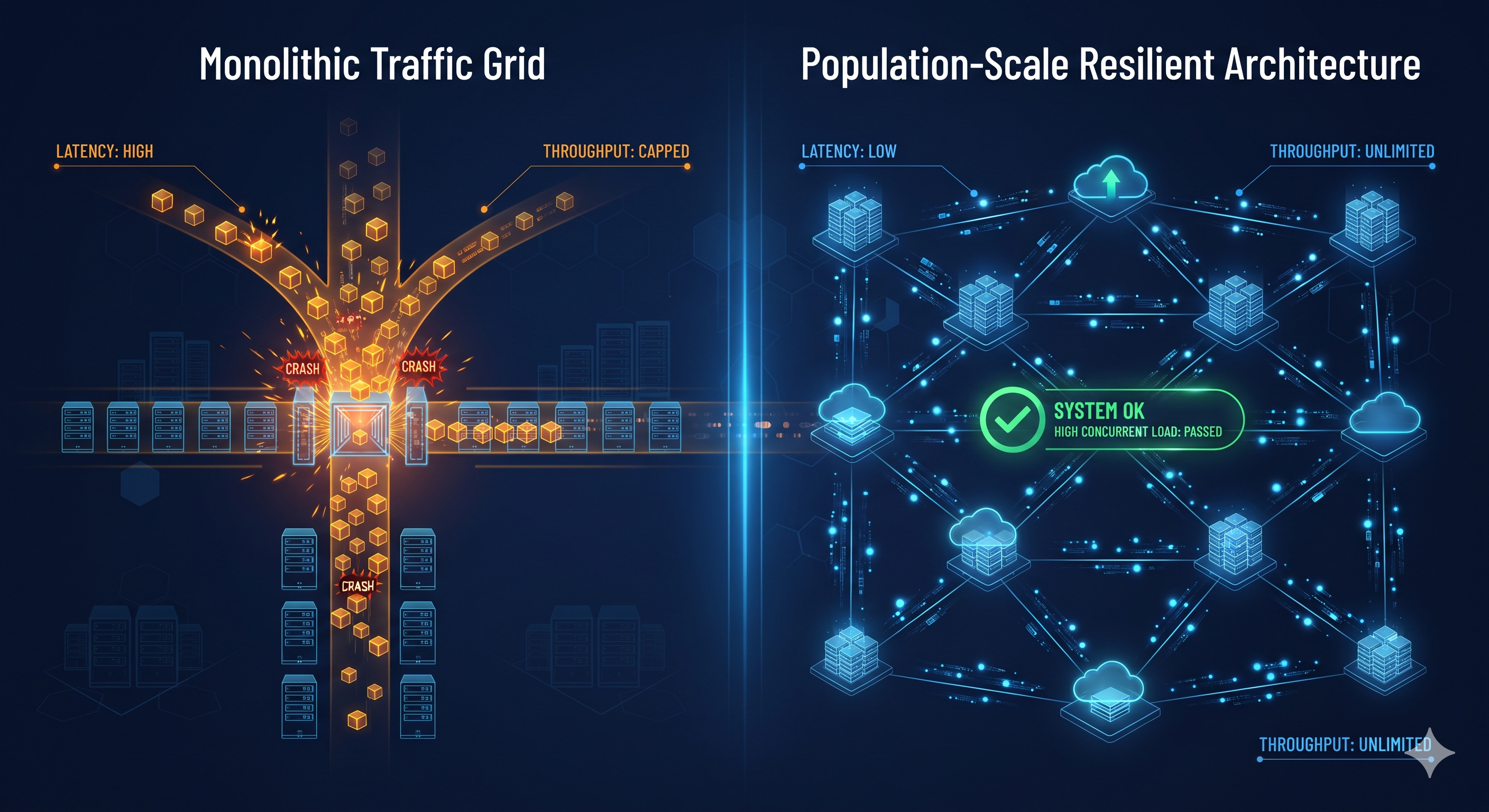
With India’s tech landscape evolving at breakneck speed, engineering teams are no longer building for niche regional cohorts; they are designing for massive, concurrent, population-scale distribution. Whether you're scaling UPI-integrated payment gateways, multi-tenant vertical SaaS, or high-throughput logistics platforms, traditional monolithic architectures and naive database queries hit a hard ceiling the moment real Indian scale hits.
Why It Matters
When concurrency explodes, unoptimized database queries, missing indexes, and unmanaged connection pools turn minor code inefficiencies into catastrophic system crashes. If your backend cannot gracefully handle traffic surges or manage distributed state under extreme load, you aren't just losing users—you are losing market trust in an ecosystem where speed and resilience define category leaders.
What You Need to Know: Engineering for Population-Scale Resilience
To build systems that survive India's heaviest traffic spikes and scale seamlessly, engineering teams must adopt high-performance architectural patterns:
Implement Aggressive Connection Pooling & Caching: Never let raw database requests absorb high-frequency spikes. Put high-speed caching layers (like Redis) in front of your primary database and tightly manage connection limits to prevent thread starvation.
Design for Asynchronous Event-Driven Workflows: Move heavy, non-critical computations (like notifications, report generation, and analytics logging) out of the synchronous request-response cycle using robust message brokers and queue systems (such as Kafka or RabbitMQ).
Load Test Under Realistic Constraints: Don't rely on synthetic staging benchmarks. Simulate erratic network latency, sudden traffic surges, and localized bandwidth constraints to discover where your system breaks before your users do.
Discussion Question
How does your team handle high-concurrency traffic spikes? Are you relying on horizontal auto-scaling, or have you had to redesign your database access patterns from the ground up?
CTA (Join Techawks India)
Want to master high-scale architecture, system design, and cutting-edge engineering practices tailored for the Indian tech ecosystem? Join Techawks India to connect with top-tier engineers building the future.
With India’s tech landscape evolving at breakneck speed, engineering teams are no longer building for niche regional cohorts; they are designing for massive, concurrent, population-scale distribution. Whether you're scaling UPI-integrated payment gateways, multi-tenant vertical SaaS, or high-throughput logistics platforms, traditional monolithic architectures and naive database queries hit a hard ceiling the moment real Indian scale hits.
Why It Matters
When concurrency explodes, unoptimized database queries, missing indexes, and unmanaged connection pools turn minor code inefficiencies into catastrophic system crashes. If your backend cannot gracefully handle traffic surges or manage distributed state under extreme load, you aren't just losing users—you are losing market trust in an ecosystem where speed and resilience define category leaders.
What You Need to Know: Engineering for Population-Scale Resilience
To build systems that survive India's heaviest traffic spikes and scale seamlessly, engineering teams must adopt high-performance architectural patterns:
Implement Aggressive Connection Pooling & Caching: Never let raw database requests absorb high-frequency spikes. Put high-speed caching layers (like Redis) in front of your primary database and tightly manage connection limits to prevent thread starvation.
Design for Asynchronous Event-Driven Workflows: Move heavy, non-critical computations (like notifications, report generation, and analytics logging) out of the synchronous request-response cycle using robust message brokers and queue systems (such as Kafka or RabbitMQ).
Load Test Under Realistic Constraints: Don't rely on synthetic staging benchmarks. Simulate erratic network latency, sudden traffic surges, and localized bandwidth constraints to discover where your system breaks before your users do.
Discussion Question
How does your team handle high-concurrency traffic spikes? Are you relying on horizontal auto-scaling, or have you had to redesign your database access patterns from the ground up?
CTA (Join Techawks India)
Want to master high-scale architecture, system design, and cutting-edge engineering practices tailored for the Indian tech ecosystem? Join Techawks India to connect with top-tier engineers building the future.
The Billion-Scale Bottleneck: Why Your System Architecture Crumbles Under India’s Traffic Spikes
With India’s tech landscape evolving at breakneck speed, engineering teams are no longer building for niche regional cohorts; they are designing for massive, concurrent, population-scale distribution. Whether you're scaling UPI-integrated payment gateways, multi-tenant vertical SaaS, or high-throughput logistics platforms, traditional monolithic architectures and naive database queries hit a hard ceiling the moment real Indian scale hits.
Why It Matters
When concurrency explodes, unoptimized database queries, missing indexes, and unmanaged connection pools turn minor code inefficiencies into catastrophic system crashes. If your backend cannot gracefully handle traffic surges or manage distributed state under extreme load, you aren't just losing users—you are losing market trust in an ecosystem where speed and resilience define category leaders.
What You Need to Know: Engineering for Population-Scale Resilience
To build systems that survive India's heaviest traffic spikes and scale seamlessly, engineering teams must adopt high-performance architectural patterns:
Implement Aggressive Connection Pooling & Caching: Never let raw database requests absorb high-frequency spikes. Put high-speed caching layers (like Redis) in front of your primary database and tightly manage connection limits to prevent thread starvation.
Design for Asynchronous Event-Driven Workflows: Move heavy, non-critical computations (like notifications, report generation, and analytics logging) out of the synchronous request-response cycle using robust message brokers and queue systems (such as Kafka or RabbitMQ).
Load Test Under Realistic Constraints: Don't rely on synthetic staging benchmarks. Simulate erratic network latency, sudden traffic surges, and localized bandwidth constraints to discover where your system breaks before your users do.
Discussion Question
How does your team handle high-concurrency traffic spikes? Are you relying on horizontal auto-scaling, or have you had to redesign your database access patterns from the ground up?
CTA (Join Techawks India)
Want to master high-scale architecture, system design, and cutting-edge engineering practices tailored for the Indian tech ecosystem? Join Techawks India to connect with top-tier engineers building the future.

 English
 Arabic
 French
 Spanish
 Portuguese
 Deutsch
 Turkish
 Dutch
Dutch
 Russian
 Romaian
 Portuguese (Brazil)
 Greek
Greek