


The Pilot-to-Production Trap: Why Your Enterprise AI Strategy Is Stalling Out
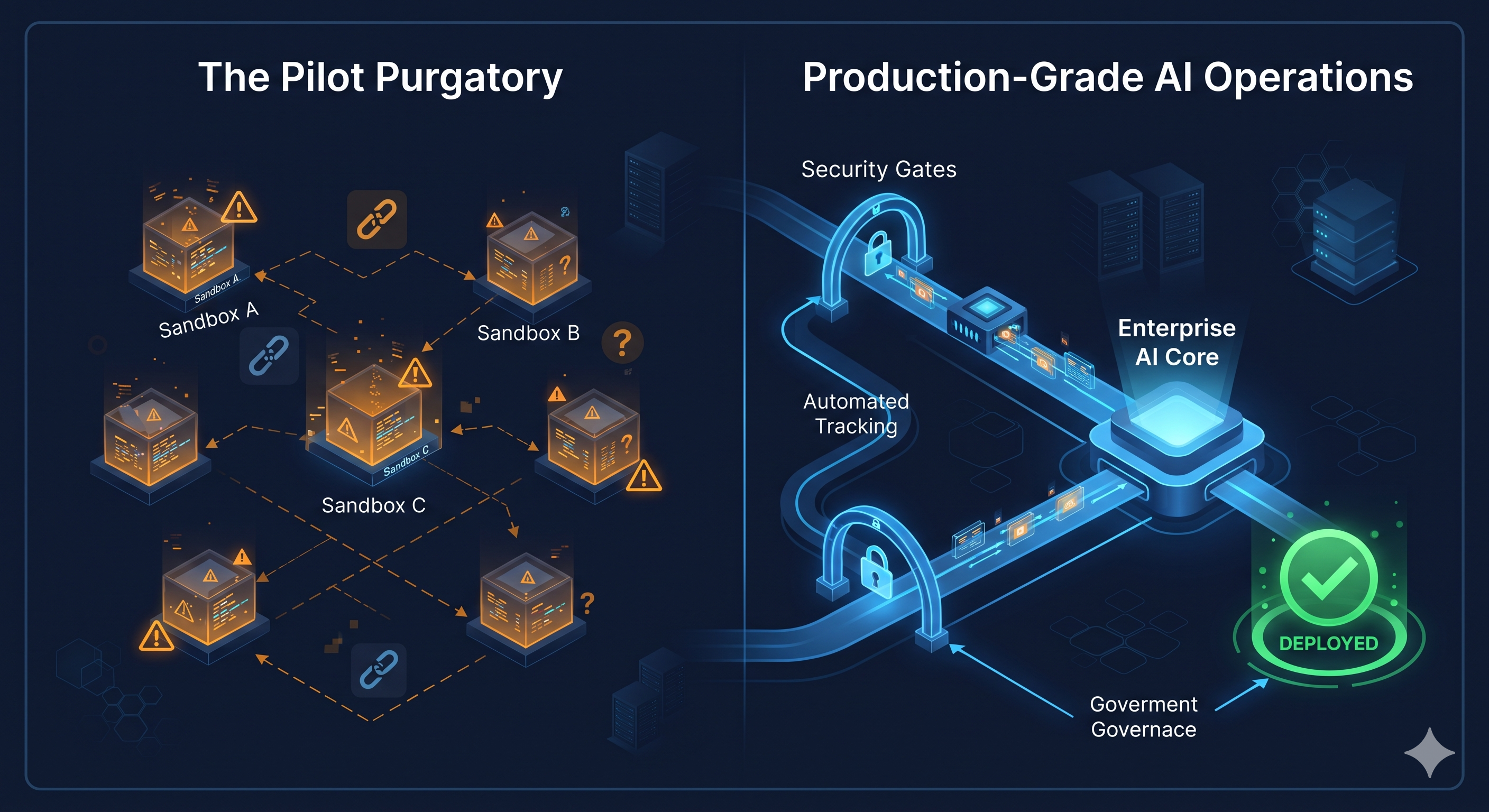
With software ecosystems across Silicon Valley and major US enterprise hubs racing to adopt autonomous agents and generative workflows, a harsh operational reality has set in. Industry data highlights that while a massive percentage of organizations are actively experimenting with AI, only a fraction have successfully transitioned those models into scalable, secure production environments. The blocker isn't model capability; it’s a fundamental failure to redesign workflows around probabilistic systems.
Why It Matters
Deploying an AI copilot as an isolated plugin is easy; transforming core business logic around autonomous agents is an architectural nightmare. When companies simply automate broken or legacy processes instead of rethinking how data, security, and human oversight interact, they invite chaos. Without strict governance, clear ownership of model outputs, and predictable inference cost management, your AI initiatives become expensive experiments that fail to deliver measurable ROI.
What You Need to Know: Bridging the Gap from Pilot to Production
To move beyond the pilot phase and build sustainable AI-native operations, technology leaders must enforce three core disciplines:
Redesign Workflows Before Automating: Stop dropping LLMs on top of messy, manual processes. Isolate single, end-to-end workflows, map every human handoff and exception path, and rebuild the pipeline for AI-first execution.
Establish Explicit Accountability Frameworks: Define who owns an AI-driven decision before it goes live. If an autonomous agent triggers an automated database mutation or customer-facing action, clear audit logs and escalation boundaries must be hardcoded into the architecture.
Optimize Inference Economics: With inference workloads rapidly outpacing training costs, treat compute efficiency as a core engineering metric. Implement aggressive caching, model quantization, and strict routing policies to prevent runaway cloud token expenditure.
Discussion Question
Is your organization successfully scaling AI into production, or are your teams stuck in an endless loop of unscaled pilots and rising cloud bills? What is your biggest bottleneck?
CTA (Join Techawks USA)
Want to connect with US-based engineering leaders, architects, and innovators solving enterprise AI and cloud scale challenges? Join Techawks USA to stay ahead of the curve.
With software ecosystems across Silicon Valley and major US enterprise hubs racing to adopt autonomous agents and generative workflows, a harsh operational reality has set in. Industry data highlights that while a massive percentage of organizations are actively experimenting with AI, only a fraction have successfully transitioned those models into scalable, secure production environments. The blocker isn't model capability; it’s a fundamental failure to redesign workflows around probabilistic systems.
Why It Matters
Deploying an AI copilot as an isolated plugin is easy; transforming core business logic around autonomous agents is an architectural nightmare. When companies simply automate broken or legacy processes instead of rethinking how data, security, and human oversight interact, they invite chaos. Without strict governance, clear ownership of model outputs, and predictable inference cost management, your AI initiatives become expensive experiments that fail to deliver measurable ROI.
What You Need to Know: Bridging the Gap from Pilot to Production
To move beyond the pilot phase and build sustainable AI-native operations, technology leaders must enforce three core disciplines:
Redesign Workflows Before Automating: Stop dropping LLMs on top of messy, manual processes. Isolate single, end-to-end workflows, map every human handoff and exception path, and rebuild the pipeline for AI-first execution.
Establish Explicit Accountability Frameworks: Define who owns an AI-driven decision before it goes live. If an autonomous agent triggers an automated database mutation or customer-facing action, clear audit logs and escalation boundaries must be hardcoded into the architecture.
Optimize Inference Economics: With inference workloads rapidly outpacing training costs, treat compute efficiency as a core engineering metric. Implement aggressive caching, model quantization, and strict routing policies to prevent runaway cloud token expenditure.
Discussion Question
Is your organization successfully scaling AI into production, or are your teams stuck in an endless loop of unscaled pilots and rising cloud bills? What is your biggest bottleneck?
CTA (Join Techawks USA)
Want to connect with US-based engineering leaders, architects, and innovators solving enterprise AI and cloud scale challenges? Join Techawks USA to stay ahead of the curve.
The Pilot-to-Production Trap: Why Your Enterprise AI Strategy Is Stalling Out
With software ecosystems across Silicon Valley and major US enterprise hubs racing to adopt autonomous agents and generative workflows, a harsh operational reality has set in. Industry data highlights that while a massive percentage of organizations are actively experimenting with AI, only a fraction have successfully transitioned those models into scalable, secure production environments. The blocker isn't model capability; it’s a fundamental failure to redesign workflows around probabilistic systems.
Why It Matters
Deploying an AI copilot as an isolated plugin is easy; transforming core business logic around autonomous agents is an architectural nightmare. When companies simply automate broken or legacy processes instead of rethinking how data, security, and human oversight interact, they invite chaos. Without strict governance, clear ownership of model outputs, and predictable inference cost management, your AI initiatives become expensive experiments that fail to deliver measurable ROI.
What You Need to Know: Bridging the Gap from Pilot to Production
To move beyond the pilot phase and build sustainable AI-native operations, technology leaders must enforce three core disciplines:
Redesign Workflows Before Automating: Stop dropping LLMs on top of messy, manual processes. Isolate single, end-to-end workflows, map every human handoff and exception path, and rebuild the pipeline for AI-first execution.
Establish Explicit Accountability Frameworks: Define who owns an AI-driven decision before it goes live. If an autonomous agent triggers an automated database mutation or customer-facing action, clear audit logs and escalation boundaries must be hardcoded into the architecture.
Optimize Inference Economics: With inference workloads rapidly outpacing training costs, treat compute efficiency as a core engineering metric. Implement aggressive caching, model quantization, and strict routing policies to prevent runaway cloud token expenditure.
Discussion Question
Is your organization successfully scaling AI into production, or are your teams stuck in an endless loop of unscaled pilots and rising cloud bills? What is your biggest bottleneck?
CTA (Join Techawks USA)
Want to connect with US-based engineering leaders, architects, and innovators solving enterprise AI and cloud scale challenges? Join Techawks USA to stay ahead of the curve.

 English
 Arabic
 French
 Spanish
 Portuguese
 Turkish
 Dutch
Dutch
 Italiano
 Russian
 Romaian
 Portuguese (Brazil)
 Greek
Greek