


The Sovereign Cloud Trap: Why Multi-Region AI Pipelines Are Violating UAE Compliance
With the UAE's data center market surging past billions in investments and powering dense GPU clusters for high-performance AI workloads, regional engineering standards have fundamentally evolved. Government digital transformation mandates, Central Bank regulations, and stricter frameworks around sovereign data residency dictate that sensitive, confidential, and government-class data must remain localized and heavily governed.
Why It Matters
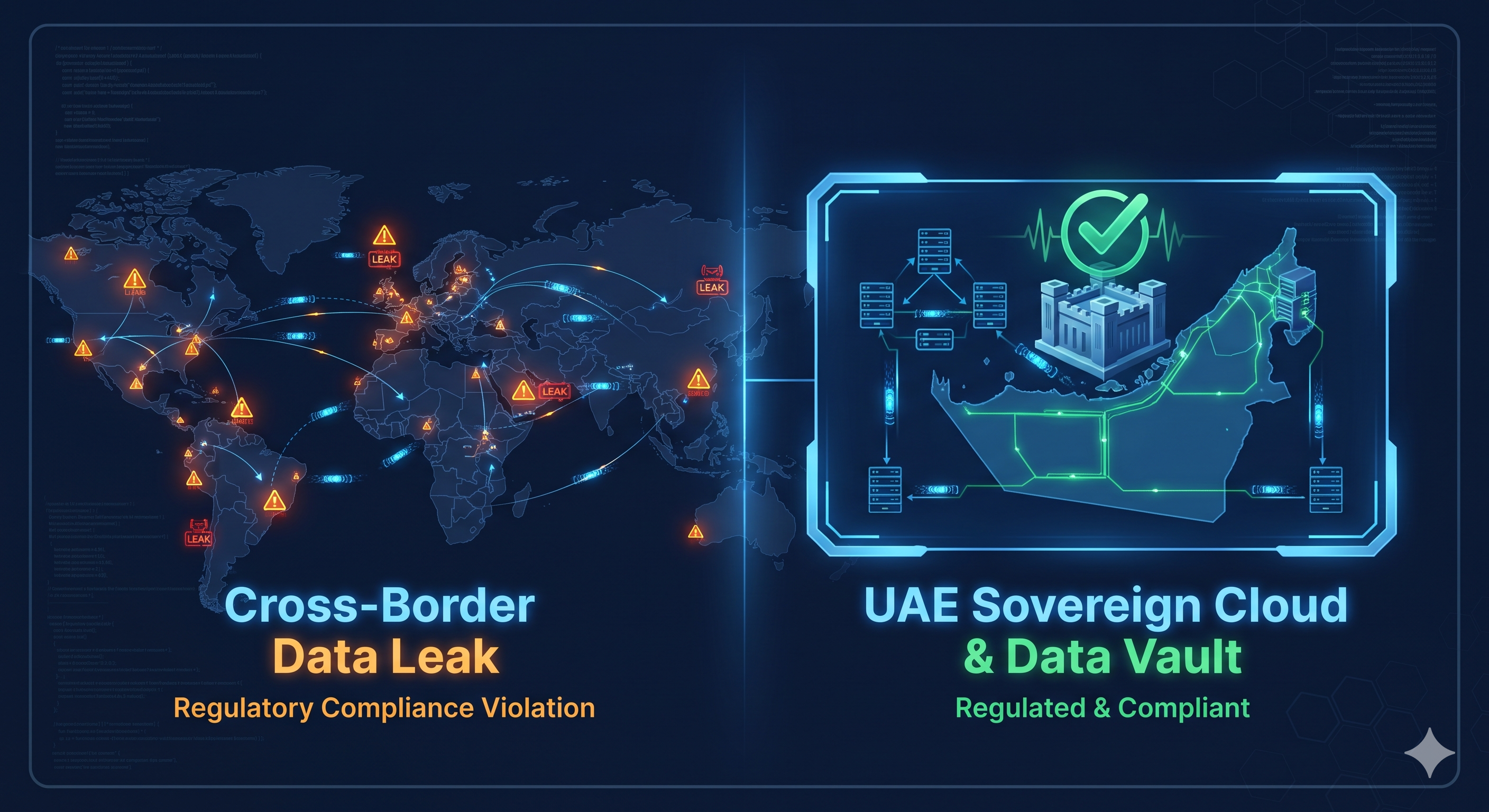
When software architectures rely on global multi-region endpoints without enforcing strict data residency boundaries, you expose your organization to regulatory penalties, failed security audits, and lost enterprise contracts. Data sovereignty isn't just about where your primary database sits; it includes logging, telemetry, backup snapshots, and secondary API routing. If data crosses an unauthorized boundary during inference or caching, your compliance posture breaks instantly.
What You Need to Know: Engineering for UAE Data Sovereignty
To keep your tech stack fully compliant while scaling modern AI and cloud architectures in the UAE, engineering teams must implement strict residency controls:
Deploy Inside Domestic Sovereign Regions: Leverage dedicated local cloud availability zones (such as UAE-based sovereign cloud infrastructure) to ensure all compute and storage nodes reside physically within the country.
Enforce Hard Geographic Boundaries: Configure cloud policy controls and network routing tables to explicitly block resource creation or data replication outside approved domestic regions. Never let global billing or telemetry services silently leak data cross-border.
Isolate AI Inference and Token Logging: When integrating LLMs and agentic pipelines, ensure prompt payloads, completion logs, and vector embeddings are stored within local data vaults rather than streaming to external global multi-tenant endpoints.
Discussion Question
How is your engineering team auditing data residency across your cloud and AI pipelines? Are you enforcing strict local routing, or are global third-party APIs creating compliance blind spots?
CTA (Join Techawks UAE)
Want to connect with UAE-based tech leaders, cloud architects, and engineers building the future of sovereign AI and infrastructure? Join Techawks UAE to stay ahead of the curve.
With the UAE's data center market surging past billions in investments and powering dense GPU clusters for high-performance AI workloads, regional engineering standards have fundamentally evolved. Government digital transformation mandates, Central Bank regulations, and stricter frameworks around sovereign data residency dictate that sensitive, confidential, and government-class data must remain localized and heavily governed.
Why It Matters
When software architectures rely on global multi-region endpoints without enforcing strict data residency boundaries, you expose your organization to regulatory penalties, failed security audits, and lost enterprise contracts. Data sovereignty isn't just about where your primary database sits; it includes logging, telemetry, backup snapshots, and secondary API routing. If data crosses an unauthorized boundary during inference or caching, your compliance posture breaks instantly.
What You Need to Know: Engineering for UAE Data Sovereignty
To keep your tech stack fully compliant while scaling modern AI and cloud architectures in the UAE, engineering teams must implement strict residency controls:
Deploy Inside Domestic Sovereign Regions: Leverage dedicated local cloud availability zones (such as UAE-based sovereign cloud infrastructure) to ensure all compute and storage nodes reside physically within the country.
Enforce Hard Geographic Boundaries: Configure cloud policy controls and network routing tables to explicitly block resource creation or data replication outside approved domestic regions. Never let global billing or telemetry services silently leak data cross-border.
Isolate AI Inference and Token Logging: When integrating LLMs and agentic pipelines, ensure prompt payloads, completion logs, and vector embeddings are stored within local data vaults rather than streaming to external global multi-tenant endpoints.
Discussion Question
How is your engineering team auditing data residency across your cloud and AI pipelines? Are you enforcing strict local routing, or are global third-party APIs creating compliance blind spots?
CTA (Join Techawks UAE)
Want to connect with UAE-based tech leaders, cloud architects, and engineers building the future of sovereign AI and infrastructure? Join Techawks UAE to stay ahead of the curve.
The Sovereign Cloud Trap: Why Multi-Region AI Pipelines Are Violating UAE Compliance
With the UAE's data center market surging past billions in investments and powering dense GPU clusters for high-performance AI workloads, regional engineering standards have fundamentally evolved. Government digital transformation mandates, Central Bank regulations, and stricter frameworks around sovereign data residency dictate that sensitive, confidential, and government-class data must remain localized and heavily governed.
Why It Matters
When software architectures rely on global multi-region endpoints without enforcing strict data residency boundaries, you expose your organization to regulatory penalties, failed security audits, and lost enterprise contracts. Data sovereignty isn't just about where your primary database sits; it includes logging, telemetry, backup snapshots, and secondary API routing. If data crosses an unauthorized boundary during inference or caching, your compliance posture breaks instantly.
What You Need to Know: Engineering for UAE Data Sovereignty
To keep your tech stack fully compliant while scaling modern AI and cloud architectures in the UAE, engineering teams must implement strict residency controls:
Deploy Inside Domestic Sovereign Regions: Leverage dedicated local cloud availability zones (such as UAE-based sovereign cloud infrastructure) to ensure all compute and storage nodes reside physically within the country.
Enforce Hard Geographic Boundaries: Configure cloud policy controls and network routing tables to explicitly block resource creation or data replication outside approved domestic regions. Never let global billing or telemetry services silently leak data cross-border.
Isolate AI Inference and Token Logging: When integrating LLMs and agentic pipelines, ensure prompt payloads, completion logs, and vector embeddings are stored within local data vaults rather than streaming to external global multi-tenant endpoints.
Discussion Question
How is your engineering team auditing data residency across your cloud and AI pipelines? Are you enforcing strict local routing, or are global third-party APIs creating compliance blind spots?
CTA (Join Techawks UAE)
Want to connect with UAE-based tech leaders, cloud architects, and engineers building the future of sovereign AI and infrastructure? Join Techawks UAE to stay ahead of the curve.

 English
 Arabic
 French
 Spanish
 Portuguese
 Deutsch
 Turkish
 Dutch
Dutch
 Russian
 Romaian
 Portuguese (Brazil)
 Greek
Greek