


The Consent Illusion: Why Your Canadian Data Architecture Will Fail a Strict Privacy Audit
With Canadian engineering teams building increasingly complex software stacks—integrating third-party analytics, customer data platforms, and automated decision-making tools—data governance has shifted from a legal afterthought to an active engineering challenge. Regulations across Canadian jurisdictions demand radical transparency around how personal information is collected, retained, and transferred.
Why It Matters
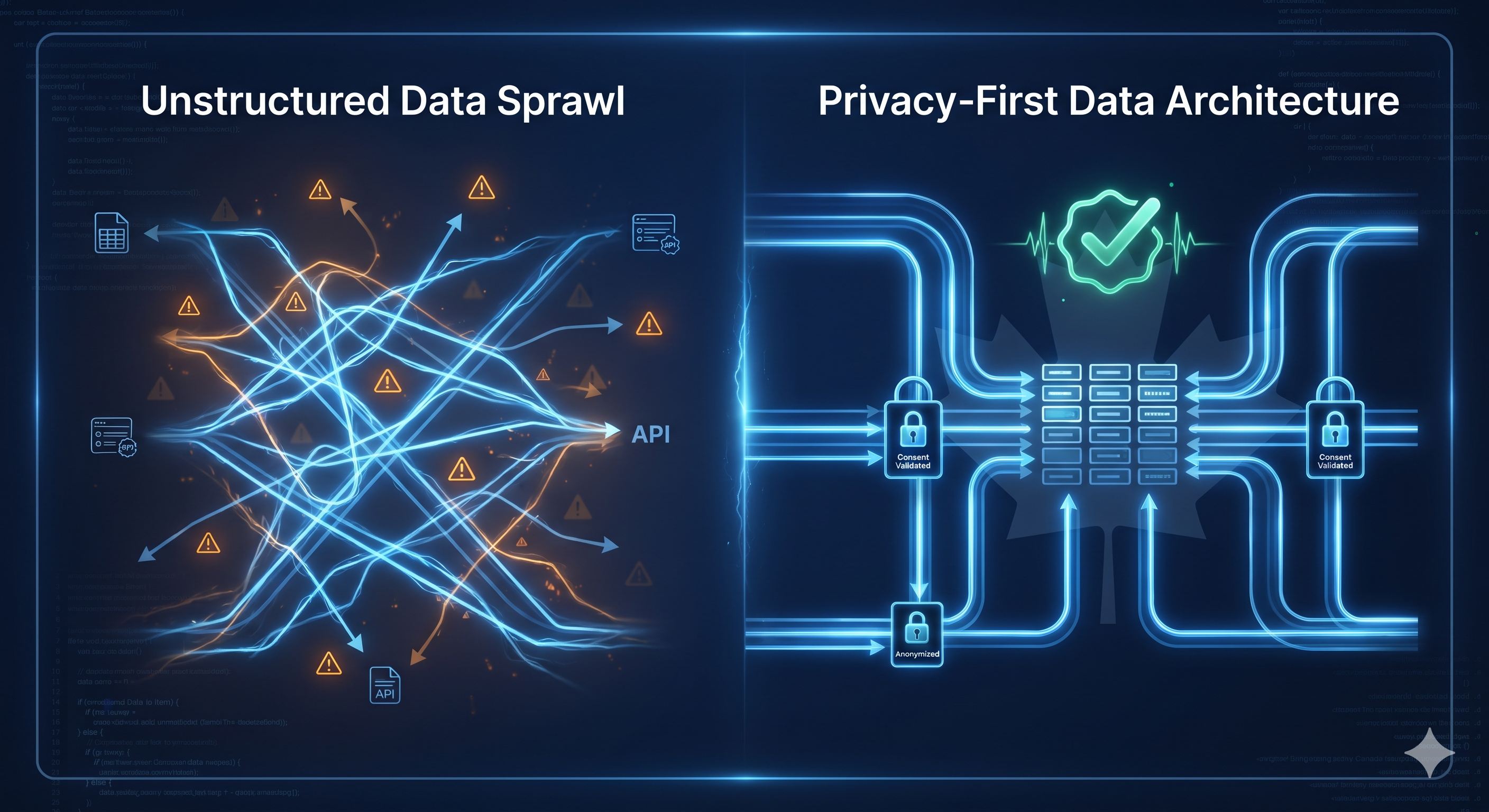
When data collection is decentralized across multiple microservices without a unified governance layer, tracking consent withdrawal, data portability requests, or retention limits becomes nearly impossible. If your architecture cannot programmatically isolate, delete, or anonymize user information upon request, your organization faces severe regulatory friction, steep penalties, and a rapid erosion of user trust.
What You Need to Know: Engineering for Canadian Data Compliance
To build resilient, privacy-forward applications that stand up to modern regulatory standards, development teams must enforce core data practices:
Map Your Data Lifecycles Programmatically: You cannot protect what you haven't inventoried. Build automated data-mapping scripts to trace where personal information enters your system, how it flows between services, and where storage snapshots reside.
Implement Granular Consent and Opt-In Workflows: Move away from ambiguous, bundled terms of service. Implement explicit, trackable consent management states that allow users to withdraw permission or request data disposal seamlessly.
Automate Data Minimization and Anonymization: Never store raw personal data longer than necessary. Strip identifiers early in your ingestion pipeline, and ensure non-production environments (like staging and testing clusters) use synthetic or anonymized data sets.
Discussion Question
How does your engineering team handle data disposal and consent tracking across your microservices? Are you managing privacy compliance through code, or relying on manual documentation?
CTA (Join Techawks Canada)
Want to connect with Canadian tech leaders, software architects, and engineers solving data governance and cloud scale challenges? Join Techawks Canada to stay ahead of the curve.
With Canadian engineering teams building increasingly complex software stacks—integrating third-party analytics, customer data platforms, and automated decision-making tools—data governance has shifted from a legal afterthought to an active engineering challenge. Regulations across Canadian jurisdictions demand radical transparency around how personal information is collected, retained, and transferred.
Why It Matters
When data collection is decentralized across multiple microservices without a unified governance layer, tracking consent withdrawal, data portability requests, or retention limits becomes nearly impossible. If your architecture cannot programmatically isolate, delete, or anonymize user information upon request, your organization faces severe regulatory friction, steep penalties, and a rapid erosion of user trust.
What You Need to Know: Engineering for Canadian Data Compliance
To build resilient, privacy-forward applications that stand up to modern regulatory standards, development teams must enforce core data practices:
Map Your Data Lifecycles Programmatically: You cannot protect what you haven't inventoried. Build automated data-mapping scripts to trace where personal information enters your system, how it flows between services, and where storage snapshots reside.
Implement Granular Consent and Opt-In Workflows: Move away from ambiguous, bundled terms of service. Implement explicit, trackable consent management states that allow users to withdraw permission or request data disposal seamlessly.
Automate Data Minimization and Anonymization: Never store raw personal data longer than necessary. Strip identifiers early in your ingestion pipeline, and ensure non-production environments (like staging and testing clusters) use synthetic or anonymized data sets.
Discussion Question
How does your engineering team handle data disposal and consent tracking across your microservices? Are you managing privacy compliance through code, or relying on manual documentation?
CTA (Join Techawks Canada)
Want to connect with Canadian tech leaders, software architects, and engineers solving data governance and cloud scale challenges? Join Techawks Canada to stay ahead of the curve.
The Consent Illusion: Why Your Canadian Data Architecture Will Fail a Strict Privacy Audit
With Canadian engineering teams building increasingly complex software stacks—integrating third-party analytics, customer data platforms, and automated decision-making tools—data governance has shifted from a legal afterthought to an active engineering challenge. Regulations across Canadian jurisdictions demand radical transparency around how personal information is collected, retained, and transferred.
Why It Matters
When data collection is decentralized across multiple microservices without a unified governance layer, tracking consent withdrawal, data portability requests, or retention limits becomes nearly impossible. If your architecture cannot programmatically isolate, delete, or anonymize user information upon request, your organization faces severe regulatory friction, steep penalties, and a rapid erosion of user trust.
What You Need to Know: Engineering for Canadian Data Compliance
To build resilient, privacy-forward applications that stand up to modern regulatory standards, development teams must enforce core data practices:
Map Your Data Lifecycles Programmatically: You cannot protect what you haven't inventoried. Build automated data-mapping scripts to trace where personal information enters your system, how it flows between services, and where storage snapshots reside.
Implement Granular Consent and Opt-In Workflows: Move away from ambiguous, bundled terms of service. Implement explicit, trackable consent management states that allow users to withdraw permission or request data disposal seamlessly.
Automate Data Minimization and Anonymization: Never store raw personal data longer than necessary. Strip identifiers early in your ingestion pipeline, and ensure non-production environments (like staging and testing clusters) use synthetic or anonymized data sets.
Discussion Question
How does your engineering team handle data disposal and consent tracking across your microservices? Are you managing privacy compliance through code, or relying on manual documentation?
CTA (Join Techawks Canada)
Want to connect with Canadian tech leaders, software architects, and engineers solving data governance and cloud scale challenges? Join Techawks Canada to stay ahead of the curve.

 Arabic
 French
 Spanish
 Portuguese
 Deutsch
 Turkish
 Dutch
Dutch
 Italiano
 Russian
 Romaian
 Portuguese (Brazil)
 Greek
Greek