


The Death of Blind Autocomplete: Why the Next Era of Coding Requires Model Context Protocols (MCP)
Modern software engineering has moved past simple text prediction. When building complex distributed systems, AI tools fail not because of weak underlying models, but because of context starvation.
Without secure, standardized access to your database schemas, internal CLI tools, and runtime logs, AI tools operate in a vacuum—forcing developers to constantly copy-paste error logs and boilerplate context.
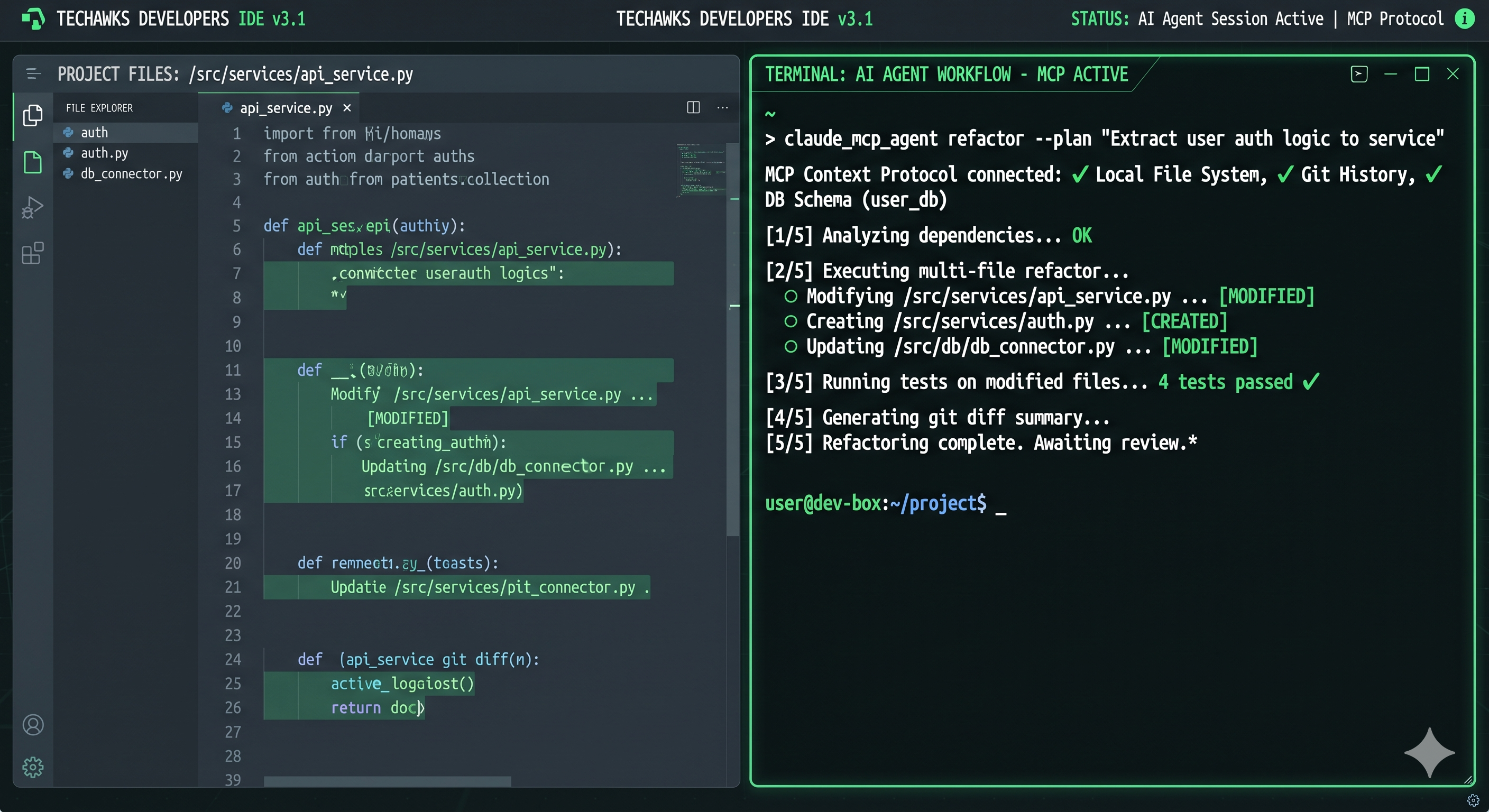
Enter Model Context Protocol (MCP) and multi-file agent workflows. Instead of treating AI as an isolated plugin, modern development pipelines treat it as an integrated system layer capable of inspecting file trees, executing terminal commands safely, and querying external data structures through explicit, standardized interfaces.
What you need to implement in your workflow:
Move to Review-First Agentic Loops: Never give an agent unverified write access. Use a review-first pattern where the agent outlines a multi-file migration plan or refactoring script before modifying your codebase.
Standardize Context via Protocols: Adopt secure server-client bridges (like MCP) to give your terminal agents read-only access to your local databases, API docs, and environment variables without leaking credentials.
Isolate Execution Boundaries: Always run agent-driven shell commands and code executions inside containerized or sandboxed environments to catch unintended side effects early.
Discussion Question
Are you integrating multi-file coding agents and context protocols into your local dev environment yet, or are you still relying primarily on traditional line-by-line autocomplete extensions?
CTA (Join Developers & Coding)
Ready to build faster, master modern coding workflows, and stay at the cutting edge of software architecture? Join Developers & Coding today and collaborate with top-tier engineers.
The Death of Blind Autocomplete: Why the Next Era of Coding Requires Model Context Protocols (MCP)
Modern software engineering has moved past simple text prediction. When building complex distributed systems, AI tools fail not because of weak underlying models, but because of context starvation.
Without secure, standardized access to your database schemas, internal CLI tools, and runtime logs, AI tools operate in a vacuum—forcing developers to constantly copy-paste error logs and boilerplate context.
Enter Model Context Protocol (MCP) and multi-file agent workflows. Instead of treating AI as an isolated plugin, modern development pipelines treat it as an integrated system layer capable of inspecting file trees, executing terminal commands safely, and querying external data structures through explicit, standardized interfaces.
What you need to implement in your workflow:
Move to Review-First Agentic Loops: Never give an agent unverified write access. Use a review-first pattern where the agent outlines a multi-file migration plan or refactoring script before modifying your codebase.
Standardize Context via Protocols: Adopt secure server-client bridges (like MCP) to give your terminal agents read-only access to your local databases, API docs, and environment variables without leaking credentials.
Isolate Execution Boundaries: Always run agent-driven shell commands and code executions inside containerized or sandboxed environments to catch unintended side effects early.
Discussion Question
Are you integrating multi-file coding agents and context protocols into your local dev environment yet, or are you still relying primarily on traditional line-by-line autocomplete extensions?
CTA (Join Developers & Coding)
Ready to build faster, master modern coding workflows, and stay at the cutting edge of software architecture? Join Developers & Coding today and collaborate with top-tier engineers.

 English
 Arabic
 French
 Spanish
 Deutsch
 Turkish
 Dutch
 Italiano
 Russian
 Romaian
 Portuguese (Brazil)
 Greek