


The Power Grid Bottleneck: Why US Tech Innovation Is Facing a Megawatt Crisis
As Big Four hyperscalers and enterprise AI providers push capital expenditures past historical records to build out massive AI inference factories, they have run into an immovable physical wall: the US power grid.
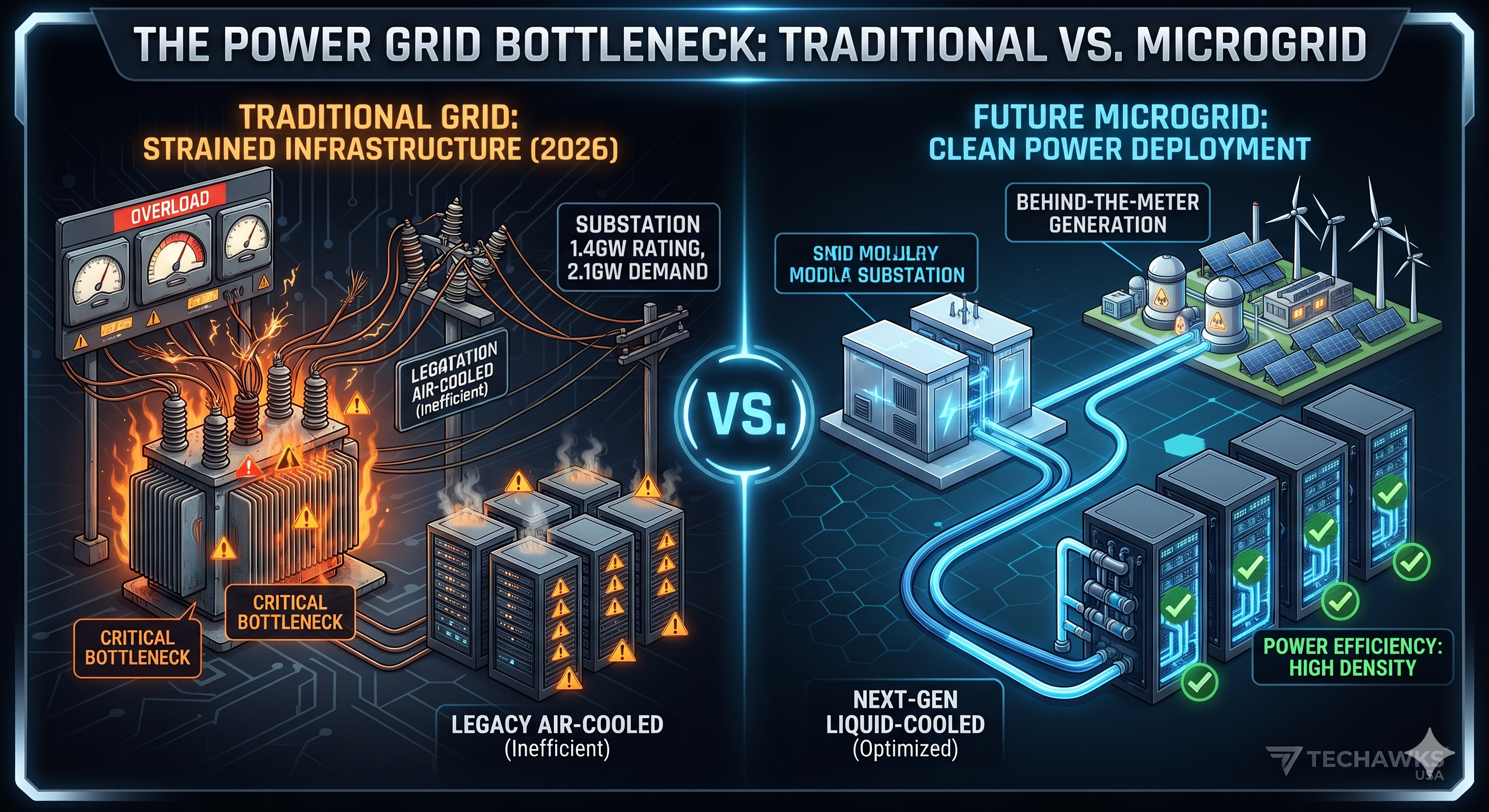
With data center electricity demand surging and lead times for large power sub-station transformers stretching past two years, energy availability has officially replaced software talent as the primary bottleneck for tech growth. Facilities that once required a few megawatts now demand hundreds, forcing the industry into an aggressive infrastructure pivot.
What you need to understand about the infrastructure shift:
The Rise of Behind-the-Meter Power: To bypass grid congestion and lengthy utility interconnection queues, leading tech campuses are increasingly investing in direct nuclear and clean energy microgrid partnerships.
Liquid Cooling and Rack Density: With upcoming high-density server racks drawing hundreds of kilowatts, traditional air cooling is obsolete. Engineering teams must redesign software workloads around liquid-cooled, high-voltage data center architectures.
Inference Efficiency as Cost Control: As power constraints drive up operational costs, writing unoptimized, bloated code is no longer just bad practice—it's an economic liability. Efficiency is the new scale.
Discussion Question
How is your engineering or infrastructure team adapting to rising energy constraints and changing cloud economics? Are you seeing power bottlenecks affect your deployment timelines?
CTA (Join Techawks USA)
Ready to build resilient architectures, stay ahead of national tech trends, and connect with top-tier US engineers and innovators? Join Techawks USA today and shape the future of American technology.
The Power Grid Bottleneck: Why US Tech Innovation Is Facing a Megawatt Crisis
As Big Four hyperscalers and enterprise AI providers push capital expenditures past historical records to build out massive AI inference factories, they have run into an immovable physical wall: the US power grid.
With data center electricity demand surging and lead times for large power sub-station transformers stretching past two years, energy availability has officially replaced software talent as the primary bottleneck for tech growth. Facilities that once required a few megawatts now demand hundreds, forcing the industry into an aggressive infrastructure pivot.
What you need to understand about the infrastructure shift:
The Rise of Behind-the-Meter Power: To bypass grid congestion and lengthy utility interconnection queues, leading tech campuses are increasingly investing in direct nuclear and clean energy microgrid partnerships.
Liquid Cooling and Rack Density: With upcoming high-density server racks drawing hundreds of kilowatts, traditional air cooling is obsolete. Engineering teams must redesign software workloads around liquid-cooled, high-voltage data center architectures.
Inference Efficiency as Cost Control: As power constraints drive up operational costs, writing unoptimized, bloated code is no longer just bad practice—it's an economic liability. Efficiency is the new scale.
Discussion Question
How is your engineering or infrastructure team adapting to rising energy constraints and changing cloud economics? Are you seeing power bottlenecks affect your deployment timelines?
CTA (Join Techawks USA)
Ready to build resilient architectures, stay ahead of national tech trends, and connect with top-tier US engineers and innovators? Join Techawks USA today and shape the future of American technology.

 English
 Arabic
 French
 Spanish
 Portuguese
 Deutsch
 Turkish
 Dutch
 Russian
 Romaian
 Portuguese (Brazil)
 Greek