


The Illusion of the Offshore Sandbox: Why Canadian Tech Scaling Demands Domestic Compute and Data Sovereignty
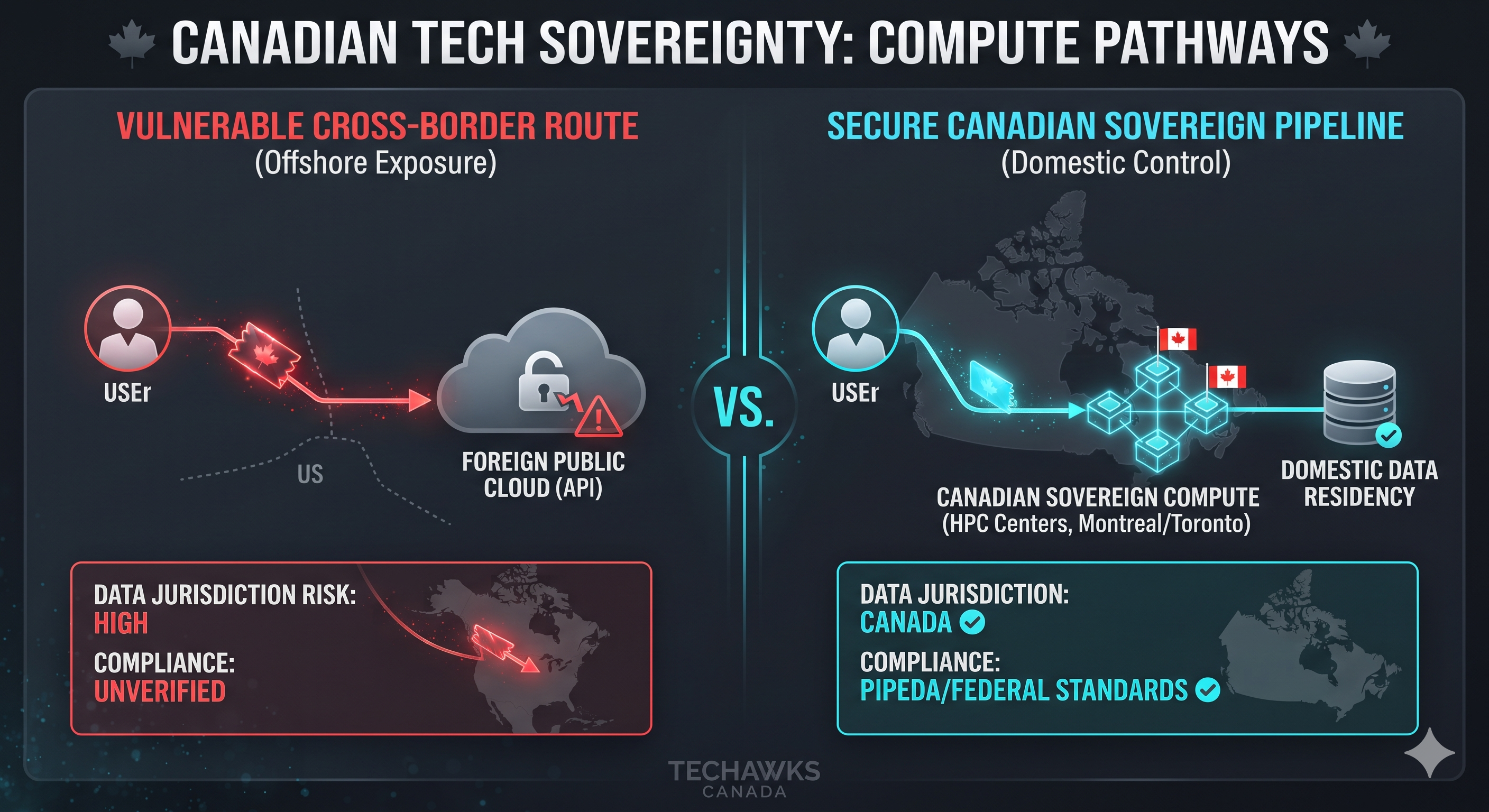
Canada has long punched above its weight class as a global powerhouse for foundational AI research and elite technical talent. Yet, for years, Canadian companies faced a frustrating structural bottleneck: scaling local innovations meant relying heavily on foreign cloud infrastructure and cross-border data pipelines.
With the rollout of domestic initiatives like the AI Sovereign Compute Infrastructure Program (SCIP) and modernized federal data frameworks, the paradigm is shifting. Sovereign control over where your AI models train, where your data rests, and how your systems process personal information is no longer just a legal preference—it's a core competitive moat.
What you need to implement in your architecture right now:
Enforce Strict Data Residency by Design: Audit your cloud stack today. Ensure that data ingestion, model fine-tuning, and token inference execute entirely within verified Canadian data center regions to comply with federal and provincial privacy laws.
Leverage Sovereign Compute Pipelines: Align your long-term infrastructure scaling plans with domestic high-performance computing (HPC) centers and national research networks rather than depending exclusively on foreign hyperscalers.
Maintain Unified AI Inventories: Build a living register of every model, third-party API, and dataset in your pipeline to easily satisfy emerging Canadian compliance guidelines and audit standards.
Discussion Question
Is your Canadian engineering team actively transitioning workloads to domestic sovereign cloud infrastructure, or are your core AI pipelines still dependent on foreign-hosted endpoints?
CTA (Join Techawks Canada)
Ready to build resilient architectures, navigate the future of Canadian tech sovereignty, and connect with top-tier builders across the country? Join Techawks Canada today and scale your impact.
The Illusion of the Offshore Sandbox: Why Canadian Tech Scaling Demands Domestic Compute and Data Sovereignty
Canada has long punched above its weight class as a global powerhouse for foundational AI research and elite technical talent. Yet, for years, Canadian companies faced a frustrating structural bottleneck: scaling local innovations meant relying heavily on foreign cloud infrastructure and cross-border data pipelines.
With the rollout of domestic initiatives like the AI Sovereign Compute Infrastructure Program (SCIP) and modernized federal data frameworks, the paradigm is shifting. Sovereign control over where your AI models train, where your data rests, and how your systems process personal information is no longer just a legal preference—it's a core competitive moat.
What you need to implement in your architecture right now:
Enforce Strict Data Residency by Design: Audit your cloud stack today. Ensure that data ingestion, model fine-tuning, and token inference execute entirely within verified Canadian data center regions to comply with federal and provincial privacy laws.
Leverage Sovereign Compute Pipelines: Align your long-term infrastructure scaling plans with domestic high-performance computing (HPC) centers and national research networks rather than depending exclusively on foreign hyperscalers.
Maintain Unified AI Inventories: Build a living register of every model, third-party API, and dataset in your pipeline to easily satisfy emerging Canadian compliance guidelines and audit standards.
Discussion Question
Is your Canadian engineering team actively transitioning workloads to domestic sovereign cloud infrastructure, or are your core AI pipelines still dependent on foreign-hosted endpoints?
CTA (Join Techawks Canada)
Ready to build resilient architectures, navigate the future of Canadian tech sovereignty, and connect with top-tier builders across the country? Join Techawks Canada today and scale your impact.

 Arabic
 French
 Spanish
 Portuguese
 Deutsch
 Turkish
 Dutch
 Italiano
 Russian
 Romaian
 Portuguese (Brazil)
 Greek