


The 5-Step RAG Optimization Guide: Stop Hallucinations in Production
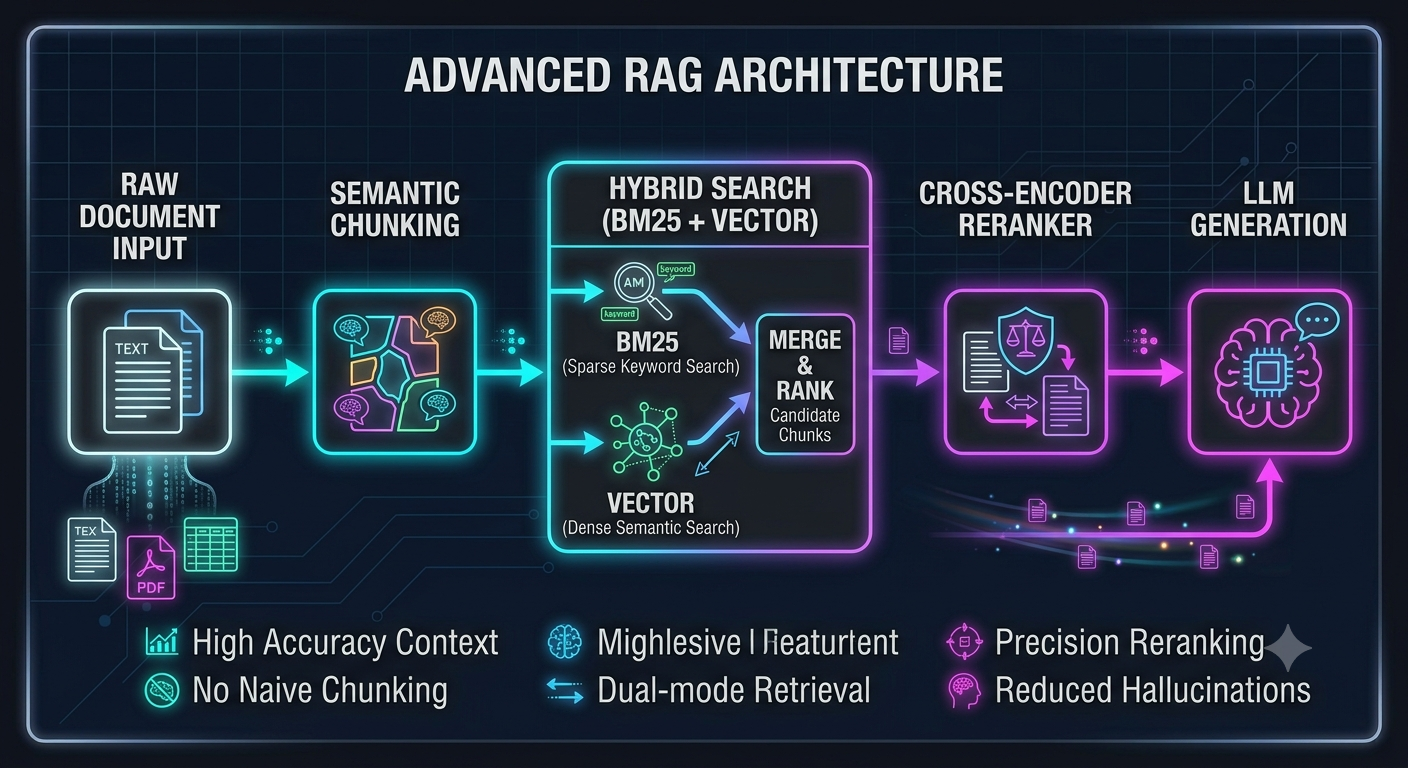
Building a robust RAG pipeline requires moving beyond simple naive retrieval (splitting text every 500 characters and querying a vector store). To build production-grade AI systems that deliver accurate, contextual responses, implement these five advanced RAG optimizations:
Semantic Chunking Over Fixed-Size Chunking
The Problem: Fixed token lengths slice through coherent paragraphs and split critical context mid-sentence.
The Fix: Group text by semantic similarity using embedding distances between sentences or leverage document structure (headers, markdown, code blocks) to preserve complete thoughts.
Hybrid Search (Dense + Sparse Retrieval)
The Problem: Dense vector embeddings excel at semantic intent but often fail with exact matches (part numbers, specific proper nouns, or code snippets).
The Fix: Combine dense vector search with sparse keyword search (BM25) using Reciprocal Rank Fusion (RRF) to get the best of both worlds.
Reranking with Cross-Encoders
The Problem: Top-$K$ vector retrieval brings back similar documents, but not necessarily the most relevant answers.
The Fix: Pass your top 20–50 retrieved chunks through a dedicated cross-encoder reranking model (like Cohere Rerank or BGE-Reranker) to score precision before sending context to your LLM.
Query Transformation & Rewriting
The Problem: Raw user queries are often ambiguous, vague, or conversational, making direct vector search inefficient.
The Fix: Use a fast, lightweight LLM step to rewrite queries, break complex multi-part questions into sub-queries, or generate hypothetical answers (HyDE) to embed instead of the question.
Context Compression & Pruning
The Problem: Stuffing irrelevant retrieved chunks into the prompt window increases latency, elevates API costs, and causes the LLM to miss key details due to "lost in the middle" phenomena.
The Fix: Filter out low-confidence chunks post-reranking and summarize or extract only the essential sentences required to answer the query.
Key Takeaways
Naive RAG isn't enough: Production systems require multi-stage pipelines.
Hybrid Search + Reranking yields the highest accuracy bump for the lowest engineering lift.
Filter context early: Less irrelevant context leads to fewer LLM hallucinations and lower token costs.
CTA
Ready to build reliable, production-ready AI applications alongside fellow engineers?
Building a robust RAG pipeline requires moving beyond simple naive retrieval (splitting text every 500 characters and querying a vector store). To build production-grade AI systems that deliver accurate, contextual responses, implement these five advanced RAG optimizations:
Semantic Chunking Over Fixed-Size Chunking
The Problem: Fixed token lengths slice through coherent paragraphs and split critical context mid-sentence.
The Fix: Group text by semantic similarity using embedding distances between sentences or leverage document structure (headers, markdown, code blocks) to preserve complete thoughts.
Hybrid Search (Dense + Sparse Retrieval)
The Problem: Dense vector embeddings excel at semantic intent but often fail with exact matches (part numbers, specific proper nouns, or code snippets).
The Fix: Combine dense vector search with sparse keyword search (BM25) using Reciprocal Rank Fusion (RRF) to get the best of both worlds.
Reranking with Cross-Encoders
The Problem: Top-$K$ vector retrieval brings back similar documents, but not necessarily the most relevant answers.
The Fix: Pass your top 20–50 retrieved chunks through a dedicated cross-encoder reranking model (like Cohere Rerank or BGE-Reranker) to score precision before sending context to your LLM.
Query Transformation & Rewriting
The Problem: Raw user queries are often ambiguous, vague, or conversational, making direct vector search inefficient.
The Fix: Use a fast, lightweight LLM step to rewrite queries, break complex multi-part questions into sub-queries, or generate hypothetical answers (HyDE) to embed instead of the question.
Context Compression & Pruning
The Problem: Stuffing irrelevant retrieved chunks into the prompt window increases latency, elevates API costs, and causes the LLM to miss key details due to "lost in the middle" phenomena.
The Fix: Filter out low-confidence chunks post-reranking and summarize or extract only the essential sentences required to answer the query.
Key Takeaways
Naive RAG isn't enough: Production systems require multi-stage pipelines.
Hybrid Search + Reranking yields the highest accuracy bump for the lowest engineering lift.
Filter context early: Less irrelevant context leads to fewer LLM hallucinations and lower token costs.
CTA
Ready to build reliable, production-ready AI applications alongside fellow engineers?
The 5-Step RAG Optimization Guide: Stop Hallucinations in Production
Building a robust RAG pipeline requires moving beyond simple naive retrieval (splitting text every 500 characters and querying a vector store). To build production-grade AI systems that deliver accurate, contextual responses, implement these five advanced RAG optimizations:
Semantic Chunking Over Fixed-Size Chunking
The Problem: Fixed token lengths slice through coherent paragraphs and split critical context mid-sentence.
The Fix: Group text by semantic similarity using embedding distances between sentences or leverage document structure (headers, markdown, code blocks) to preserve complete thoughts.
Hybrid Search (Dense + Sparse Retrieval)
The Problem: Dense vector embeddings excel at semantic intent but often fail with exact matches (part numbers, specific proper nouns, or code snippets).
The Fix: Combine dense vector search with sparse keyword search (BM25) using Reciprocal Rank Fusion (RRF) to get the best of both worlds.
Reranking with Cross-Encoders
The Problem: Top-$K$ vector retrieval brings back similar documents, but not necessarily the most relevant answers.
The Fix: Pass your top 20–50 retrieved chunks through a dedicated cross-encoder reranking model (like Cohere Rerank or BGE-Reranker) to score precision before sending context to your LLM.
Query Transformation & Rewriting
The Problem: Raw user queries are often ambiguous, vague, or conversational, making direct vector search inefficient.
The Fix: Use a fast, lightweight LLM step to rewrite queries, break complex multi-part questions into sub-queries, or generate hypothetical answers (HyDE) to embed instead of the question.
Context Compression & Pruning
The Problem: Stuffing irrelevant retrieved chunks into the prompt window increases latency, elevates API costs, and causes the LLM to miss key details due to "lost in the middle" phenomena.
The Fix: Filter out low-confidence chunks post-reranking and summarize or extract only the essential sentences required to answer the query.
Key Takeaways
Naive RAG isn't enough: Production systems require multi-stage pipelines.
Hybrid Search + Reranking yields the highest accuracy bump for the lowest engineering lift.
Filter context early: Less irrelevant context leads to fewer LLM hallucinations and lower token costs.
CTA
Ready to build reliable, production-ready AI applications alongside fellow engineers?

 English
 French
 Spanish
 Portuguese
 Deutsch
 Turkish
 Dutch
Dutch
 Italiano
 Russian
 Romaian
 Portuguese (Brazil)
 Greek
Greek