


Prompt Engineering vs. Fine-Tuning vs. RAG: Choosing the Right Strategy for Your LLM App
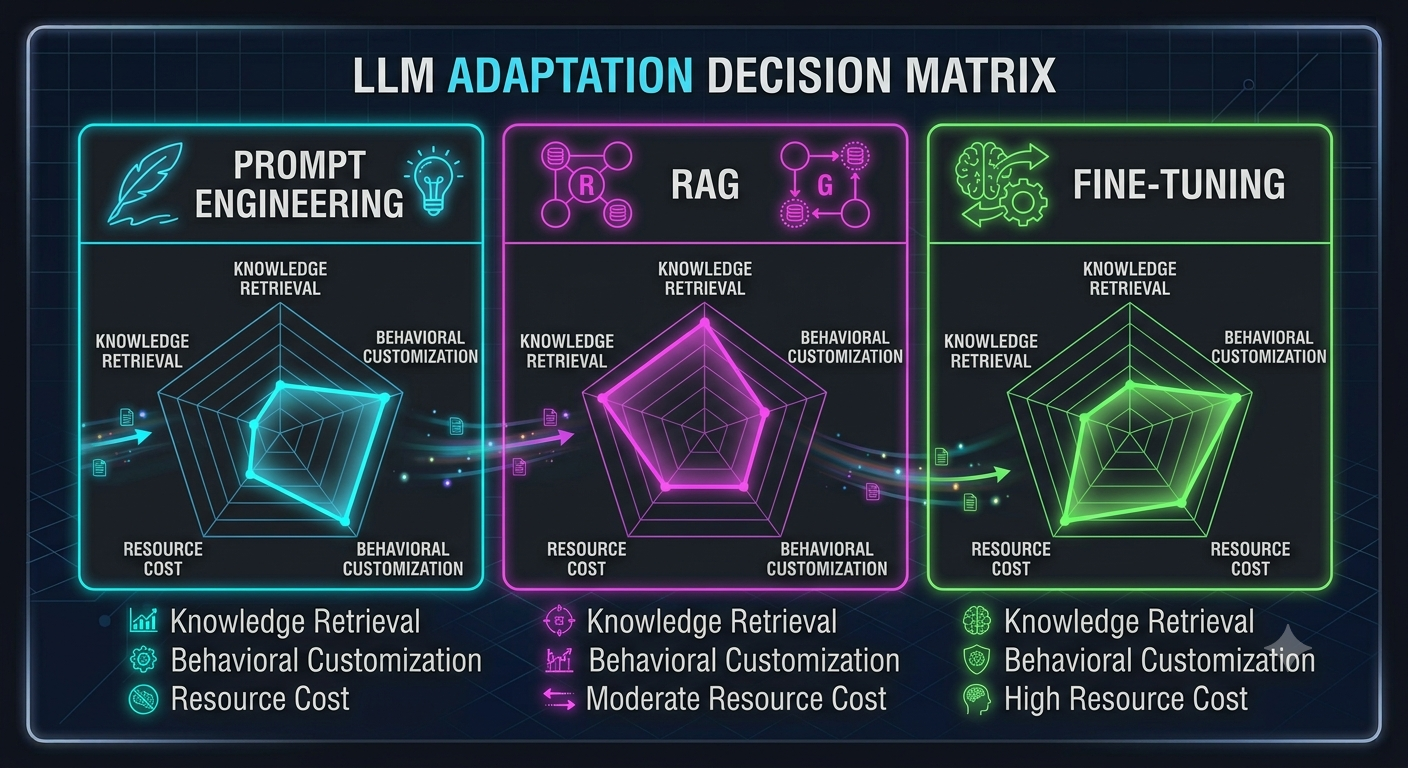
To pick the optimal path, you need to understand the trade-offs between speed to deploy, implementation complexity, and ongoing maintenance costs. Here is a clear decision framework for the three primary LLM adaptation strategies:
Prompt Engineering & In-Context Learning
What it is: Optimizing system instructions, formats, and few-shot examples directly within the context window.
When to use: Rapid prototyping, simple tasks, formatting output (e.g., JSON), or setting tone and style.
Pros: Zero training cost, instant iteration, no infrastructure management.
Cons: High latency and token costs for large prompts; limited by the context window size.
Retrieval-Augmented Generation (RAG)
What it is: Connecting your LLM to an external dynamic knowledge base via vector embeddings or search engines to fetch relevant documents dynamically.
When to use: Accessing proprietary, frequently updated, or factual enterprise data (e.g., company wiki, customer support docs, live APIs).
Pros: Highly accurate, verifiable source attribution, easy to update data without retraining.
Cons: Adds architectural complexity (vector databases, embedding pipelines, chunking strategies).
Fine-Tuning (e.g., LoRA / QLoRA)
What it is: Updating a pretrained model's internal weights on a specialized dataset using Parameter-Efficient Fine-Tuning.
When to use: Teaching the model a niche style/syntax, optimizing for specific structured outputs, or running smaller, specialized models on-premise at high throughput.
Pros: Reduces context window size (lowers per-query token cost), fast inference speed, high consistency.
Cons: Expensive to train and maintain; bad for rapidly changing knowledge (weights become stale quickly).
Key Takeaways
Start with Prompting: Always build a baseline with prompt engineering before adding architectural complexity.
Use RAG for Knowledge: If your model needs accurate, up-to-date, or private dynamic data, build a RAG pipeline.
Use Fine-Tuning for Behavior: If your model needs to master a specialized skill, syntax, or tone at high efficiency, fine-tune.
CTA
Stuck deciding on the best AI architecture for your project?
To pick the optimal path, you need to understand the trade-offs between speed to deploy, implementation complexity, and ongoing maintenance costs. Here is a clear decision framework for the three primary LLM adaptation strategies:
Prompt Engineering & In-Context Learning
What it is: Optimizing system instructions, formats, and few-shot examples directly within the context window.
When to use: Rapid prototyping, simple tasks, formatting output (e.g., JSON), or setting tone and style.
Pros: Zero training cost, instant iteration, no infrastructure management.
Cons: High latency and token costs for large prompts; limited by the context window size.
Retrieval-Augmented Generation (RAG)
What it is: Connecting your LLM to an external dynamic knowledge base via vector embeddings or search engines to fetch relevant documents dynamically.
When to use: Accessing proprietary, frequently updated, or factual enterprise data (e.g., company wiki, customer support docs, live APIs).
Pros: Highly accurate, verifiable source attribution, easy to update data without retraining.
Cons: Adds architectural complexity (vector databases, embedding pipelines, chunking strategies).
Fine-Tuning (e.g., LoRA / QLoRA)
What it is: Updating a pretrained model's internal weights on a specialized dataset using Parameter-Efficient Fine-Tuning.
When to use: Teaching the model a niche style/syntax, optimizing for specific structured outputs, or running smaller, specialized models on-premise at high throughput.
Pros: Reduces context window size (lowers per-query token cost), fast inference speed, high consistency.
Cons: Expensive to train and maintain; bad for rapidly changing knowledge (weights become stale quickly).
Key Takeaways
Start with Prompting: Always build a baseline with prompt engineering before adding architectural complexity.
Use RAG for Knowledge: If your model needs accurate, up-to-date, or private dynamic data, build a RAG pipeline.
Use Fine-Tuning for Behavior: If your model needs to master a specialized skill, syntax, or tone at high efficiency, fine-tune.
CTA
Stuck deciding on the best AI architecture for your project?
Prompt Engineering vs. Fine-Tuning vs. RAG: Choosing the Right Strategy for Your LLM App
To pick the optimal path, you need to understand the trade-offs between speed to deploy, implementation complexity, and ongoing maintenance costs. Here is a clear decision framework for the three primary LLM adaptation strategies:
Prompt Engineering & In-Context Learning
What it is: Optimizing system instructions, formats, and few-shot examples directly within the context window.
When to use: Rapid prototyping, simple tasks, formatting output (e.g., JSON), or setting tone and style.
Pros: Zero training cost, instant iteration, no infrastructure management.
Cons: High latency and token costs for large prompts; limited by the context window size.
Retrieval-Augmented Generation (RAG)
What it is: Connecting your LLM to an external dynamic knowledge base via vector embeddings or search engines to fetch relevant documents dynamically.
When to use: Accessing proprietary, frequently updated, or factual enterprise data (e.g., company wiki, customer support docs, live APIs).
Pros: Highly accurate, verifiable source attribution, easy to update data without retraining.
Cons: Adds architectural complexity (vector databases, embedding pipelines, chunking strategies).
Fine-Tuning (e.g., LoRA / QLoRA)
What it is: Updating a pretrained model's internal weights on a specialized dataset using Parameter-Efficient Fine-Tuning.
When to use: Teaching the model a niche style/syntax, optimizing for specific structured outputs, or running smaller, specialized models on-premise at high throughput.
Pros: Reduces context window size (lowers per-query token cost), fast inference speed, high consistency.
Cons: Expensive to train and maintain; bad for rapidly changing knowledge (weights become stale quickly).
Key Takeaways
Start with Prompting: Always build a baseline with prompt engineering before adding architectural complexity.
Use RAG for Knowledge: If your model needs accurate, up-to-date, or private dynamic data, build a RAG pipeline.
Use Fine-Tuning for Behavior: If your model needs to master a specialized skill, syntax, or tone at high efficiency, fine-tune.
CTA
Stuck deciding on the best AI architecture for your project?

 Arabic
 French
 Spanish
 Portuguese
 Deutsch
 Turkish
 Dutch
Dutch
 Italiano
 Russian
 Romaian
 Portuguese (Brazil)
 Greek
Greek