


Autonomous AI Agents vs. Deterministic Workflows: When Should You Trust the Loop?
Building production AI features isn't just about giving an LLM tool-calling abilities; it’s about choosing the right balance between dynamic orchestration and hardcoded reliability.
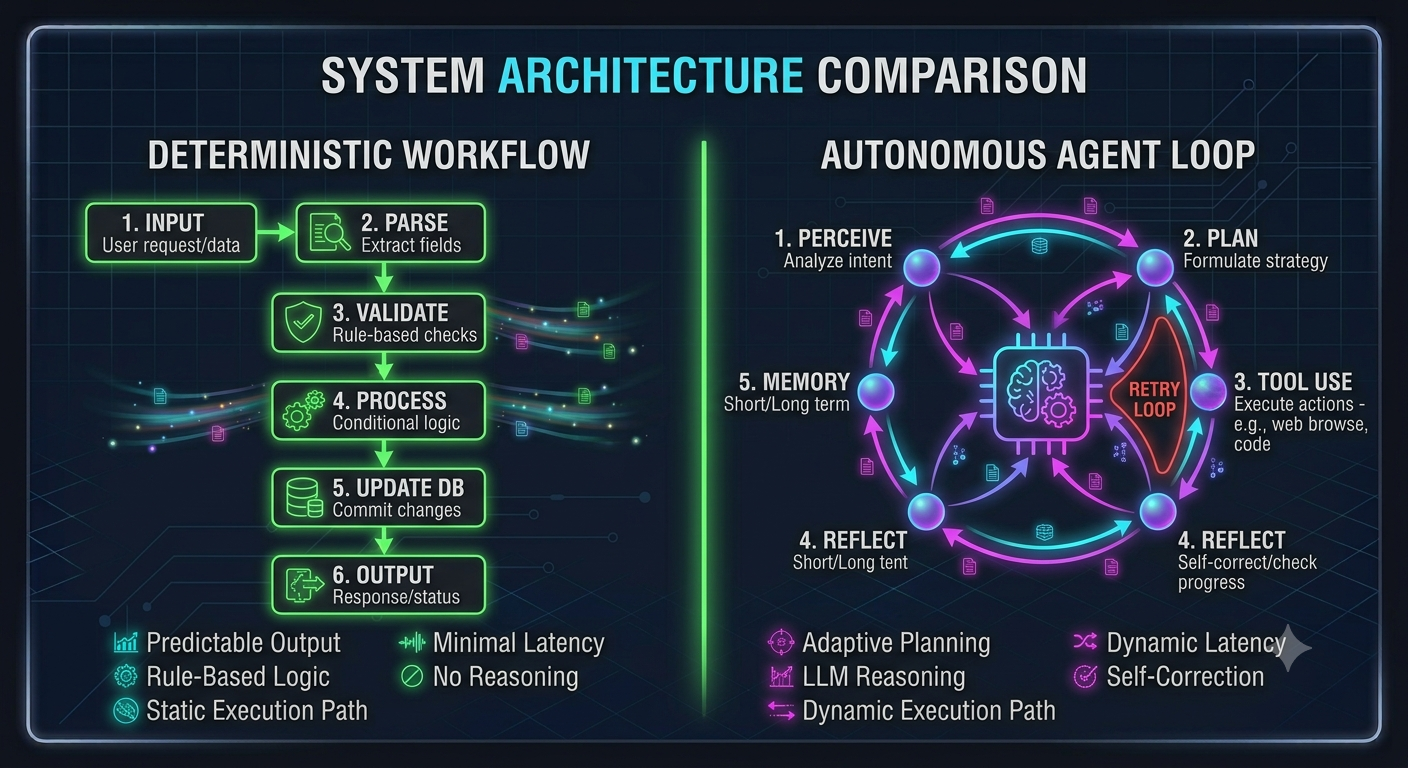
When architecture choices lean too far toward fully autonomous loops, systems become non-deterministic, hard to evaluate, and prone to unpredictable failures. Lean too far toward rigid, step-by-step logic, and you lose the power of LLM reasoning.
To build resilient AI systems, evaluate your workflows against these three operational boundaries:
Task Ambiguity vs. Latency Tolerance
Deterministic Workflows: Ideal for highly structured tasks with clear paths (e.g., extracting fields from a standard invoice or running a structured RAG pipeline). Output quality is predictable, and latency is minimized.
Agentic Loops: Necessary when the solution path is dynamic or unknown beforehand (e.g., exploratory data analysis, complex debugging, or dynamic multi-step search).
Human-in-the-Loop (HITL) Gatekeeping
Don't let autonomous agents execute side-effects (like modifying production databases, sending emails, or making financial transactions) without explicit confirmation bounds.
Use agents to generate state proposals or action plans, then use deterministic checks or human approval before execution.
Deterministic Guardrails & State Machines
Wrap agent loops inside strict finite state machines (FSMs).
Define hard caps on tool invocations, maximum token consumption, and clear fallback pathways when an agent fails to make progress after $N$ iterations.
Key Takeaways
Don't use autonomous agents for linear problems: If the steps can be written in code, write them in code.
Bound your loops: Every agentic feature must have strict token caps, recursion limits, and state fallbacks.
Decouple planning from execution: Let the LLM plan the actions, but use deterministic code to execute side-effects.
CTA
How are you structuring AI applications in your stack? Are you deploying fully autonomous agents, or relying on structured workflow DAGs?
Building production AI features isn't just about giving an LLM tool-calling abilities; it’s about choosing the right balance between dynamic orchestration and hardcoded reliability.
When architecture choices lean too far toward fully autonomous loops, systems become non-deterministic, hard to evaluate, and prone to unpredictable failures. Lean too far toward rigid, step-by-step logic, and you lose the power of LLM reasoning.
To build resilient AI systems, evaluate your workflows against these three operational boundaries:
Task Ambiguity vs. Latency Tolerance
Deterministic Workflows: Ideal for highly structured tasks with clear paths (e.g., extracting fields from a standard invoice or running a structured RAG pipeline). Output quality is predictable, and latency is minimized.
Agentic Loops: Necessary when the solution path is dynamic or unknown beforehand (e.g., exploratory data analysis, complex debugging, or dynamic multi-step search).
Human-in-the-Loop (HITL) Gatekeeping
Don't let autonomous agents execute side-effects (like modifying production databases, sending emails, or making financial transactions) without explicit confirmation bounds.
Use agents to generate state proposals or action plans, then use deterministic checks or human approval before execution.
Deterministic Guardrails & State Machines
Wrap agent loops inside strict finite state machines (FSMs).
Define hard caps on tool invocations, maximum token consumption, and clear fallback pathways when an agent fails to make progress after $N$ iterations.
Key Takeaways
Don't use autonomous agents for linear problems: If the steps can be written in code, write them in code.
Bound your loops: Every agentic feature must have strict token caps, recursion limits, and state fallbacks.
Decouple planning from execution: Let the LLM plan the actions, but use deterministic code to execute side-effects.
CTA
How are you structuring AI applications in your stack? Are you deploying fully autonomous agents, or relying on structured workflow DAGs?
Autonomous AI Agents vs. Deterministic Workflows: When Should You Trust the Loop?
Building production AI features isn't just about giving an LLM tool-calling abilities; it’s about choosing the right balance between dynamic orchestration and hardcoded reliability.
When architecture choices lean too far toward fully autonomous loops, systems become non-deterministic, hard to evaluate, and prone to unpredictable failures. Lean too far toward rigid, step-by-step logic, and you lose the power of LLM reasoning.
To build resilient AI systems, evaluate your workflows against these three operational boundaries:
Task Ambiguity vs. Latency Tolerance
Deterministic Workflows: Ideal for highly structured tasks with clear paths (e.g., extracting fields from a standard invoice or running a structured RAG pipeline). Output quality is predictable, and latency is minimized.
Agentic Loops: Necessary when the solution path is dynamic or unknown beforehand (e.g., exploratory data analysis, complex debugging, or dynamic multi-step search).
Human-in-the-Loop (HITL) Gatekeeping
Don't let autonomous agents execute side-effects (like modifying production databases, sending emails, or making financial transactions) without explicit confirmation bounds.
Use agents to generate state proposals or action plans, then use deterministic checks or human approval before execution.
Deterministic Guardrails & State Machines
Wrap agent loops inside strict finite state machines (FSMs).
Define hard caps on tool invocations, maximum token consumption, and clear fallback pathways when an agent fails to make progress after $N$ iterations.
Key Takeaways
Don't use autonomous agents for linear problems: If the steps can be written in code, write them in code.
Bound your loops: Every agentic feature must have strict token caps, recursion limits, and state fallbacks.
Decouple planning from execution: Let the LLM plan the actions, but use deterministic code to execute side-effects.
CTA
How are you structuring AI applications in your stack? Are you deploying fully autonomous agents, or relying on structured workflow DAGs?

 English
 Arabic
 French
 Spanish
 Portuguese
 Deutsch
 Dutch
Dutch
 Italiano
 Russian
 Romaian
 Portuguese (Brazil)
 Greek
Greek