


Beyond Copilots: Why Production Teams Are Building "Agent Coding Harnesses"
Most developers have experienced the "almost right" trap with AI-generated code: syntax looks pristine, unit tests pass in isolation, but runtime integration fails under edge cases.
In engineering orgs deploying autonomous coding agents directly into CI/CD pipelines, teams are replacing unconstrained code-generation prompts with a closed-loop Agent Coding Harness.
The Core Problem: The Open-Loop Failure Mode
A typical code assistant operates in an open loop:
Read prompt + local context file.
Predict diff/patch.
Emit code to working tree.
Without programmatic feedback, hallucinated APIs and subtle memory or type mismatches silently leak into pull requests, forcing engineers to spend more time debugging synthetic code than writing it from scratch.
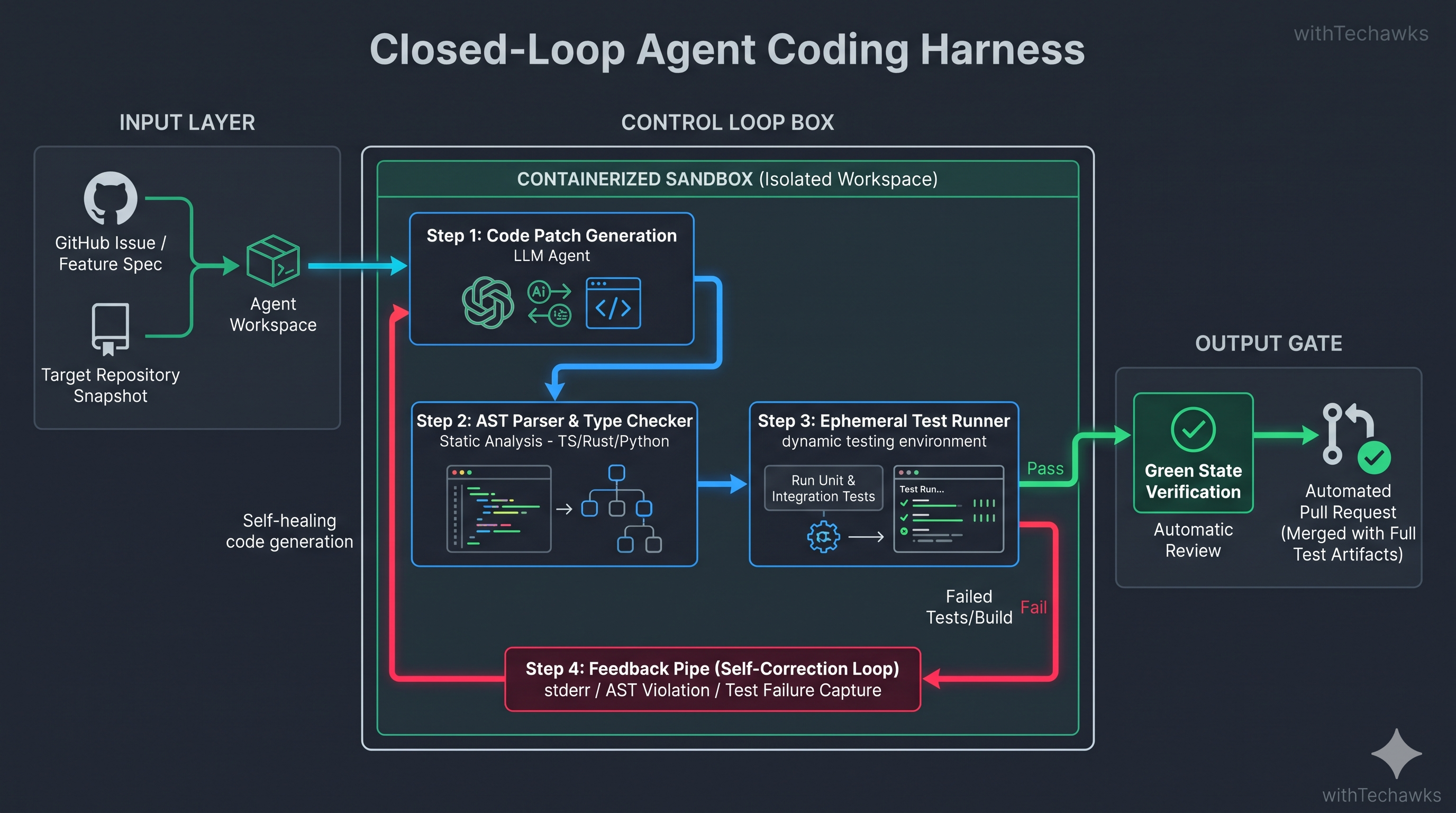
The Pattern: The 4-Stage Closed-Loop Harness
A robust developer harness isolates agent execution inside an automated sandbox using an execution-evaluation loop:
Deterministic Workspace Snapshot:
Before the agent touches source code, the harness provisions a containerized ephemeral branch containing mock data and frozen dependency locks.
AST-Level Schema Invariants (Static Verification):
Rather than letting the model freely emit raw text, the harness parses proposed patches into an Abstract Syntax Tree (AST). It enforces strict type checks, export signatures, and architectural boundary rules (e.g., prohibiting direct DB calls from presentation layers).
Automated Reproduction Harness (Dynamic Verification):
Before accepting any proposed bug fix or feature code, the agent is forced to write a failing test demonstrating the condition, apply the patch, and prove the test passes green without breaking the existing test suite.
Self-Healing Error Feedback Loop:
If compilation fails or runtime exceptions occur, stderr and stack traces are captured by the harness and piped directly back into the agent’s scratchpad context as deterministic feedback:
Plaintext
[Harness Error] Type mismatch at auth.service.ts:42
Expected: Promise<UserSession>
Received: UserSession | null
Action: Re-evaluate nullable boundary in handleAuthCallback()
By turning coding agents from unconstrained text generators into bounded, self-correcting state machines, teams protect architectural integrity while unlocking genuine automation.
Discussion Question
Community Poll: When integrating autonomous coding agents into your team's workflow, where does the validation loop break down most often?
A) Semantic logic errors that pass unit tests but fail integration
B) Flaky test suites causing false positive loop re-tries
C) Environment sandboxing and secure API mock management
D) High token spend and latency during iterative compile-fail loops
CTA
Looking to master systems-level engineering, testing architectures, and next-generation developer tooling?
👉 Join Developers & Coding to build, debug, and scale with fellow engineers in the Techawks community.
Beyond Copilots: Why Production Teams Are Building "Agent Coding Harnesses"
Most developers have experienced the "almost right" trap with AI-generated code: syntax looks pristine, unit tests pass in isolation, but runtime integration fails under edge cases.
In engineering orgs deploying autonomous coding agents directly into CI/CD pipelines, teams are replacing unconstrained code-generation prompts with a closed-loop Agent Coding Harness.
The Core Problem: The Open-Loop Failure Mode
A typical code assistant operates in an open loop:
Read prompt + local context file.
Predict diff/patch.
Emit code to working tree.
Without programmatic feedback, hallucinated APIs and subtle memory or type mismatches silently leak into pull requests, forcing engineers to spend more time debugging synthetic code than writing it from scratch.
The Pattern: The 4-Stage Closed-Loop Harness
A robust developer harness isolates agent execution inside an automated sandbox using an execution-evaluation loop:
Deterministic Workspace Snapshot:
Before the agent touches source code, the harness provisions a containerized ephemeral branch containing mock data and frozen dependency locks.
AST-Level Schema Invariants (Static Verification):
Rather than letting the model freely emit raw text, the harness parses proposed patches into an Abstract Syntax Tree (AST). It enforces strict type checks, export signatures, and architectural boundary rules (e.g., prohibiting direct DB calls from presentation layers).
Automated Reproduction Harness (Dynamic Verification):
Before accepting any proposed bug fix or feature code, the agent is forced to write a failing test demonstrating the condition, apply the patch, and prove the test passes green without breaking the existing test suite.
Self-Healing Error Feedback Loop:
If compilation fails or runtime exceptions occur, stderr and stack traces are captured by the harness and piped directly back into the agent’s scratchpad context as deterministic feedback:
Plaintext
[Harness Error] Type mismatch at auth.service.ts:42
Expected: Promise<UserSession>
Received: UserSession | null
Action: Re-evaluate nullable boundary in handleAuthCallback()
By turning coding agents from unconstrained text generators into bounded, self-correcting state machines, teams protect architectural integrity while unlocking genuine automation.
Discussion Question
Community Poll: When integrating autonomous coding agents into your team's workflow, where does the validation loop break down most often?
A) Semantic logic errors that pass unit tests but fail integration
B) Flaky test suites causing false positive loop re-tries
C) Environment sandboxing and secure API mock management
D) High token spend and latency during iterative compile-fail loops
CTA
Looking to master systems-level engineering, testing architectures, and next-generation developer tooling?
👉 Join Developers & Coding to build, debug, and scale with fellow engineers in the Techawks community.

 English
 Arabic
 French
 Spanish
 Portuguese
 Deutsch
 Turkish
 Dutch
 Italiano
 Romaian
 Portuguese (Brazil)
 Greek