


The Clean Code Checklist: 5 Refactoring Patterns to Level Up Your Codebase
Tech debt compounds quietly. It usually starts with a quick patch here, a nested if statement there, and suddenly you're staring at a 500-line function no one dares to touch.
Here are five practical, language-agnostic code refactoring patterns you can apply immediately to clean up your codebase:
Replace Magic Numbers with Named Constants
The Bad: if (user.status === 3) { retry(4); }
The Fix: Assign clear, descriptive names to raw values (e.g., USER_STATUS_PENDING = 3, MAX_RETRY_ATTEMPTS = 4). It instantly makes the code self-documenting and prevents typos across your codebase.
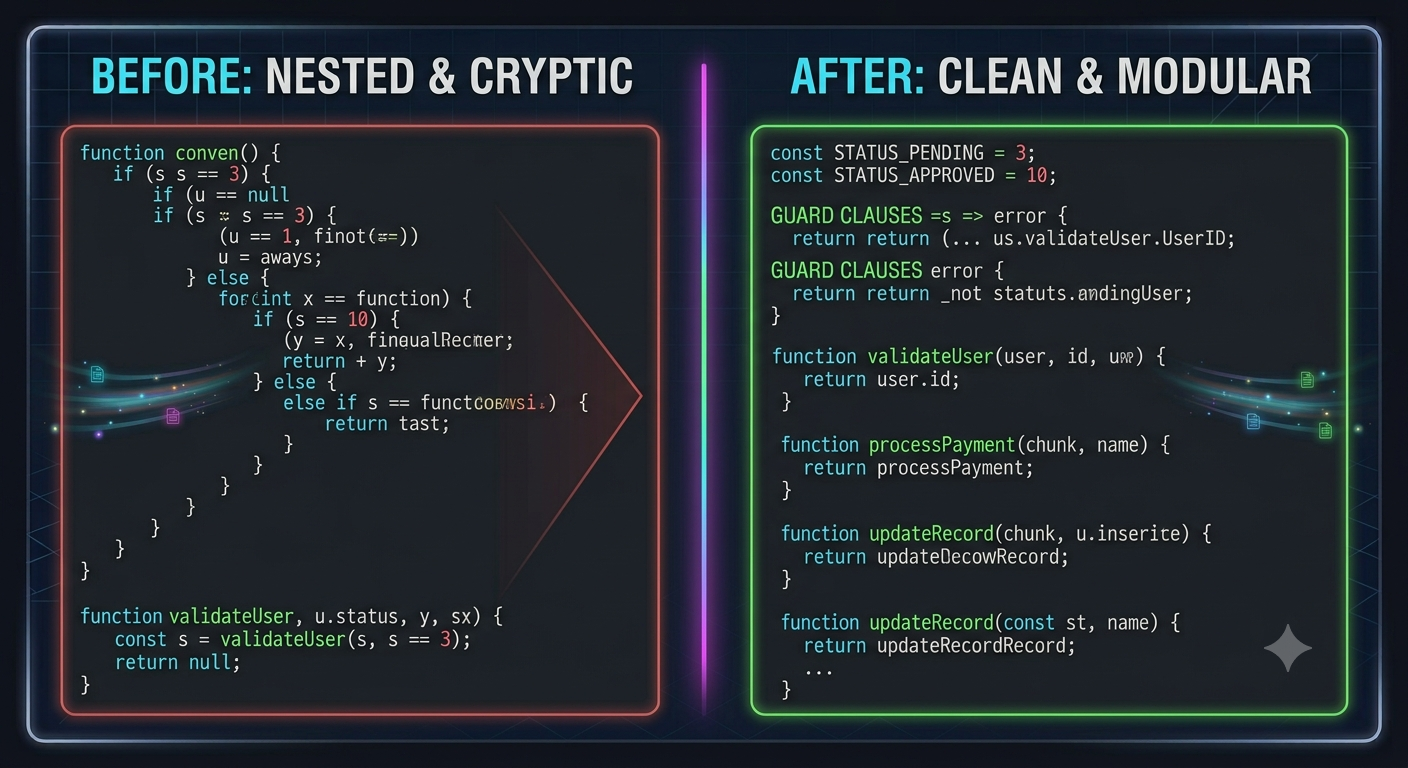
Flatten Deeply Nested Logic with Guard Clauses
The Bad: Arrow-shaped code filled with 4–5 levels of nested if-else blocks checking for valid states.
The Fix: Return early. Validate preconditions at the very top of your function (e.g., if (!user) return;) to handle error cases first. This keeps the primary execution path clean and flush against the left margin.
Break Up "God Functions" (Single Responsibility Principle)
The Bad: A single function that parses incoming request payloads, validates input fields, writes to a database, and emails a receipt.
The Fix: Extract discrete logical operations into small, single-purpose helper functions. A good rule of thumb: if a function's behavior needs an "and" to explain what it does, it's doing too much.
Prefer Pure Functions Where Possible
The Bad: Functions that rely heavily on hidden global variables or mutate state outside their immediate scope, making them unpredictable to test.
The Fix: Write pure functions—where the same inputs always return the exact same output without side effects. Pure functions are vastly easier to unit test, debug, and reason about.
Replace Boolean Flags with Enum or Explicit Function Strategy
The Bad: Calling renderUI(true, false, true) where no one knows what those positional parameters control without checking the function definition.
The Fix: Pass named configuration objects or split the behavior into distinct, explicitly named functions (e.g., renderAdminDashboard() vs. renderUserDashboard()).
Key Takeaways
Return early: Guard clauses eliminate cognitive overload caused by deeply nested conditionals.
Keep functions tiny: Aim for functions that do one thing and do it predictably.
Name with intent: Code is read far more often than it is written—make every variable name earn its place.
CTA
Ready to refine your syntax, adopt better design patterns, and write production-ready code with fellow developers?
[Join Developers & Coding] to share code snippets, get PR feedback, and sharpen your software engineering skills every single day.
Tech debt compounds quietly. It usually starts with a quick patch here, a nested if statement there, and suddenly you're staring at a 500-line function no one dares to touch.
Here are five practical, language-agnostic code refactoring patterns you can apply immediately to clean up your codebase:
Replace Magic Numbers with Named Constants
The Bad: if (user.status === 3) { retry(4); }
The Fix: Assign clear, descriptive names to raw values (e.g., USER_STATUS_PENDING = 3, MAX_RETRY_ATTEMPTS = 4). It instantly makes the code self-documenting and prevents typos across your codebase.
Flatten Deeply Nested Logic with Guard Clauses
The Bad: Arrow-shaped code filled with 4–5 levels of nested if-else blocks checking for valid states.
The Fix: Return early. Validate preconditions at the very top of your function (e.g., if (!user) return;) to handle error cases first. This keeps the primary execution path clean and flush against the left margin.
Break Up "God Functions" (Single Responsibility Principle)
The Bad: A single function that parses incoming request payloads, validates input fields, writes to a database, and emails a receipt.
The Fix: Extract discrete logical operations into small, single-purpose helper functions. A good rule of thumb: if a function's behavior needs an "and" to explain what it does, it's doing too much.
Prefer Pure Functions Where Possible
The Bad: Functions that rely heavily on hidden global variables or mutate state outside their immediate scope, making them unpredictable to test.
The Fix: Write pure functions—where the same inputs always return the exact same output without side effects. Pure functions are vastly easier to unit test, debug, and reason about.
Replace Boolean Flags with Enum or Explicit Function Strategy
The Bad: Calling renderUI(true, false, true) where no one knows what those positional parameters control without checking the function definition.
The Fix: Pass named configuration objects or split the behavior into distinct, explicitly named functions (e.g., renderAdminDashboard() vs. renderUserDashboard()).
Key Takeaways
Return early: Guard clauses eliminate cognitive overload caused by deeply nested conditionals.
Keep functions tiny: Aim for functions that do one thing and do it predictably.
Name with intent: Code is read far more often than it is written—make every variable name earn its place.
CTA
Ready to refine your syntax, adopt better design patterns, and write production-ready code with fellow developers?
[Join Developers & Coding] to share code snippets, get PR feedback, and sharpen your software engineering skills every single day.
The Clean Code Checklist: 5 Refactoring Patterns to Level Up Your Codebase
Tech debt compounds quietly. It usually starts with a quick patch here, a nested if statement there, and suddenly you're staring at a 500-line function no one dares to touch.
Here are five practical, language-agnostic code refactoring patterns you can apply immediately to clean up your codebase:
Replace Magic Numbers with Named Constants
The Bad: if (user.status === 3) { retry(4); }
The Fix: Assign clear, descriptive names to raw values (e.g., USER_STATUS_PENDING = 3, MAX_RETRY_ATTEMPTS = 4). It instantly makes the code self-documenting and prevents typos across your codebase.
Flatten Deeply Nested Logic with Guard Clauses
The Bad: Arrow-shaped code filled with 4–5 levels of nested if-else blocks checking for valid states.
The Fix: Return early. Validate preconditions at the very top of your function (e.g., if (!user) return;) to handle error cases first. This keeps the primary execution path clean and flush against the left margin.
Break Up "God Functions" (Single Responsibility Principle)
The Bad: A single function that parses incoming request payloads, validates input fields, writes to a database, and emails a receipt.
The Fix: Extract discrete logical operations into small, single-purpose helper functions. A good rule of thumb: if a function's behavior needs an "and" to explain what it does, it's doing too much.
Prefer Pure Functions Where Possible
The Bad: Functions that rely heavily on hidden global variables or mutate state outside their immediate scope, making them unpredictable to test.
The Fix: Write pure functions—where the same inputs always return the exact same output without side effects. Pure functions are vastly easier to unit test, debug, and reason about.
Replace Boolean Flags with Enum or Explicit Function Strategy
The Bad: Calling renderUI(true, false, true) where no one knows what those positional parameters control without checking the function definition.
The Fix: Pass named configuration objects or split the behavior into distinct, explicitly named functions (e.g., renderAdminDashboard() vs. renderUserDashboard()).
Key Takeaways
Return early: Guard clauses eliminate cognitive overload caused by deeply nested conditionals.
Keep functions tiny: Aim for functions that do one thing and do it predictably.
Name with intent: Code is read far more often than it is written—make every variable name earn its place.
CTA
Ready to refine your syntax, adopt better design patterns, and write production-ready code with fellow developers?
[Join Developers & Coding] to share code snippets, get PR feedback, and sharpen your software engineering skills every single day.

 English
 Arabic
 French
 Spanish
 Portuguese
 Deutsch
 Turkish
 Dutch
Dutch
 Italiano
 Russian
 Romaian
 Portuguese (Brazil)