


Mastering Async Control Flow: Callbacks, Promises, and Async/Await
Whether you are fetching API data, reading from a file system, or querying a database, non-blocking asynchronous operations are essential for application performance. However, as your code scales, managing async execution flow requires choosing the right mechanism for the task.
Here is an actionable breakdown of the evolution of async patterns and when to use each:
Callbacks: The Foundational Mechanism
How it works: You pass a function as an argument to another function, which executes once the async operation finishes.
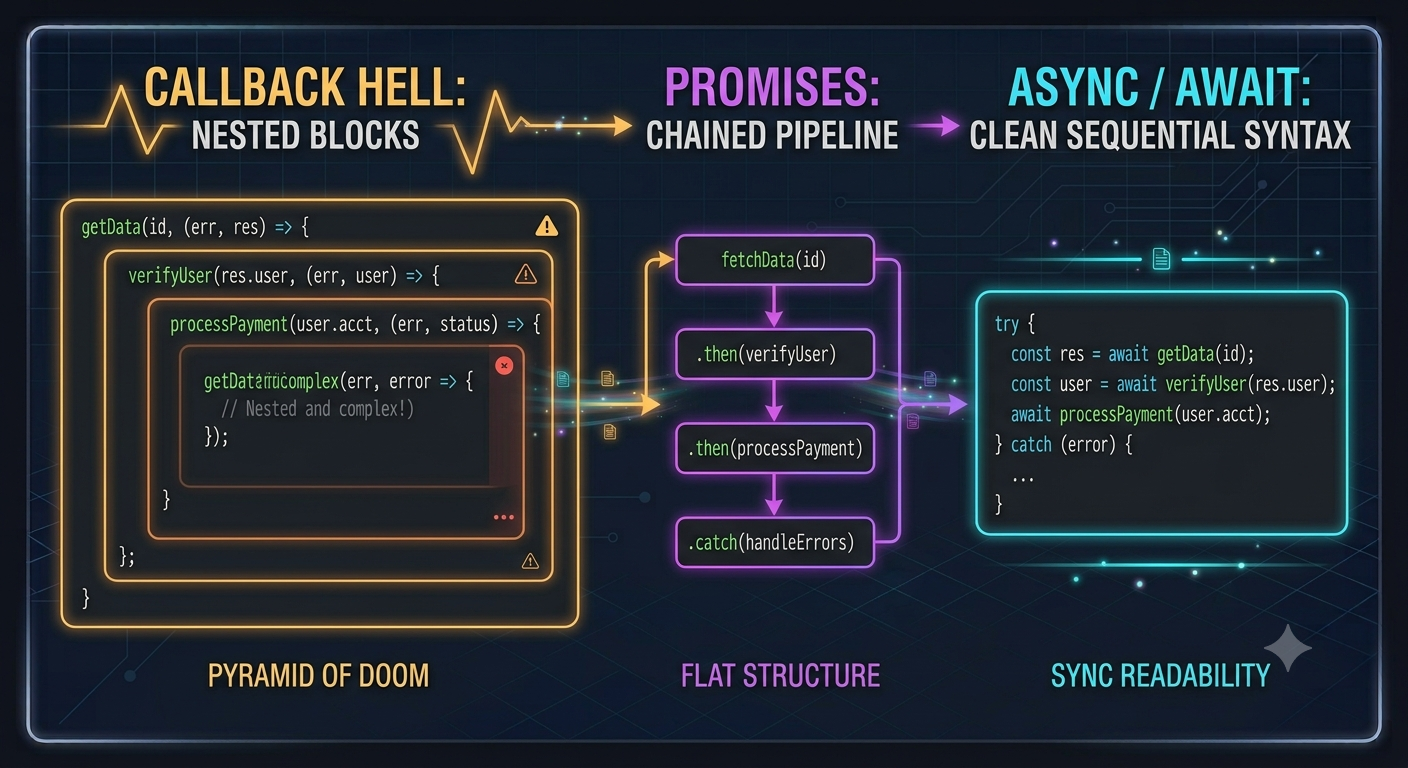
The Trap: Nesting multiple dependent callbacks creates "Callback Hell" (Pyramid of Doom), making error handling extremely cumbersome.
Best Practice: Limit callbacks to simple single-event listeners or low-level library interfaces.
Promises: Flat, Chainable Async Flow
How it works: Represents a value that may be available now, in the future, or never (Pending, Fulfilled, Rejected state machine).
The Superpower: Flattens nested logic using .then() chains and centralizes error handling via .catch().
Best Practice: Use Promise.all() to execute independent async operations concurrently (e.g., fetching 3 distinct APIs at once) rather than awaiting them sequentially.
Async / Await: Syntactic Sugar with Synchronous Readability
How it works: Built on top of Promises, async/await allows asynchronous code to be written and read like standard sequential code.
The Trap: Accidental sequential blocking. Awaiting independent promises one after another inside a for loop slows execution significantly.
Best Practice: Combine async/await with Promise.all() for concurrent operations, and always wrap execution blocks in try/catch statements for reliable error handling.
Key Takeaways
Callbacks are foundational but quickly create hard-to-read nested code.
Promises introduce predictable state management and concurrent helpers like Promise.all().
Async/Await delivers clean readability, but always ensure independent operations run concurrently instead of blocking sequentially.
CTA
Want to sharpen your understanding of execution stacks, event loops, and clean coding patterns?
[Join Developers & Coding] to share code snippets, participate in technical breakdown sessions, and elevate your engineering capabilities with developers worldwide.
Whether you are fetching API data, reading from a file system, or querying a database, non-blocking asynchronous operations are essential for application performance. However, as your code scales, managing async execution flow requires choosing the right mechanism for the task.
Here is an actionable breakdown of the evolution of async patterns and when to use each:
Callbacks: The Foundational Mechanism
How it works: You pass a function as an argument to another function, which executes once the async operation finishes.
The Trap: Nesting multiple dependent callbacks creates "Callback Hell" (Pyramid of Doom), making error handling extremely cumbersome.
Best Practice: Limit callbacks to simple single-event listeners or low-level library interfaces.
Promises: Flat, Chainable Async Flow
How it works: Represents a value that may be available now, in the future, or never (Pending, Fulfilled, Rejected state machine).
The Superpower: Flattens nested logic using .then() chains and centralizes error handling via .catch().
Best Practice: Use Promise.all() to execute independent async operations concurrently (e.g., fetching 3 distinct APIs at once) rather than awaiting them sequentially.
Async / Await: Syntactic Sugar with Synchronous Readability
How it works: Built on top of Promises, async/await allows asynchronous code to be written and read like standard sequential code.
The Trap: Accidental sequential blocking. Awaiting independent promises one after another inside a for loop slows execution significantly.
Best Practice: Combine async/await with Promise.all() for concurrent operations, and always wrap execution blocks in try/catch statements for reliable error handling.
Key Takeaways
Callbacks are foundational but quickly create hard-to-read nested code.
Promises introduce predictable state management and concurrent helpers like Promise.all().
Async/Await delivers clean readability, but always ensure independent operations run concurrently instead of blocking sequentially.
CTA
Want to sharpen your understanding of execution stacks, event loops, and clean coding patterns?
[Join Developers & Coding] to share code snippets, participate in technical breakdown sessions, and elevate your engineering capabilities with developers worldwide.
Mastering Async Control Flow: Callbacks, Promises, and Async/Await
Whether you are fetching API data, reading from a file system, or querying a database, non-blocking asynchronous operations are essential for application performance. However, as your code scales, managing async execution flow requires choosing the right mechanism for the task.
Here is an actionable breakdown of the evolution of async patterns and when to use each:
Callbacks: The Foundational Mechanism
How it works: You pass a function as an argument to another function, which executes once the async operation finishes.
The Trap: Nesting multiple dependent callbacks creates "Callback Hell" (Pyramid of Doom), making error handling extremely cumbersome.
Best Practice: Limit callbacks to simple single-event listeners or low-level library interfaces.
Promises: Flat, Chainable Async Flow
How it works: Represents a value that may be available now, in the future, or never (Pending, Fulfilled, Rejected state machine).
The Superpower: Flattens nested logic using .then() chains and centralizes error handling via .catch().
Best Practice: Use Promise.all() to execute independent async operations concurrently (e.g., fetching 3 distinct APIs at once) rather than awaiting them sequentially.
Async / Await: Syntactic Sugar with Synchronous Readability
How it works: Built on top of Promises, async/await allows asynchronous code to be written and read like standard sequential code.
The Trap: Accidental sequential blocking. Awaiting independent promises one after another inside a for loop slows execution significantly.
Best Practice: Combine async/await with Promise.all() for concurrent operations, and always wrap execution blocks in try/catch statements for reliable error handling.
Key Takeaways
Callbacks are foundational but quickly create hard-to-read nested code.
Promises introduce predictable state management and concurrent helpers like Promise.all().
Async/Await delivers clean readability, but always ensure independent operations run concurrently instead of blocking sequentially.
CTA
Want to sharpen your understanding of execution stacks, event loops, and clean coding patterns?
[Join Developers & Coding] to share code snippets, participate in technical breakdown sessions, and elevate your engineering capabilities with developers worldwide.

 English
 Arabic
 French
 Spanish
 Portuguese
 Deutsch
 Turkish
 Dutch
Dutch
 Italiano
 Romaian
 Portuguese (Brazil)
 Greek
Greek