


TDD vs. Integration-First: What’s Your Actual Testing Strategy?
Testing strategy is often treated like dogmatic theology in software engineering. Test-Driven Development (TDD) purists advocate for strict Red-Green-Refactor cycles at the unit level, while pragmatists argue that heavy unit mocking slows down refactoring and misses critical boundary bugs.
To build a sustainable automated testing suite without suffocating developer velocity, evaluate your approach across these three operational dimensions:
The Cost of Mocks vs. Real Implementations
Unit Tests (TDD): Fast and deterministic, but over-mocking external dependencies (databases, payment gateways, microservices) can lead to tests that pass green while production completely breaks.
Integration Tests: Slower to run, but test actual system boundaries. Using lightweight containers (like Testcontainers) to spin up real databases gives far higher confidence than mocking the ORM.
The "Refactoring Tax"
Strict unit testing often binds your test suite to implementation details. When you change internal class structures, dozens of tests break—even if the overall feature input/output remains identical.
Actionable Rule: Test behavior, not implementation details. If a refactor doesn't change public API outputs, your tests shouldn't break.
Applying the Testing Trophy over the Pyramid
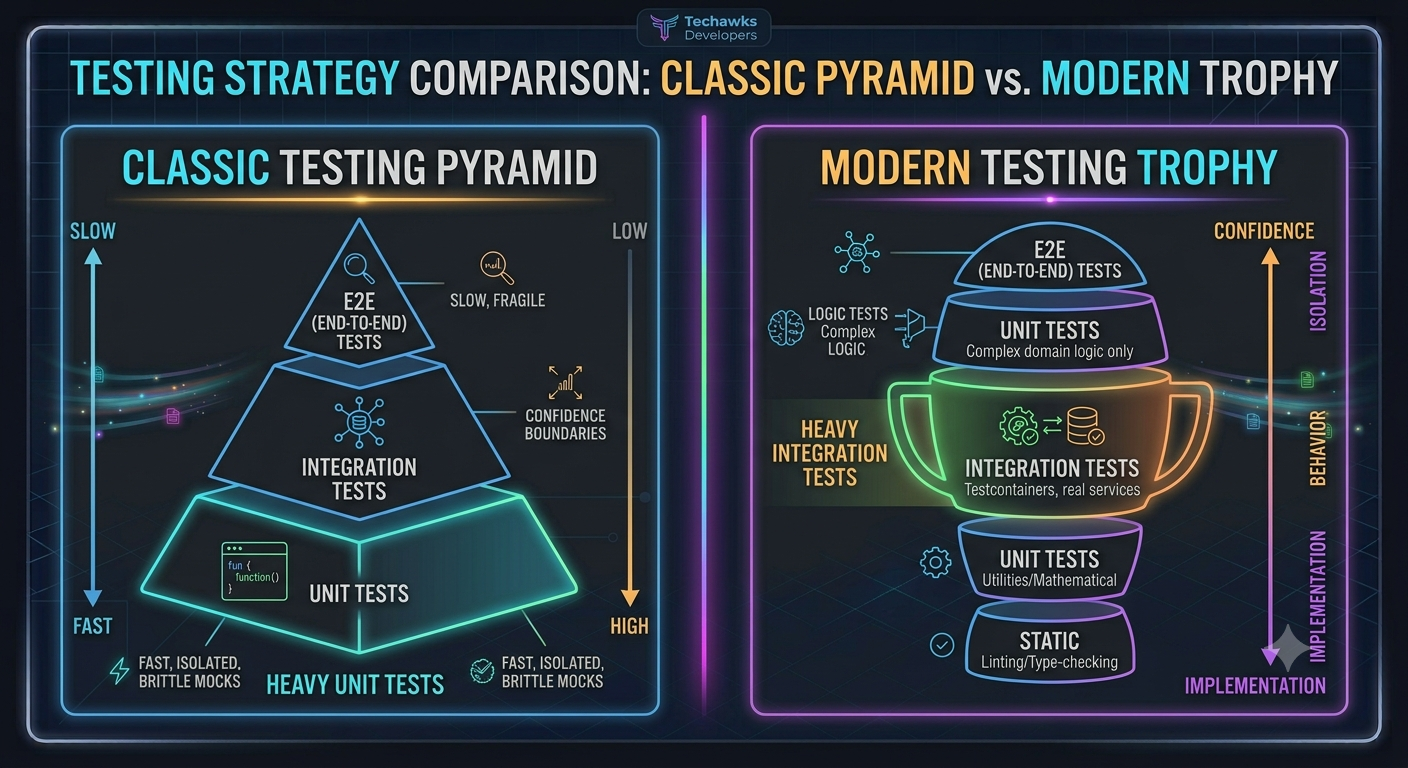
Shift primary focus from hundreds of isolated unit tests (the base of the classic pyramid) toward a robust suite of integration tests (the meat of the testing trophy).
Reserve pure unit tests for complex domain logic, mathematical computations, and algorithmic utilities where edge cases are plentiful.
Key Takeaways
Test behavior, not implementation: Avoid tying unit tests to private methods or exact internal call chains.
Mocks are a double-edged sword: Over-reliance on mock objects creates false confidence and brittle test suites.
Prioritize integration confidence: A suite of solid integration tests catching boundary failures often yields a higher ROI than 100% unit code coverage.
CTA
Where do you and your engineering team land on the testing spectrum? Do you strictly adhere to TDD, rely heavily on integration tests, or test manually in staging?
Share your real-world testing setups in the comments below, and [Join Developers & Coding] to debate software patterns and code architecture with developers worldwide.
Testing strategy is often treated like dogmatic theology in software engineering. Test-Driven Development (TDD) purists advocate for strict Red-Green-Refactor cycles at the unit level, while pragmatists argue that heavy unit mocking slows down refactoring and misses critical boundary bugs.
To build a sustainable automated testing suite without suffocating developer velocity, evaluate your approach across these three operational dimensions:
The Cost of Mocks vs. Real Implementations
Unit Tests (TDD): Fast and deterministic, but over-mocking external dependencies (databases, payment gateways, microservices) can lead to tests that pass green while production completely breaks.
Integration Tests: Slower to run, but test actual system boundaries. Using lightweight containers (like Testcontainers) to spin up real databases gives far higher confidence than mocking the ORM.
The "Refactoring Tax"
Strict unit testing often binds your test suite to implementation details. When you change internal class structures, dozens of tests break—even if the overall feature input/output remains identical.
Actionable Rule: Test behavior, not implementation details. If a refactor doesn't change public API outputs, your tests shouldn't break.
Applying the Testing Trophy over the Pyramid
Shift primary focus from hundreds of isolated unit tests (the base of the classic pyramid) toward a robust suite of integration tests (the meat of the testing trophy).
Reserve pure unit tests for complex domain logic, mathematical computations, and algorithmic utilities where edge cases are plentiful.
Key Takeaways
Test behavior, not implementation: Avoid tying unit tests to private methods or exact internal call chains.
Mocks are a double-edged sword: Over-reliance on mock objects creates false confidence and brittle test suites.
Prioritize integration confidence: A suite of solid integration tests catching boundary failures often yields a higher ROI than 100% unit code coverage.
CTA
Where do you and your engineering team land on the testing spectrum? Do you strictly adhere to TDD, rely heavily on integration tests, or test manually in staging?
Share your real-world testing setups in the comments below, and [Join Developers & Coding] to debate software patterns and code architecture with developers worldwide.
TDD vs. Integration-First: What’s Your Actual Testing Strategy?
Testing strategy is often treated like dogmatic theology in software engineering. Test-Driven Development (TDD) purists advocate for strict Red-Green-Refactor cycles at the unit level, while pragmatists argue that heavy unit mocking slows down refactoring and misses critical boundary bugs.
To build a sustainable automated testing suite without suffocating developer velocity, evaluate your approach across these three operational dimensions:
The Cost of Mocks vs. Real Implementations
Unit Tests (TDD): Fast and deterministic, but over-mocking external dependencies (databases, payment gateways, microservices) can lead to tests that pass green while production completely breaks.
Integration Tests: Slower to run, but test actual system boundaries. Using lightweight containers (like Testcontainers) to spin up real databases gives far higher confidence than mocking the ORM.
The "Refactoring Tax"
Strict unit testing often binds your test suite to implementation details. When you change internal class structures, dozens of tests break—even if the overall feature input/output remains identical.
Actionable Rule: Test behavior, not implementation details. If a refactor doesn't change public API outputs, your tests shouldn't break.
Applying the Testing Trophy over the Pyramid
Shift primary focus from hundreds of isolated unit tests (the base of the classic pyramid) toward a robust suite of integration tests (the meat of the testing trophy).
Reserve pure unit tests for complex domain logic, mathematical computations, and algorithmic utilities where edge cases are plentiful.
Key Takeaways
Test behavior, not implementation: Avoid tying unit tests to private methods or exact internal call chains.
Mocks are a double-edged sword: Over-reliance on mock objects creates false confidence and brittle test suites.
Prioritize integration confidence: A suite of solid integration tests catching boundary failures often yields a higher ROI than 100% unit code coverage.
CTA
Where do you and your engineering team land on the testing spectrum? Do you strictly adhere to TDD, rely heavily on integration tests, or test manually in staging?
Share your real-world testing setups in the comments below, and [Join Developers & Coding] to debate software patterns and code architecture with developers worldwide.

 English
 Arabic
 Spanish
 Portuguese
 Deutsch
 Turkish
 Dutch
Dutch
 Italiano
 Russian
 Romaian
 Portuguese (Brazil)
 Greek
Greek