


The Software Engineer’s Resume Blueprint: How to Pass the 6-Second Recruiter Screen
Standing out in today’s hiring environment isn't about padding your tech stack list with buzzwords. It’s about clearly communicating business impact, technical ownership, and problem-solving capability.
Whether you are applying for your first developer role or a senior engineering position, use this actionable blueprint to structure high-converting resume bullet points:
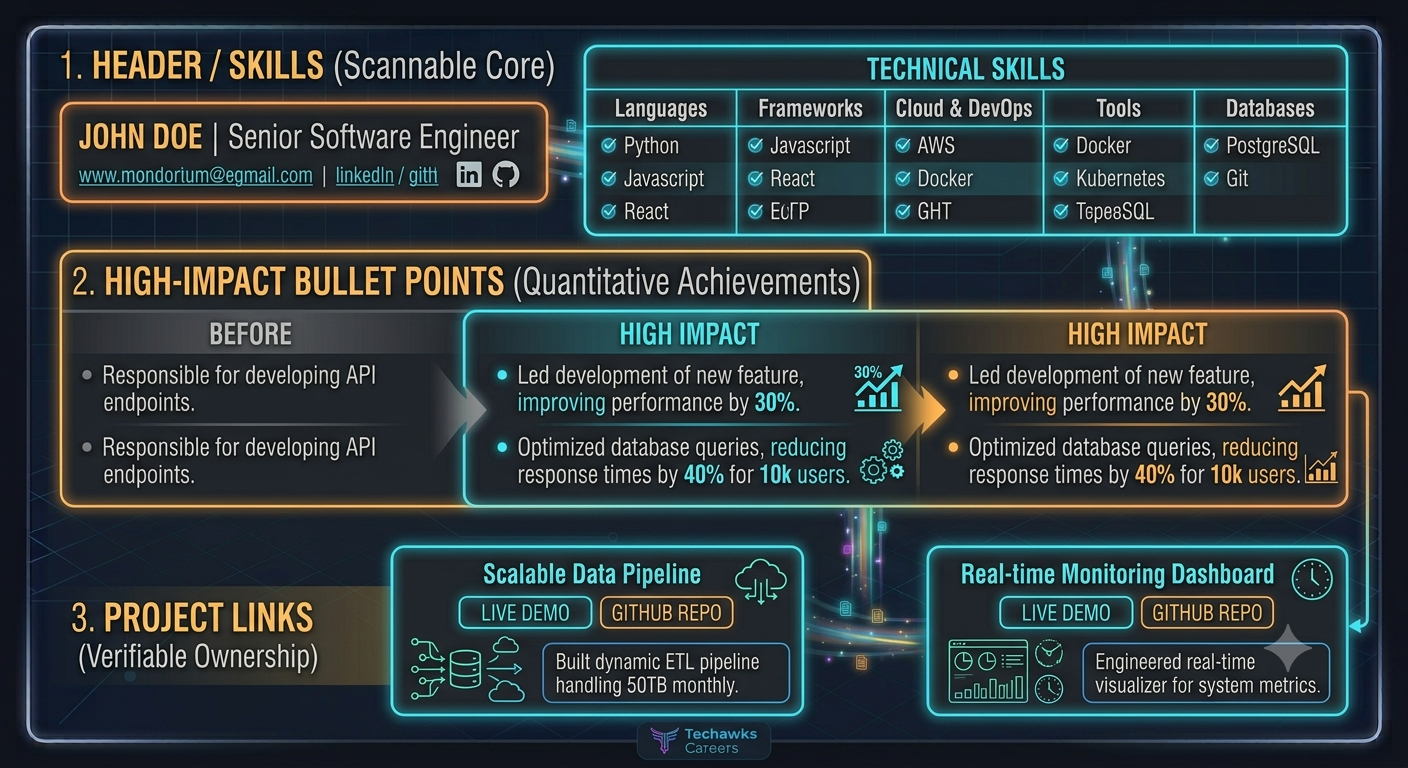
Adopt the Action + Context + Outcome Formula
The Bad: "Responsible for building REST APIs in Node.js."
The Fix: Frame every project accomplishment using the Google XYZ framework ("Accomplished [X], as measured by [Y], by doing [Z]").
Example: "Reduced API response latency by 42% by implementing a Redis caching layer for high-volume database queries."
Categorize Your Skills Strategy
Don't dump 30 programming languages and frameworks into an unsorted block at the top.
Group skills logically into categories: Languages, Frameworks & Libraries, Databases & Storage, and Cloud & DevOps. Place the tools you are most proficient with first.
Showcase System Scale & Problem Complexity
Metrics matter. Whenever possible, include numbers that quantify scale: throughput, active users, data volume, deployment frequency, or test coverage improvements.
If working on a side project, quantify performance metrics (e.g., "Engineered a RAG pipeline handling 10k+ vector lookups under 200ms").
Highlight Engineering Trade-offs & Ownership
In project descriptions, briefly note why you chose a specific technology over an alternative.
Highlight cross-functional collaboration, such as leading architecture reviews, mentoring junior devs, or establishing testing standards.
Keep Formatting Aggressively Scannable
Stick to a single-page format (two pages only if you have 8+ years of experience).
Use clean line spacing, bold key metrics, and link directly to active GitHub repositories or live production demos.
Key Takeaways
Focus on impact over duties: Quantify results with specific numbers, metrics, and business outcomes.
Format for scannability: Group your technical skills logically so recruiters can evaluate fit instantly.
Showcase trade-offs: Prove that you understand why you chose certain tools, not just how to use them.
CTA
Looking to land your next technical role, polish your resume, or prepare for tough technical interviews?
[Join Tech Jobs & Opportunities] to access curated job listings, resume teardowns, and career growth strategies from experienced tech recruiters and engineering leaders.
Suggested Image
Standing out in today’s hiring environment isn't about padding your tech stack list with buzzwords. It’s about clearly communicating business impact, technical ownership, and problem-solving capability.
Whether you are applying for your first developer role or a senior engineering position, use this actionable blueprint to structure high-converting resume bullet points:
Adopt the Action + Context + Outcome Formula
The Bad: "Responsible for building REST APIs in Node.js."
The Fix: Frame every project accomplishment using the Google XYZ framework ("Accomplished [X], as measured by [Y], by doing [Z]").
Example: "Reduced API response latency by 42% by implementing a Redis caching layer for high-volume database queries."
Categorize Your Skills Strategy
Don't dump 30 programming languages and frameworks into an unsorted block at the top.
Group skills logically into categories: Languages, Frameworks & Libraries, Databases & Storage, and Cloud & DevOps. Place the tools you are most proficient with first.
Showcase System Scale & Problem Complexity
Metrics matter. Whenever possible, include numbers that quantify scale: throughput, active users, data volume, deployment frequency, or test coverage improvements.
If working on a side project, quantify performance metrics (e.g., "Engineered a RAG pipeline handling 10k+ vector lookups under 200ms").
Highlight Engineering Trade-offs & Ownership
In project descriptions, briefly note why you chose a specific technology over an alternative.
Highlight cross-functional collaboration, such as leading architecture reviews, mentoring junior devs, or establishing testing standards.
Keep Formatting Aggressively Scannable
Stick to a single-page format (two pages only if you have 8+ years of experience).
Use clean line spacing, bold key metrics, and link directly to active GitHub repositories or live production demos.
Key Takeaways
Focus on impact over duties: Quantify results with specific numbers, metrics, and business outcomes.
Format for scannability: Group your technical skills logically so recruiters can evaluate fit instantly.
Showcase trade-offs: Prove that you understand why you chose certain tools, not just how to use them.
CTA
Looking to land your next technical role, polish your resume, or prepare for tough technical interviews?
[Join Tech Jobs & Opportunities] to access curated job listings, resume teardowns, and career growth strategies from experienced tech recruiters and engineering leaders.
Suggested Image
The Software Engineer’s Resume Blueprint: How to Pass the 6-Second Recruiter Screen
Standing out in today’s hiring environment isn't about padding your tech stack list with buzzwords. It’s about clearly communicating business impact, technical ownership, and problem-solving capability.
Whether you are applying for your first developer role or a senior engineering position, use this actionable blueprint to structure high-converting resume bullet points:
Adopt the Action + Context + Outcome Formula
The Bad: "Responsible for building REST APIs in Node.js."
The Fix: Frame every project accomplishment using the Google XYZ framework ("Accomplished [X], as measured by [Y], by doing [Z]").
Example: "Reduced API response latency by 42% by implementing a Redis caching layer for high-volume database queries."
Categorize Your Skills Strategy
Don't dump 30 programming languages and frameworks into an unsorted block at the top.
Group skills logically into categories: Languages, Frameworks & Libraries, Databases & Storage, and Cloud & DevOps. Place the tools you are most proficient with first.
Showcase System Scale & Problem Complexity
Metrics matter. Whenever possible, include numbers that quantify scale: throughput, active users, data volume, deployment frequency, or test coverage improvements.
If working on a side project, quantify performance metrics (e.g., "Engineered a RAG pipeline handling 10k+ vector lookups under 200ms").
Highlight Engineering Trade-offs & Ownership
In project descriptions, briefly note why you chose a specific technology over an alternative.
Highlight cross-functional collaboration, such as leading architecture reviews, mentoring junior devs, or establishing testing standards.
Keep Formatting Aggressively Scannable
Stick to a single-page format (two pages only if you have 8+ years of experience).
Use clean line spacing, bold key metrics, and link directly to active GitHub repositories or live production demos.
Key Takeaways
Focus on impact over duties: Quantify results with specific numbers, metrics, and business outcomes.
Format for scannability: Group your technical skills logically so recruiters can evaluate fit instantly.
Showcase trade-offs: Prove that you understand why you chose certain tools, not just how to use them.
CTA
Looking to land your next technical role, polish your resume, or prepare for tough technical interviews?
[Join Tech Jobs & Opportunities] to access curated job listings, resume teardowns, and career growth strategies from experienced tech recruiters and engineering leaders.
Suggested Image

 English
 Arabic
 French
 Portuguese
 Deutsch
 Turkish
 Dutch
Dutch
 Italiano
 Russian
 Romaian
 Portuguese (Brazil)
 Greek
Greek