


Cracking the System Design Interview: A Framework for Mid-to-Senior Engineers
Whether you are tasked with designing a URL shortener or a global messaging system, every successful system design interview follows a structured, repeatable framework.
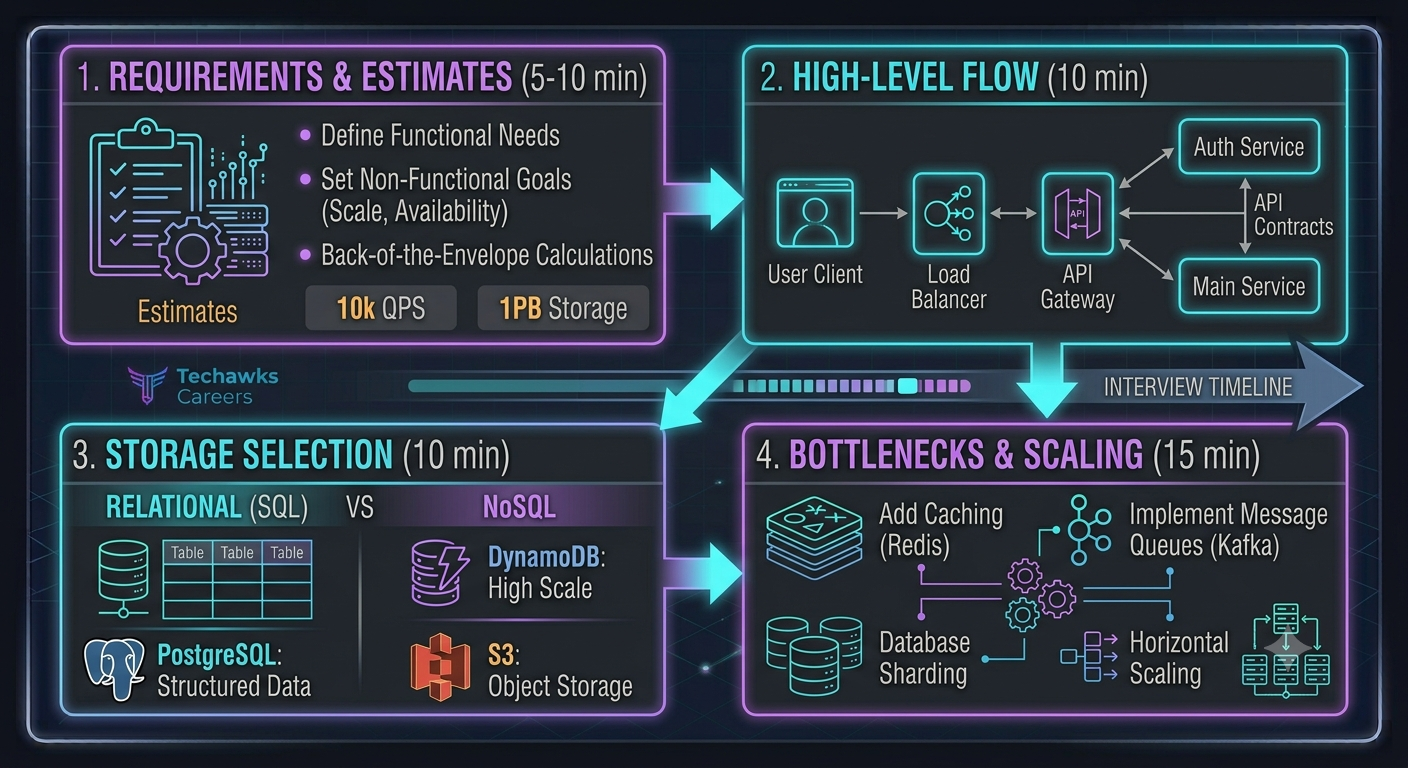
Use this 4-step framework to lead the conversation and demonstrate senior-level engineering thinking:
Clarify Requirements & Scope (First 5–10 Minutes)
Functional Requirements: Define exactly what the system must do (e.g., "Users can upload videos and view their feed").
Non-Functional Requirements: Establish scale expectations, availability targets (99.99%), latency limits (<200ms), and data consistency models (eventual vs. strong consistency).
Back-of-the-Envelope Estimates: Calculate estimated read/write QPS (Queries Per Second), bandwidth requirements, and storage capacity needed over 5 years.
Define High-Level Architecture & API Boundaries (Next 10 Minutes)
Sketch the basic data flow before diving into microservices or complex caching layers.
Draw the core components: Client → Load Balancer → API Gateway → Core Service → Database.
Define major API contracts (e.g., POST /v1/videos/upload and GET /v1/feed?user_id=123).
Choose Data Storage & Database Paradigm (Next 10 Minutes)
Relational (SQL): Choose PostgreSQL/MySQL when transaction ACID compliance and structured complex queries are required.
NoSQL (Document/Key-Value): Choose DynamoDB/Cassandra for massive horizontal scale, high throughput, and simple key-value lookups.
Blob Storage: Direct raw file uploads (images/videos) to S3/GCS rather than database blobs.
Identify Bottlenecks & Scale Components (Final 15 Minutes)
Read-Heavy System? Add Redis/Memcached caching layers or a Content Delivery Network (CDN) at the edge.
Write-Heavy System? Introduce message queues (Kafka/RabbitMQ) to decouple processing and absorb traffic spikes.
Database Bottleneck? Discuss read replicas, database sharding strategies, or indexing optimizations.
Key Takeaways
Never skip requirements gathering: Spending 5 minutes clarifying scope prevents building the wrong architecture.
Lead with trade-offs: Explicitly state why you chose NoSQL over SQL or why caching is required for your specific QPS.
Focus on bottlenecks: Identify single points of failure, network latency issues, and database read/write limits proactively.
CTA
Preparing for technical interviews, system design rounds, or negotiating your next offer?
[Join Tech Jobs & Opportunities] to access real interview case studies, mock system design practice, and direct career guidance from senior engineers and tech hiring managers.
Whether you are tasked with designing a URL shortener or a global messaging system, every successful system design interview follows a structured, repeatable framework.
Use this 4-step framework to lead the conversation and demonstrate senior-level engineering thinking:
Clarify Requirements & Scope (First 5–10 Minutes)
Functional Requirements: Define exactly what the system must do (e.g., "Users can upload videos and view their feed").
Non-Functional Requirements: Establish scale expectations, availability targets (99.99%), latency limits (<200ms), and data consistency models (eventual vs. strong consistency).
Back-of-the-Envelope Estimates: Calculate estimated read/write QPS (Queries Per Second), bandwidth requirements, and storage capacity needed over 5 years.
Define High-Level Architecture & API Boundaries (Next 10 Minutes)
Sketch the basic data flow before diving into microservices or complex caching layers.
Draw the core components: Client → Load Balancer → API Gateway → Core Service → Database.
Define major API contracts (e.g., POST /v1/videos/upload and GET /v1/feed?user_id=123).
Choose Data Storage & Database Paradigm (Next 10 Minutes)
Relational (SQL): Choose PostgreSQL/MySQL when transaction ACID compliance and structured complex queries are required.
NoSQL (Document/Key-Value): Choose DynamoDB/Cassandra for massive horizontal scale, high throughput, and simple key-value lookups.
Blob Storage: Direct raw file uploads (images/videos) to S3/GCS rather than database blobs.
Identify Bottlenecks & Scale Components (Final 15 Minutes)
Read-Heavy System? Add Redis/Memcached caching layers or a Content Delivery Network (CDN) at the edge.
Write-Heavy System? Introduce message queues (Kafka/RabbitMQ) to decouple processing and absorb traffic spikes.
Database Bottleneck? Discuss read replicas, database sharding strategies, or indexing optimizations.
Key Takeaways
Never skip requirements gathering: Spending 5 minutes clarifying scope prevents building the wrong architecture.
Lead with trade-offs: Explicitly state why you chose NoSQL over SQL or why caching is required for your specific QPS.
Focus on bottlenecks: Identify single points of failure, network latency issues, and database read/write limits proactively.
CTA
Preparing for technical interviews, system design rounds, or negotiating your next offer?
[Join Tech Jobs & Opportunities] to access real interview case studies, mock system design practice, and direct career guidance from senior engineers and tech hiring managers.
Cracking the System Design Interview: A Framework for Mid-to-Senior Engineers
Whether you are tasked with designing a URL shortener or a global messaging system, every successful system design interview follows a structured, repeatable framework.
Use this 4-step framework to lead the conversation and demonstrate senior-level engineering thinking:
Clarify Requirements & Scope (First 5–10 Minutes)
Functional Requirements: Define exactly what the system must do (e.g., "Users can upload videos and view their feed").
Non-Functional Requirements: Establish scale expectations, availability targets (99.99%), latency limits (<200ms), and data consistency models (eventual vs. strong consistency).
Back-of-the-Envelope Estimates: Calculate estimated read/write QPS (Queries Per Second), bandwidth requirements, and storage capacity needed over 5 years.
Define High-Level Architecture & API Boundaries (Next 10 Minutes)
Sketch the basic data flow before diving into microservices or complex caching layers.
Draw the core components: Client → Load Balancer → API Gateway → Core Service → Database.
Define major API contracts (e.g., POST /v1/videos/upload and GET /v1/feed?user_id=123).
Choose Data Storage & Database Paradigm (Next 10 Minutes)
Relational (SQL): Choose PostgreSQL/MySQL when transaction ACID compliance and structured complex queries are required.
NoSQL (Document/Key-Value): Choose DynamoDB/Cassandra for massive horizontal scale, high throughput, and simple key-value lookups.
Blob Storage: Direct raw file uploads (images/videos) to S3/GCS rather than database blobs.
Identify Bottlenecks & Scale Components (Final 15 Minutes)
Read-Heavy System? Add Redis/Memcached caching layers or a Content Delivery Network (CDN) at the edge.
Write-Heavy System? Introduce message queues (Kafka/RabbitMQ) to decouple processing and absorb traffic spikes.
Database Bottleneck? Discuss read replicas, database sharding strategies, or indexing optimizations.
Key Takeaways
Never skip requirements gathering: Spending 5 minutes clarifying scope prevents building the wrong architecture.
Lead with trade-offs: Explicitly state why you chose NoSQL over SQL or why caching is required for your specific QPS.
Focus on bottlenecks: Identify single points of failure, network latency issues, and database read/write limits proactively.
CTA
Preparing for technical interviews, system design rounds, or negotiating your next offer?
[Join Tech Jobs & Opportunities] to access real interview case studies, mock system design practice, and direct career guidance from senior engineers and tech hiring managers.

 Arabic
 French
 Spanish
 Portuguese
 Deutsch
 Turkish
 Dutch
Dutch
 Italiano
 Russian
 Romaian
 Portuguese (Brazil)
 Greek
Greek