


IC Path vs. Engineering Management: Which Career Track Actually Fits You?
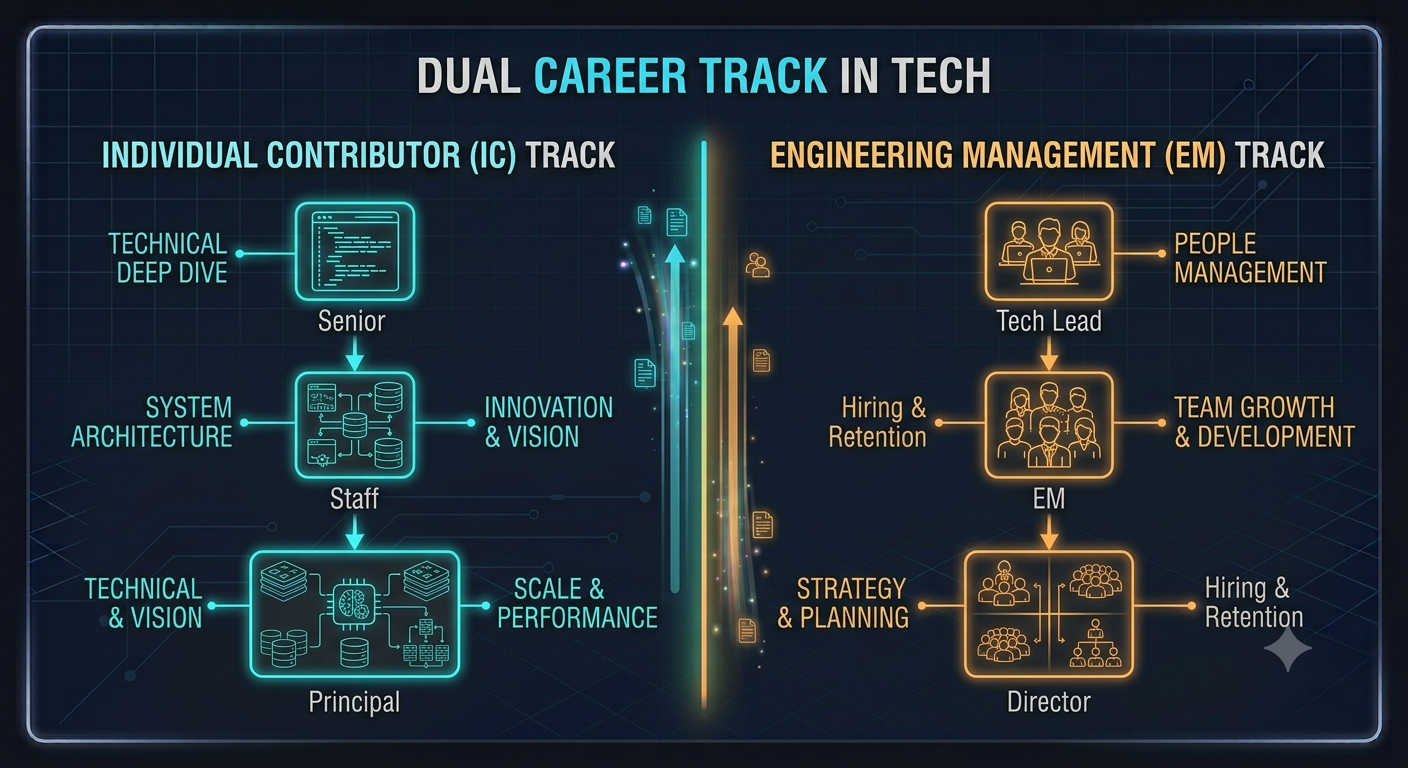
The modern tech industry has widely adopted dual-ladder career progression. This means you no longer have to step into people management just to increase your compensation, impact, or organizational title.
Before making your next internal move or applying for your next role, evaluate both paths across these key dimensions:
Individual Contributor (IC) Track: Staff / Principal Engineer
Core Focus: System architecture, technical vision, solving complex engineering bottlenecks, and establishing technical standards across teams.
Primary Value: You scale your impact through code quality, architectural decisions, and technical mentorship.
The Trade-off: Less direct involvement in organizational hiring, performance reviews, or budget allocation. You must influence without explicit authority.
Management Track: Engineering Manager (EM)
Core Focus: People development, team velocity, hiring, performance management, and aligning engineering deliverables with product roadmap goals.
Primary Value: You scale your impact by building high-performing, unblocked engineering teams and fostering career growth for others.
The Trade-off: You will write far less code (if any). Your days will shift from deep flow state focus to context-switching between meetings, 1-on-1s, and stakeholder alignment.
How to Test the Waters Before Committing
To test the IC track: Lead cross-team architecture discussions, author technical RFCs (Request for Comments), or take ownership of high-risk, ambiguous technical migrations.
To test the EM track: Step up as a Tech Lead, mentor junior developers, manage sprint planning, or lead intern hiring cycles.
Key Takeaways
Dual career tracks exist for a reason: Moving into management is a career change, not just a promotion.
IC impact scales through systems: Staff+ roles focus on cross-team technical architecture and code health.
EM impact scales through people: Management roles focus on team throughput, career growth, and operational alignment.
CTA
Have you made the transition from IC to Management—or consciously decided to stay on the technical path? What surprised you most about your choice?
Share your career experiences and battle scars in the comments, and [Join Tech Jobs & Opportunities] to engage with engineering leaders, career mentors, and job seekers navigating the tech industry.
The modern tech industry has widely adopted dual-ladder career progression. This means you no longer have to step into people management just to increase your compensation, impact, or organizational title.
Before making your next internal move or applying for your next role, evaluate both paths across these key dimensions:
Individual Contributor (IC) Track: Staff / Principal Engineer
Core Focus: System architecture, technical vision, solving complex engineering bottlenecks, and establishing technical standards across teams.
Primary Value: You scale your impact through code quality, architectural decisions, and technical mentorship.
The Trade-off: Less direct involvement in organizational hiring, performance reviews, or budget allocation. You must influence without explicit authority.
Management Track: Engineering Manager (EM)
Core Focus: People development, team velocity, hiring, performance management, and aligning engineering deliverables with product roadmap goals.
Primary Value: You scale your impact by building high-performing, unblocked engineering teams and fostering career growth for others.
The Trade-off: You will write far less code (if any). Your days will shift from deep flow state focus to context-switching between meetings, 1-on-1s, and stakeholder alignment.
How to Test the Waters Before Committing
To test the IC track: Lead cross-team architecture discussions, author technical RFCs (Request for Comments), or take ownership of high-risk, ambiguous technical migrations.
To test the EM track: Step up as a Tech Lead, mentor junior developers, manage sprint planning, or lead intern hiring cycles.
Key Takeaways
Dual career tracks exist for a reason: Moving into management is a career change, not just a promotion.
IC impact scales through systems: Staff+ roles focus on cross-team technical architecture and code health.
EM impact scales through people: Management roles focus on team throughput, career growth, and operational alignment.
CTA
Have you made the transition from IC to Management—or consciously decided to stay on the technical path? What surprised you most about your choice?
Share your career experiences and battle scars in the comments, and [Join Tech Jobs & Opportunities] to engage with engineering leaders, career mentors, and job seekers navigating the tech industry.
IC Path vs. Engineering Management: Which Career Track Actually Fits You?
The modern tech industry has widely adopted dual-ladder career progression. This means you no longer have to step into people management just to increase your compensation, impact, or organizational title.
Before making your next internal move or applying for your next role, evaluate both paths across these key dimensions:
Individual Contributor (IC) Track: Staff / Principal Engineer
Core Focus: System architecture, technical vision, solving complex engineering bottlenecks, and establishing technical standards across teams.
Primary Value: You scale your impact through code quality, architectural decisions, and technical mentorship.
The Trade-off: Less direct involvement in organizational hiring, performance reviews, or budget allocation. You must influence without explicit authority.
Management Track: Engineering Manager (EM)
Core Focus: People development, team velocity, hiring, performance management, and aligning engineering deliverables with product roadmap goals.
Primary Value: You scale your impact by building high-performing, unblocked engineering teams and fostering career growth for others.
The Trade-off: You will write far less code (if any). Your days will shift from deep flow state focus to context-switching between meetings, 1-on-1s, and stakeholder alignment.
How to Test the Waters Before Committing
To test the IC track: Lead cross-team architecture discussions, author technical RFCs (Request for Comments), or take ownership of high-risk, ambiguous technical migrations.
To test the EM track: Step up as a Tech Lead, mentor junior developers, manage sprint planning, or lead intern hiring cycles.
Key Takeaways
Dual career tracks exist for a reason: Moving into management is a career change, not just a promotion.
IC impact scales through systems: Staff+ roles focus on cross-team technical architecture and code health.
EM impact scales through people: Management roles focus on team throughput, career growth, and operational alignment.
CTA
Have you made the transition from IC to Management—or consciously decided to stay on the technical path? What surprised you most about your choice?
Share your career experiences and battle scars in the comments, and [Join Tech Jobs & Opportunities] to engage with engineering leaders, career mentors, and job seekers navigating the tech industry.

 English
 Arabic
 French
 Spanish
 Portuguese
 Deutsch
 Turkish
 Dutch
Dutch
 Italiano
 Russian
 Portuguese (Brazil)
 Greek
Greek