


Tool Review: Inside Claude Code with Prompt Caching — Why Agentic CLI Runtimes Are Replacing Chat IDEs
Agentic workflows have officially moved into your local shell. With the latest wave of developer runtimes like Claude Code, engineers are transitioning from passive autocomplete to autonomous execution loops.
Here is an architectural breakdown of what makes modern CLI agents different, why prompt caching is the critical unlock, and how to structure your development cycle around them:
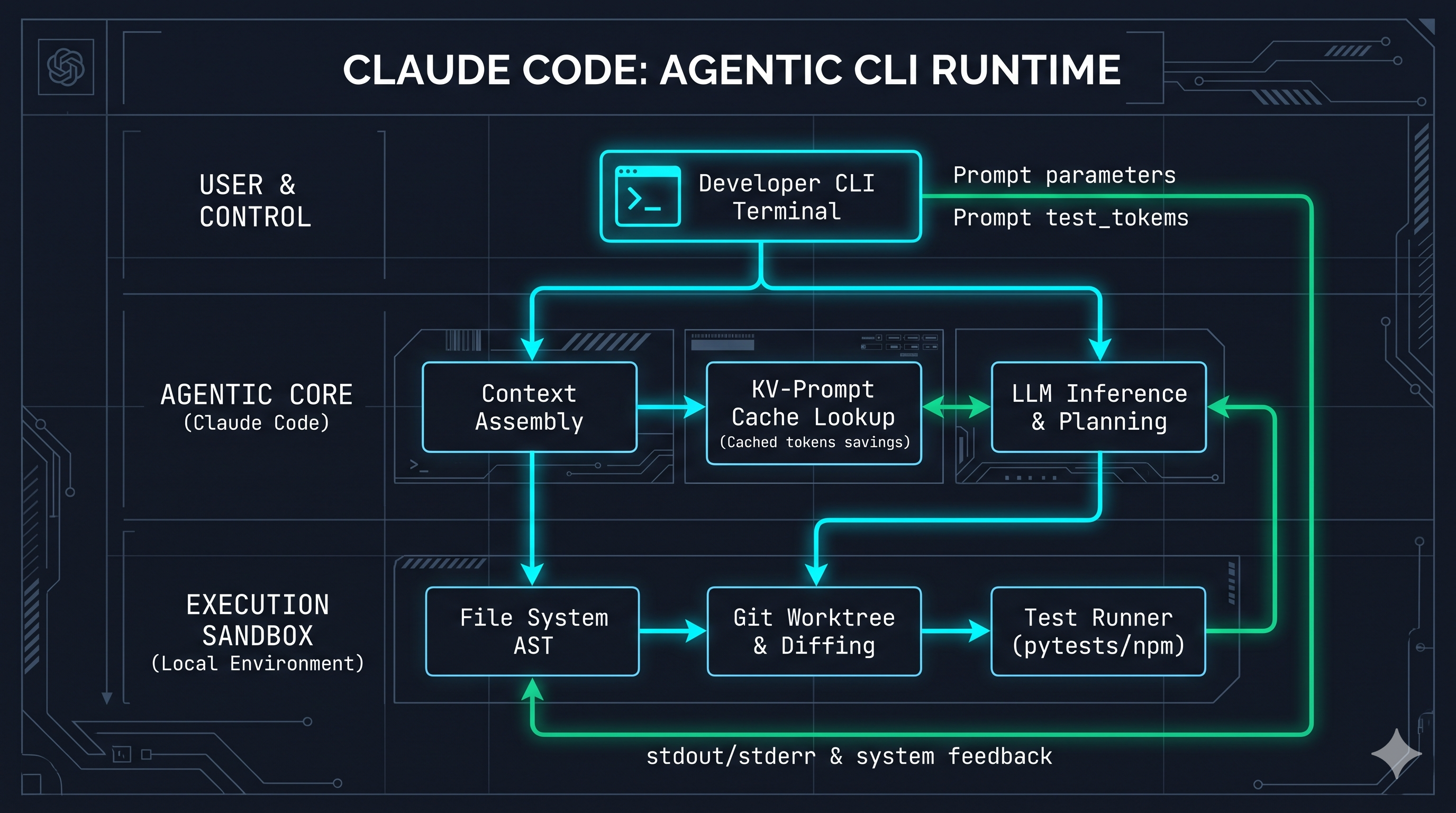
1. The Core Architecture: Read-Eval-Act Loop
Unlike traditional editor copilots that guess the next token based on open buffer tabs, a CLI agent operates directly inside your local repository using system tools:
Context Ingestion: The agent scans .git, file trees, and AST structures without requiring manual copy-pasting.
Deterministic Execution: It writes patches, runs test suites via pytest/npm test, reads stdout/stderr, and self-heals syntax errors before prompting you for confirmation.
Git Worktree Isolation: High-performing workflows spin up isolated worktrees so agents can experiment, benchmark, and revert regressions without touching your active branch.
2. The Bottleneck It Solves: Context Degradation & Token Cost
Until recently, feeding entire multi-file codebases into an agentic loop was either financially prohibitive or stalled by rate limits.
KV-Cache Hits ($0.20/M tokens): Modern prompt caching keeps 90%+ of repository context frozen in memory. Subsequent tool calls only pay for incremental diffs and output tokens.
Low-Latency Agentic Rounds: Sub-second time-to-first-token (TTFT) on cached context allows the model to perform 5–8 iterative verification loops in under 30 seconds.
3. Best Practices for AI Builders
To get production-grade output from terminal agents:
Define Strict Tool Guardrails: Configure approval flags for destructive bash commands (rm, git push --force, schema migrations).
Standardize Task Spec Files: Feed the agent a concise SPEC.md or acceptance criteria checklist rather than open-ended natural language prompts.
Enforce Test-Driven Prompts: Tell the agent to write a failing integration test first, run it, and iterate until green.
Discussion Question
For your day-to-day engineering, do you prefer autonomous terminal agents executing bash commands, or inline IDE completions where you retain character-level control?
CTA
Join AI Builders & Enthusiasts: Connect with engineers, system architects, and developers shaping the future of autonomous software workflows at Techawks.
Tool Review: Inside Claude Code with Prompt Caching — Why Agentic CLI Runtimes Are Replacing Chat IDEs
Agentic workflows have officially moved into your local shell. With the latest wave of developer runtimes like Claude Code, engineers are transitioning from passive autocomplete to autonomous execution loops.
Here is an architectural breakdown of what makes modern CLI agents different, why prompt caching is the critical unlock, and how to structure your development cycle around them:
1. The Core Architecture: Read-Eval-Act Loop
Unlike traditional editor copilots that guess the next token based on open buffer tabs, a CLI agent operates directly inside your local repository using system tools:
Context Ingestion: The agent scans .git, file trees, and AST structures without requiring manual copy-pasting.
Deterministic Execution: It writes patches, runs test suites via pytest/npm test, reads stdout/stderr, and self-heals syntax errors before prompting you for confirmation.
Git Worktree Isolation: High-performing workflows spin up isolated worktrees so agents can experiment, benchmark, and revert regressions without touching your active branch.
2. The Bottleneck It Solves: Context Degradation & Token Cost
Until recently, feeding entire multi-file codebases into an agentic loop was either financially prohibitive or stalled by rate limits.
KV-Cache Hits ($0.20/M tokens): Modern prompt caching keeps 90%+ of repository context frozen in memory. Subsequent tool calls only pay for incremental diffs and output tokens.
Low-Latency Agentic Rounds: Sub-second time-to-first-token (TTFT) on cached context allows the model to perform 5–8 iterative verification loops in under 30 seconds.
3. Best Practices for AI Builders
To get production-grade output from terminal agents:
Define Strict Tool Guardrails: Configure approval flags for destructive bash commands (rm, git push --force, schema migrations).
Standardize Task Spec Files: Feed the agent a concise SPEC.md or acceptance criteria checklist rather than open-ended natural language prompts.
Enforce Test-Driven Prompts: Tell the agent to write a failing integration test first, run it, and iterate until green.
Discussion Question
For your day-to-day engineering, do you prefer autonomous terminal agents executing bash commands, or inline IDE completions where you retain character-level control?
CTA
Join AI Builders & Enthusiasts: Connect with engineers, system architects, and developers shaping the future of autonomous software workflows at Techawks.

 Arabic
 French
 Spanish
 Portuguese
 Deutsch
 Turkish
 Dutch
 Italiano
 Russian
 Romaian
 Portuguese (Brazil)
 Greek