


Async/Await Does Not Make Code Run in Parallel: The Concurrency vs. Parallelism Reality
As developers scale asynchronous runtimes (Node.js/V8, Python asyncio, Go runtimes, or Rust tokio), one of the most persistent misconceptions across backend engineering is: "async/await runs tasks in parallel."
Here is why confusing concurrency with parallelism degrades performance in high-throughput applications:
Myth vs Fact
Myth: Wrapping a slow computational function in async and awaiting it runs the task on another core, preventing latency spikes for other users.
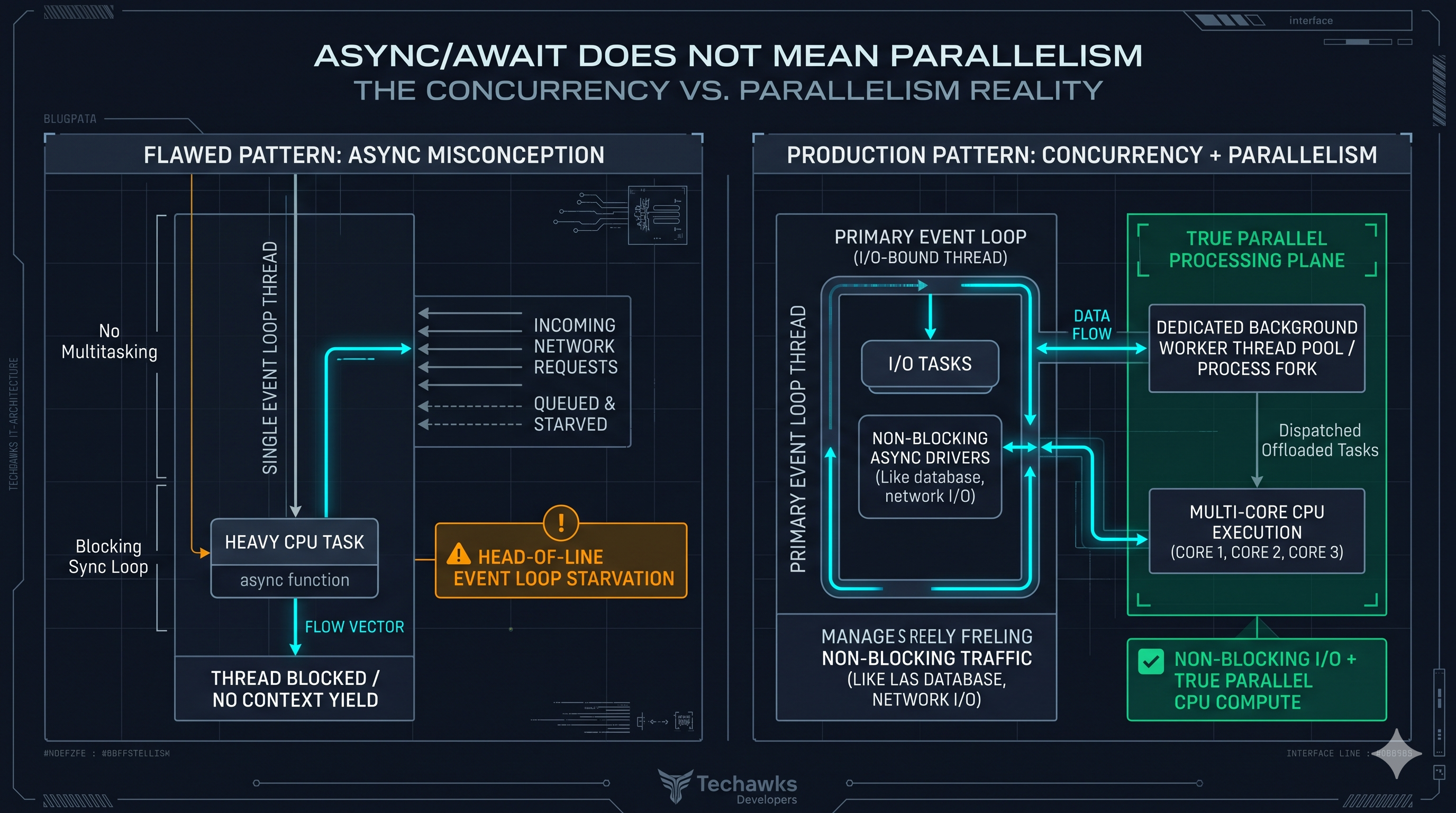
Fact: async/await provides concurrency, not parallelism. It enables cooperative multitasking over I/O-bound wait cycles on an event loop or worker thread pool. A CPU-heavy synchronous loop inside an async function monopolizes the execution thread and halts the entire runtime tick.
The Core Problem: The Thread-Starvation Trap
Concurrency is about structure (handling multiple things at once); parallelism is about execution (doing multiple things at the same physical instant across CPU cores).
When an asynchronous routine issues an I/O request (a PostgreSQL query, an HTTP fetch, or a disk read), it registers a callback or future, yields its execution context back to the event loop, and frees the thread to process incoming requests.
However, if you place intensive computation (JSON serialization of gigabyte payloads, image transformations, cryptographic hashing, or large array sorting) inside an async function:
The Event Loop Freezes: Because the task does not yield (it performs no non-blocking I/O), no other incoming traffic can be processed.
Cascading Health-Check Failures: Readiness probes and ping endpoints time out because their handlers are queued behind the CPU-bound task.
P99 Latency Explodes: Concurrency collapses into a sequential, head-of-line blocking bottleneck.
What to Implement Instead: Proper Workload Isolation
Keep Async Strictly for Non-Blocking I/O: Use native non-blocking network sockets and database drivers that release the thread while waiting for kernel socket notifications (e.g., epoll, kqueue, io_uring).
Offload CPU-Bound Tasks to OS Worker Pools: Dispatch compute workloads outside the primary event loop using separate processes or OS-managed worker thread pools (e.g., Node.js worker_threads, Python ProcessPoolExecutor, Go goroutines scheduled across GOMAXPROCS cores).
Implement Explicit Cooperative Chunking: When long-running calculations must stay in the main loop, explicitly break the operation into discrete batches and yield back to the scheduler using zero-delay timers or microtask yields (e.g., await setImmediate() or await asyncio.sleep(0)).
Discussion Question
How does your team detect and prevent CPU-bound tasks from quietly blocking your primary backend event loops during peak production traffic?
CTA (Join Developers & Coding)
Ready to build bulletproof backend systems, master low-level runtime internals, and write cleaner, high-performance code? Join the Techawks Developers & Coding Community to connect with top engineers, review real-world system designs, and debug alongside peers.
Async/Await Does Not Make Code Run in Parallel: The Concurrency vs. Parallelism Reality
As developers scale asynchronous runtimes (Node.js/V8, Python asyncio, Go runtimes, or Rust tokio), one of the most persistent misconceptions across backend engineering is: "async/await runs tasks in parallel."
Here is why confusing concurrency with parallelism degrades performance in high-throughput applications:
Myth vs Fact
Myth: Wrapping a slow computational function in async and awaiting it runs the task on another core, preventing latency spikes for other users.
Fact: async/await provides concurrency, not parallelism. It enables cooperative multitasking over I/O-bound wait cycles on an event loop or worker thread pool. A CPU-heavy synchronous loop inside an async function monopolizes the execution thread and halts the entire runtime tick.
The Core Problem: The Thread-Starvation Trap
Concurrency is about structure (handling multiple things at once); parallelism is about execution (doing multiple things at the same physical instant across CPU cores).
When an asynchronous routine issues an I/O request (a PostgreSQL query, an HTTP fetch, or a disk read), it registers a callback or future, yields its execution context back to the event loop, and frees the thread to process incoming requests.
However, if you place intensive computation (JSON serialization of gigabyte payloads, image transformations, cryptographic hashing, or large array sorting) inside an async function:
The Event Loop Freezes: Because the task does not yield (it performs no non-blocking I/O), no other incoming traffic can be processed.
Cascading Health-Check Failures: Readiness probes and ping endpoints time out because their handlers are queued behind the CPU-bound task.
P99 Latency Explodes: Concurrency collapses into a sequential, head-of-line blocking bottleneck.
What to Implement Instead: Proper Workload Isolation
Keep Async Strictly for Non-Blocking I/O: Use native non-blocking network sockets and database drivers that release the thread while waiting for kernel socket notifications (e.g., epoll, kqueue, io_uring).
Offload CPU-Bound Tasks to OS Worker Pools: Dispatch compute workloads outside the primary event loop using separate processes or OS-managed worker thread pools (e.g., Node.js worker_threads, Python ProcessPoolExecutor, Go goroutines scheduled across GOMAXPROCS cores).
Implement Explicit Cooperative Chunking: When long-running calculations must stay in the main loop, explicitly break the operation into discrete batches and yield back to the scheduler using zero-delay timers or microtask yields (e.g., await setImmediate() or await asyncio.sleep(0)).
Discussion Question
How does your team detect and prevent CPU-bound tasks from quietly blocking your primary backend event loops during peak production traffic?
CTA (Join Developers & Coding)
Ready to build bulletproof backend systems, master low-level runtime internals, and write cleaner, high-performance code? Join the Techawks Developers & Coding Community to connect with top engineers, review real-world system designs, and debug alongside peers.

 English
 Arabic
 French
 Spanish
 Portuguese
 Deutsch
 Turkish
 Dutch
 Russian
 Romaian
 Portuguese (Brazil)
 Greek