


Stop Writing Defensive Nil Checks: Why Invariant Contracts Beat Null Guard Sprawl
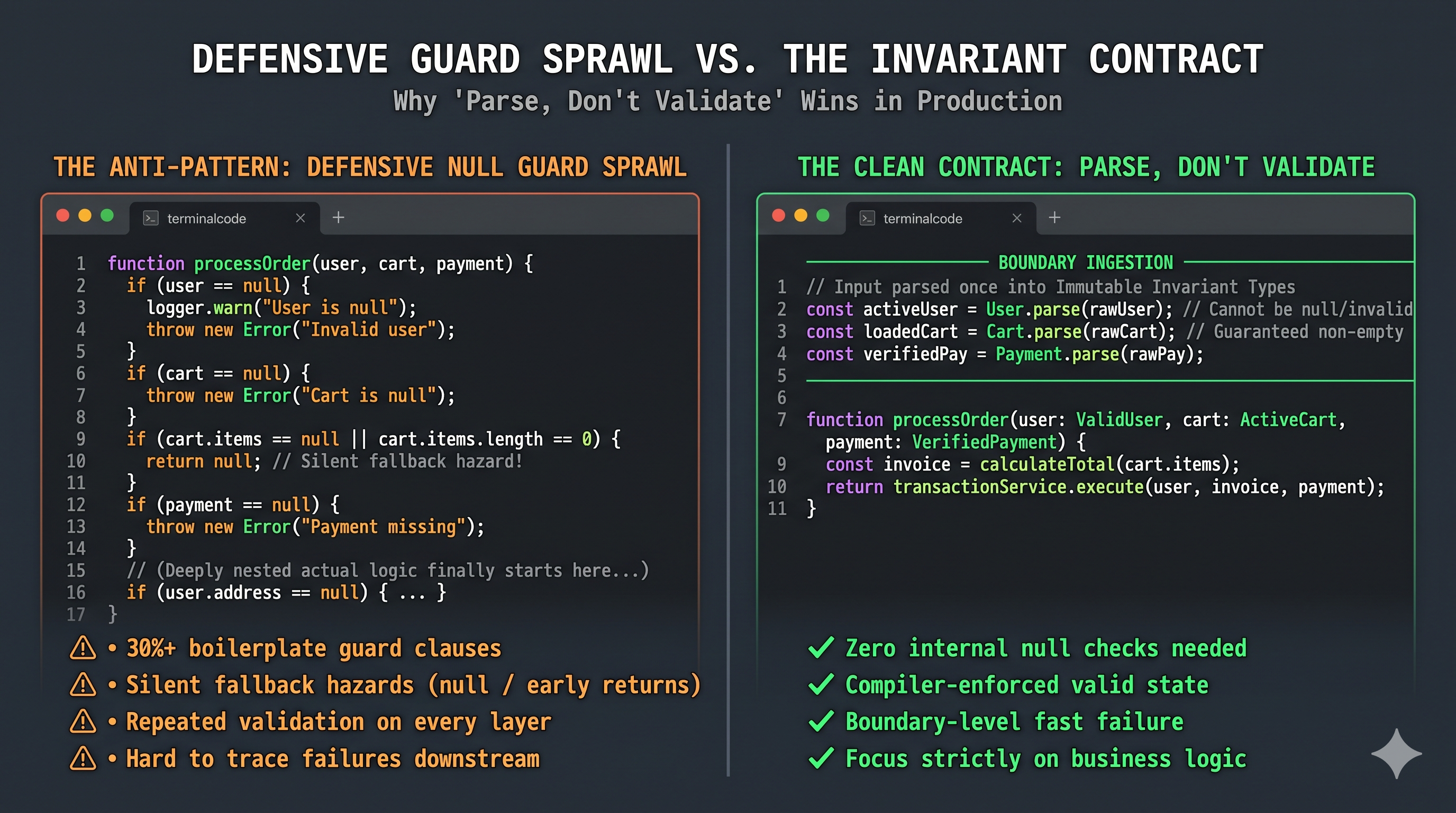
Modern production services spend an absurd amount of CPU cycles and developer cognitive overhead defensively verifying data that should have been structurally impossible to invalidate in the first place.When every nested layer of a service re-validates the same inputs, two critical problems emerge:Silent Fallback Hazards: Falling back to empty lists, default zeros, or swallowing null deep in the call stack defers failure to downstream systems where root-cause tracing is nearly impossible.Cognitive Noise in Code Reviews: Business logic drowns in guard clauses. The real operational contract is hidden beneath defensive boilerplate.The Core Shift: Parse, Don't ValidateValidation is verifying a boolean property. Parsing is transforming data into a type that fundamentally guarantees that property across the remainder of the execution pipeline.[ Unchecked Input / Payload ]
│
▼
┌───────────────────────┐
│ Ingestion Boundary │ ──► Parse directly into Branded / Refined Types
│ (Single Parse Gate) │ (e.g., NonEmptyList, PositiveInt, ValidatedUUID)
└───────────────────────┘
│
▼
┌───────────────────────┐
│ Pure Core Domain │ ──► Zero defensive checks needed.
│ (Zero Null Checks) │ Compiler-enforced valid state by definition.
└───────────────────────┘
How to apply this to your codebase:Replace Primitive Types with Invariant Wrappers: Stop passing raw String or int parameters for sensitive domain identifiers. A UserId or CurrencyAmount class that asserts validity during instantiation guarantees that downstream methods never have to re-verify formatting, range, or nullity.Enforce Preconditions at Language Boundaries: Instead of sprinkling manual if-statements across internal functions, adopt formal Preconditions and Invariant Contracts. If a function cannot proceed without a valid state, fail fast at the boundary rather than returning a nullable result that forces the caller into another defensive branch.
Make the Invalid State Unrepresentable: If a user account cannot exist without a verified email in state $B$, do not make verifiedEmail an optional field on a monolithic User object. Represent states explicitly through algebraic data types (enums or sealed classes): PendingUser vs. VerifiedUser.
When the type system carries the invariant, your runtime no longer has to guess.
Discussion Question
What is your team’s policy on internal defensive checks—do you enforce fail-fast preconditions at the boundary, or let defensive null checks run through every service layer?
CTA (Join Developers & Coding)
Join the Techawks Developers community to level up your software architecture, tackle hard engineering challenges, and build production-grade systems alongside top engineers. Drop your perspective in the comments below.
Stop Writing Defensive Nil Checks: Why Invariant Contracts Beat Null Guard Sprawl
Modern production services spend an absurd amount of CPU cycles and developer cognitive overhead defensively verifying data that should have been structurally impossible to invalidate in the first place.When every nested layer of a service re-validates the same inputs, two critical problems emerge:Silent Fallback Hazards: Falling back to empty lists, default zeros, or swallowing null deep in the call stack defers failure to downstream systems where root-cause tracing is nearly impossible.Cognitive Noise in Code Reviews: Business logic drowns in guard clauses. The real operational contract is hidden beneath defensive boilerplate.The Core Shift: Parse, Don't ValidateValidation is verifying a boolean property. Parsing is transforming data into a type that fundamentally guarantees that property across the remainder of the execution pipeline.[ Unchecked Input / Payload ]
│
▼
┌───────────────────────┐
│ Ingestion Boundary │ ──► Parse directly into Branded / Refined Types
│ (Single Parse Gate) │ (e.g., NonEmptyList, PositiveInt, ValidatedUUID)
└───────────────────────┘
│
▼
┌───────────────────────┐
│ Pure Core Domain │ ──► Zero defensive checks needed.
│ (Zero Null Checks) │ Compiler-enforced valid state by definition.
└───────────────────────┘
How to apply this to your codebase:Replace Primitive Types with Invariant Wrappers: Stop passing raw String or int parameters for sensitive domain identifiers. A UserId or CurrencyAmount class that asserts validity during instantiation guarantees that downstream methods never have to re-verify formatting, range, or nullity.Enforce Preconditions at Language Boundaries: Instead of sprinkling manual if-statements across internal functions, adopt formal Preconditions and Invariant Contracts. If a function cannot proceed without a valid state, fail fast at the boundary rather than returning a nullable result that forces the caller into another defensive branch.
Make the Invalid State Unrepresentable: If a user account cannot exist without a verified email in state $B$, do not make verifiedEmail an optional field on a monolithic User object. Represent states explicitly through algebraic data types (enums or sealed classes): PendingUser vs. VerifiedUser.
When the type system carries the invariant, your runtime no longer has to guess.
Discussion Question
What is your team’s policy on internal defensive checks—do you enforce fail-fast preconditions at the boundary, or let defensive null checks run through every service layer?
CTA (Join Developers & Coding)
Join the Techawks Developers community to level up your software architecture, tackle hard engineering challenges, and build production-grade systems alongside top engineers. Drop your perspective in the comments below.

 English
 Arabic
 French
 Spanish
 Portuguese
 Deutsch
 Dutch
 Italiano
 Russian
 Romaian
 Portuguese (Brazil)
 Greek