


Zero Trust Architecture 101: How to Secure Microservices in Production
The traditional "castle-and-moat" security model—where everything inside the corporate VPN or private subnet is trusted—is obsolete. As engineering teams in the US transition toward multi-region deployments, hybrid clouds, and remote-first operations, security must be embedded directly into service-to-service communication.
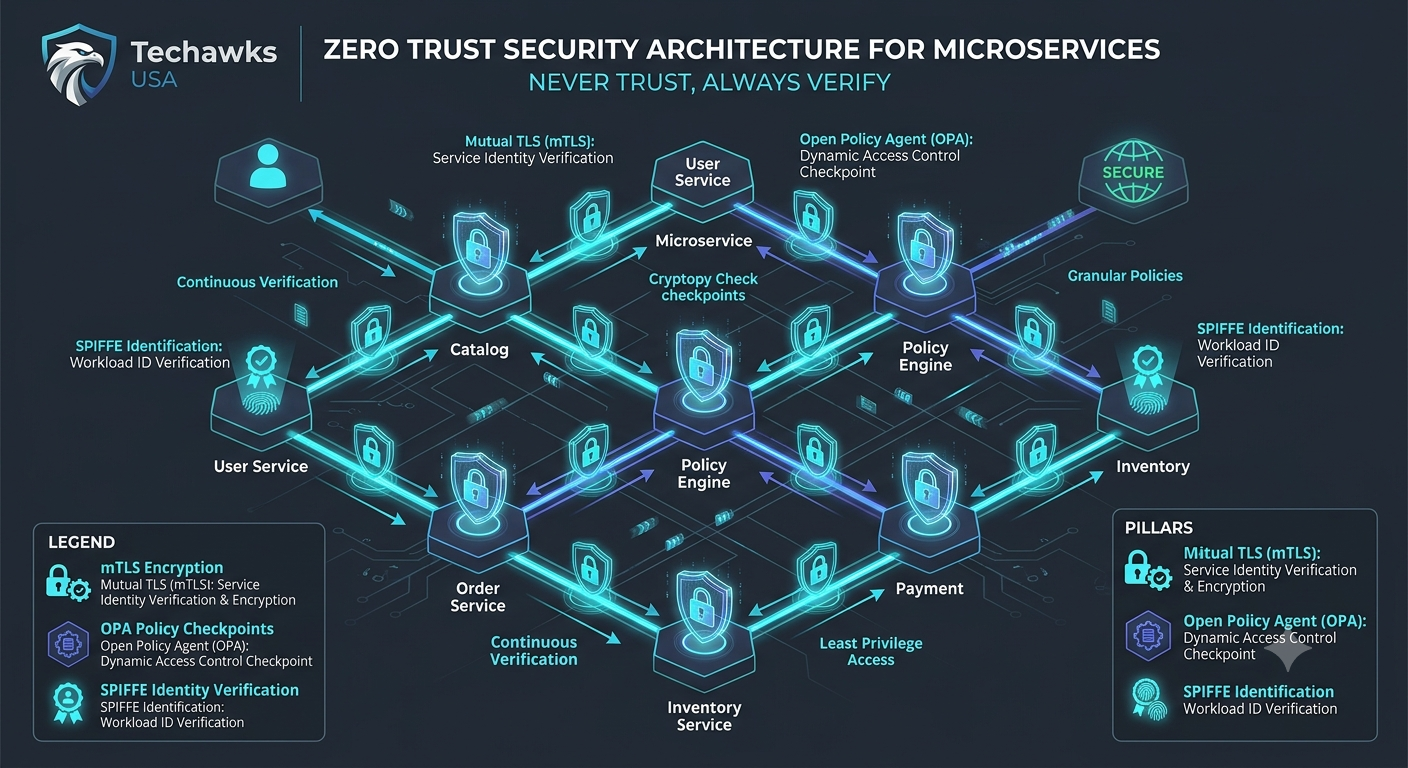
Zero Trust operates on one core principle: Never trust, always verify.
Here is a practical, step-by-step roadmap to implement Zero Trust within your microservices architecture:
Enforce Service-to-Service Authentication with mTLS
Do not rely on unencrypted HTTP or basic API keys for internal traffic. Implement Mutual TLS (mTLS) using a service mesh like Istio or Linkerd.
mTLS ensures that every service cryptographically verifies the identity of the calling service and encrypts all data in transit automatically.
Adopt Least-Privilege Identity Management (SPIFFE/SPIRE)
Move away from static IAM secrets and long-lived tokens stored in environment variables.
Use SPIFFE/SPIRE to issue short-lived, cryptographically verifiable identities (SVIDs) to your workloads based on runtime properties, automatically rotating certificates every few hours.
Implement Attribute-Based Access Control (ABAC)
Role-Based Access Control (RBAC) often leads to role bloat. Instead, use fine-grained policy engines like Open Policy Agent (OPA).
Authorize incoming requests dynamically based on context—such as caller identity, time of day, request payload, and target endpoint parameters.
Micro-segment Your Network
Define explicit egress and ingress security rules using Kubernetes NetworkPolicies or cloud security groups. By default, deny all cross-namespace traffic and only white-list routes that are explicitly required for the application to function.
Key Takeaways
Kill the Perimeter: Treat internal network traffic as untrusted by default.
Encrypt Everything: Use mTLS via a service mesh for automatic service identity verification and transit encryption.
Short-Lived Credentials: Replace hardcoded secrets with dynamic runtime identities using SPIFFE/SPIRE.
Policy as Code: Centralize authorization rules using policy engines like OPA to ensure consistent auditability.
CTA
Looking to level up your cloud-native security practices and connect with top DevOps and security engineers across the US?
[Join Techawks USA today] and be part of the community shaping the future of secure software engineering.
The traditional "castle-and-moat" security model—where everything inside the corporate VPN or private subnet is trusted—is obsolete. As engineering teams in the US transition toward multi-region deployments, hybrid clouds, and remote-first operations, security must be embedded directly into service-to-service communication.
Zero Trust operates on one core principle: Never trust, always verify.
Here is a practical, step-by-step roadmap to implement Zero Trust within your microservices architecture:
Enforce Service-to-Service Authentication with mTLS
Do not rely on unencrypted HTTP or basic API keys for internal traffic. Implement Mutual TLS (mTLS) using a service mesh like Istio or Linkerd.
mTLS ensures that every service cryptographically verifies the identity of the calling service and encrypts all data in transit automatically.
Adopt Least-Privilege Identity Management (SPIFFE/SPIRE)
Move away from static IAM secrets and long-lived tokens stored in environment variables.
Use SPIFFE/SPIRE to issue short-lived, cryptographically verifiable identities (SVIDs) to your workloads based on runtime properties, automatically rotating certificates every few hours.
Implement Attribute-Based Access Control (ABAC)
Role-Based Access Control (RBAC) often leads to role bloat. Instead, use fine-grained policy engines like Open Policy Agent (OPA).
Authorize incoming requests dynamically based on context—such as caller identity, time of day, request payload, and target endpoint parameters.
Micro-segment Your Network
Define explicit egress and ingress security rules using Kubernetes NetworkPolicies or cloud security groups. By default, deny all cross-namespace traffic and only white-list routes that are explicitly required for the application to function.
Key Takeaways
Kill the Perimeter: Treat internal network traffic as untrusted by default.
Encrypt Everything: Use mTLS via a service mesh for automatic service identity verification and transit encryption.
Short-Lived Credentials: Replace hardcoded secrets with dynamic runtime identities using SPIFFE/SPIRE.
Policy as Code: Centralize authorization rules using policy engines like OPA to ensure consistent auditability.
CTA
Looking to level up your cloud-native security practices and connect with top DevOps and security engineers across the US?
[Join Techawks USA today] and be part of the community shaping the future of secure software engineering.
Zero Trust Architecture 101: How to Secure Microservices in Production
The traditional "castle-and-moat" security model—where everything inside the corporate VPN or private subnet is trusted—is obsolete. As engineering teams in the US transition toward multi-region deployments, hybrid clouds, and remote-first operations, security must be embedded directly into service-to-service communication.
Zero Trust operates on one core principle: Never trust, always verify.
Here is a practical, step-by-step roadmap to implement Zero Trust within your microservices architecture:
Enforce Service-to-Service Authentication with mTLS
Do not rely on unencrypted HTTP or basic API keys for internal traffic. Implement Mutual TLS (mTLS) using a service mesh like Istio or Linkerd.
mTLS ensures that every service cryptographically verifies the identity of the calling service and encrypts all data in transit automatically.
Adopt Least-Privilege Identity Management (SPIFFE/SPIRE)
Move away from static IAM secrets and long-lived tokens stored in environment variables.
Use SPIFFE/SPIRE to issue short-lived, cryptographically verifiable identities (SVIDs) to your workloads based on runtime properties, automatically rotating certificates every few hours.
Implement Attribute-Based Access Control (ABAC)
Role-Based Access Control (RBAC) often leads to role bloat. Instead, use fine-grained policy engines like Open Policy Agent (OPA).
Authorize incoming requests dynamically based on context—such as caller identity, time of day, request payload, and target endpoint parameters.
Micro-segment Your Network
Define explicit egress and ingress security rules using Kubernetes NetworkPolicies or cloud security groups. By default, deny all cross-namespace traffic and only white-list routes that are explicitly required for the application to function.
Key Takeaways
Kill the Perimeter: Treat internal network traffic as untrusted by default.
Encrypt Everything: Use mTLS via a service mesh for automatic service identity verification and transit encryption.
Short-Lived Credentials: Replace hardcoded secrets with dynamic runtime identities using SPIFFE/SPIRE.
Policy as Code: Centralize authorization rules using policy engines like OPA to ensure consistent auditability.
CTA
Looking to level up your cloud-native security practices and connect with top DevOps and security engineers across the US?
[Join Techawks USA today] and be part of the community shaping the future of secure software engineering.

 English
 Arabic
 French
 Spanish
 Portuguese
 Deutsch
 Turkish
 Dutch
Dutch
 Italiano
 Russian
 Romaian
 Portuguese (Brazil)