


The UK Engineer’s Guide to Building GDPR-Compliant Cloud Data Pipelines
For tech teams in the UK, handling personal data requires strict adherence to privacy-by-design principles. Relying on superficial consent banners while storing raw user identifiers in your analytics warehouse creates massive compliance exposure.
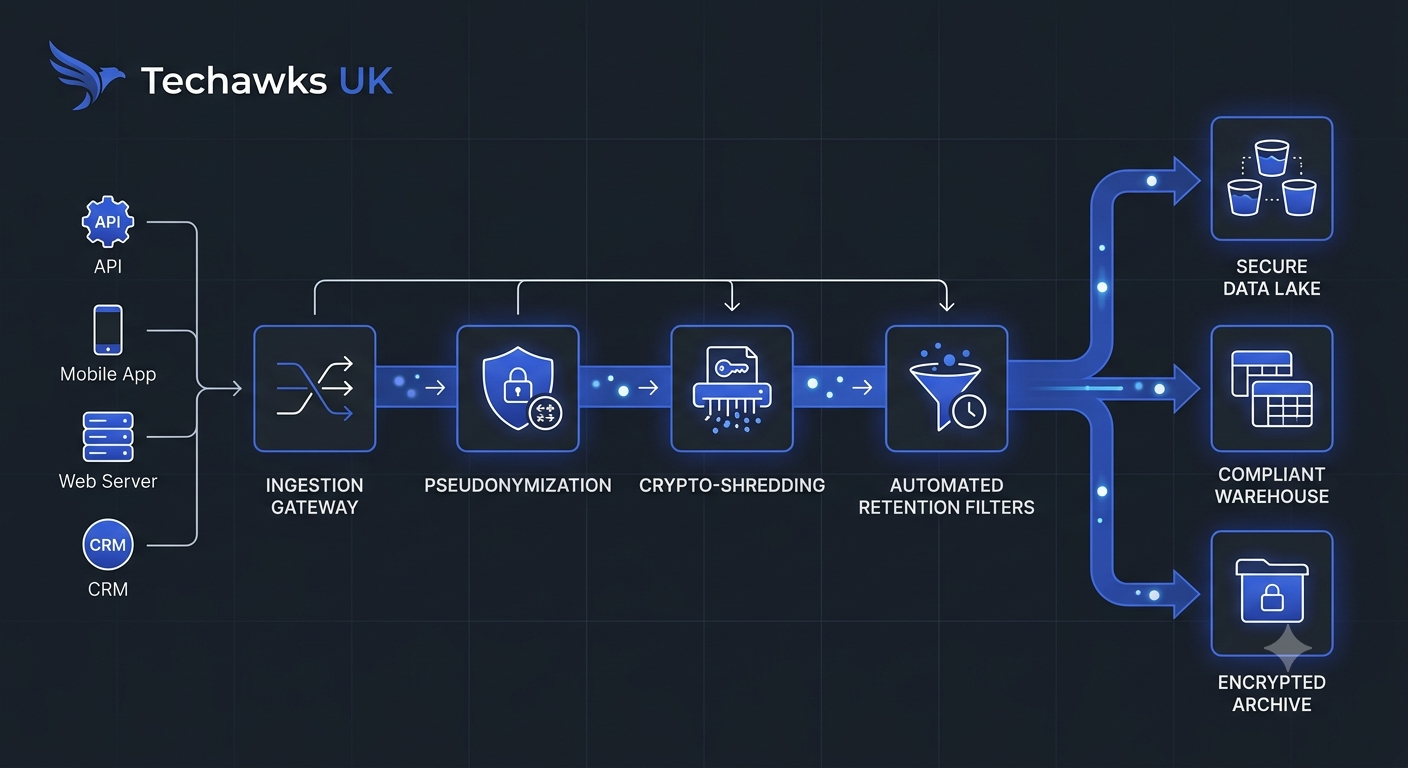
Architecting data pipelines for scalability and strict regulatory compliance doesn't have to slow down your development velocity. Here is how to keep your data pipelines compliant by design:
Pseudonymize at the Ingestion Layer
Never store raw Personally Identifiable Information (PII) like names, emails, or IP addresses directly in your data lake.
Apply cryptographically salted hashes (e.g., HMAC-SHA256) at the point of ingestion before data hits storage buckets or processing queues.
Decouple Identity from Telemetry Data
Maintain a separate, highly restricted identity lookup table for user mappings.
Store transactional and event telemetry separately using anonymous internal identifiers. This isolates risk and simplifies governance audits.
Architect for the "Right to be Forgotten" (Data Erasure)
Deleting individual records from immutable columnar data stores (like AWS Redshift, Snowflake, or Parquet files on S3) is notoriously slow and costly.
Implement a Crypto-Shredding strategy: encrypt each user's PII with a unique, dedicated key stored in a Key Management Service (KMS). When a user requests data deletion, simply destroy their specific key—instantly rendering all their historical data cryptographically unreadable.
Automate Data Retention Lifecycles
Storing stale user data indefinitely directly violates UK GDPR storage limitation principles.
Set up automated TTL (Time-To-Live) policies on database rows and S3 lifecycle rules to purge or archive transient log data after its retention window expires.
Key Takeaways
Hash Early: Strip or pseudonymize PII at the ingestion point before it reaches downstream analytics stores.
Crypto-Shredding: Simplify compliance deletions in immutable data lakes by destroying per-user encryption keys.
Isolate Identity: Keep identity mappings separate from behavioral telemetry.
Enforce TTLs: Automate retention schedules so old data expires according to regulatory policy.
CTA
Want to share data engineering best practices and discuss UK tech compliance with lead architects across the country?
[Join Techawks UK today] and collaborate with our growing tech ecosystem.
For tech teams in the UK, handling personal data requires strict adherence to privacy-by-design principles. Relying on superficial consent banners while storing raw user identifiers in your analytics warehouse creates massive compliance exposure.
Architecting data pipelines for scalability and strict regulatory compliance doesn't have to slow down your development velocity. Here is how to keep your data pipelines compliant by design:
Pseudonymize at the Ingestion Layer
Never store raw Personally Identifiable Information (PII) like names, emails, or IP addresses directly in your data lake.
Apply cryptographically salted hashes (e.g., HMAC-SHA256) at the point of ingestion before data hits storage buckets or processing queues.
Decouple Identity from Telemetry Data
Maintain a separate, highly restricted identity lookup table for user mappings.
Store transactional and event telemetry separately using anonymous internal identifiers. This isolates risk and simplifies governance audits.
Architect for the "Right to be Forgotten" (Data Erasure)
Deleting individual records from immutable columnar data stores (like AWS Redshift, Snowflake, or Parquet files on S3) is notoriously slow and costly.
Implement a Crypto-Shredding strategy: encrypt each user's PII with a unique, dedicated key stored in a Key Management Service (KMS). When a user requests data deletion, simply destroy their specific key—instantly rendering all their historical data cryptographically unreadable.
Automate Data Retention Lifecycles
Storing stale user data indefinitely directly violates UK GDPR storage limitation principles.
Set up automated TTL (Time-To-Live) policies on database rows and S3 lifecycle rules to purge or archive transient log data after its retention window expires.
Key Takeaways
Hash Early: Strip or pseudonymize PII at the ingestion point before it reaches downstream analytics stores.
Crypto-Shredding: Simplify compliance deletions in immutable data lakes by destroying per-user encryption keys.
Isolate Identity: Keep identity mappings separate from behavioral telemetry.
Enforce TTLs: Automate retention schedules so old data expires according to regulatory policy.
CTA
Want to share data engineering best practices and discuss UK tech compliance with lead architects across the country?
[Join Techawks UK today] and collaborate with our growing tech ecosystem.
The UK Engineer’s Guide to Building GDPR-Compliant Cloud Data Pipelines
For tech teams in the UK, handling personal data requires strict adherence to privacy-by-design principles. Relying on superficial consent banners while storing raw user identifiers in your analytics warehouse creates massive compliance exposure.
Architecting data pipelines for scalability and strict regulatory compliance doesn't have to slow down your development velocity. Here is how to keep your data pipelines compliant by design:
Pseudonymize at the Ingestion Layer
Never store raw Personally Identifiable Information (PII) like names, emails, or IP addresses directly in your data lake.
Apply cryptographically salted hashes (e.g., HMAC-SHA256) at the point of ingestion before data hits storage buckets or processing queues.
Decouple Identity from Telemetry Data
Maintain a separate, highly restricted identity lookup table for user mappings.
Store transactional and event telemetry separately using anonymous internal identifiers. This isolates risk and simplifies governance audits.
Architect for the "Right to be Forgotten" (Data Erasure)
Deleting individual records from immutable columnar data stores (like AWS Redshift, Snowflake, or Parquet files on S3) is notoriously slow and costly.
Implement a Crypto-Shredding strategy: encrypt each user's PII with a unique, dedicated key stored in a Key Management Service (KMS). When a user requests data deletion, simply destroy their specific key—instantly rendering all their historical data cryptographically unreadable.
Automate Data Retention Lifecycles
Storing stale user data indefinitely directly violates UK GDPR storage limitation principles.
Set up automated TTL (Time-To-Live) policies on database rows and S3 lifecycle rules to purge or archive transient log data after its retention window expires.
Key Takeaways
Hash Early: Strip or pseudonymize PII at the ingestion point before it reaches downstream analytics stores.
Crypto-Shredding: Simplify compliance deletions in immutable data lakes by destroying per-user encryption keys.
Isolate Identity: Keep identity mappings separate from behavioral telemetry.
Enforce TTLs: Automate retention schedules so old data expires according to regulatory policy.
CTA
Want to share data engineering best practices and discuss UK tech compliance with lead architects across the country?
[Join Techawks UK today] and collaborate with our growing tech ecosystem.

 English
 French
 Spanish
 Portuguese
 Deutsch
 Turkish
 Dutch
Dutch
 Italiano
 Russian
 Romaian
 Portuguese (Brazil)
 Greek
Greek