


Building High-Throughput Node.js Applications: How to Solve Worker Thread Bottlenecks
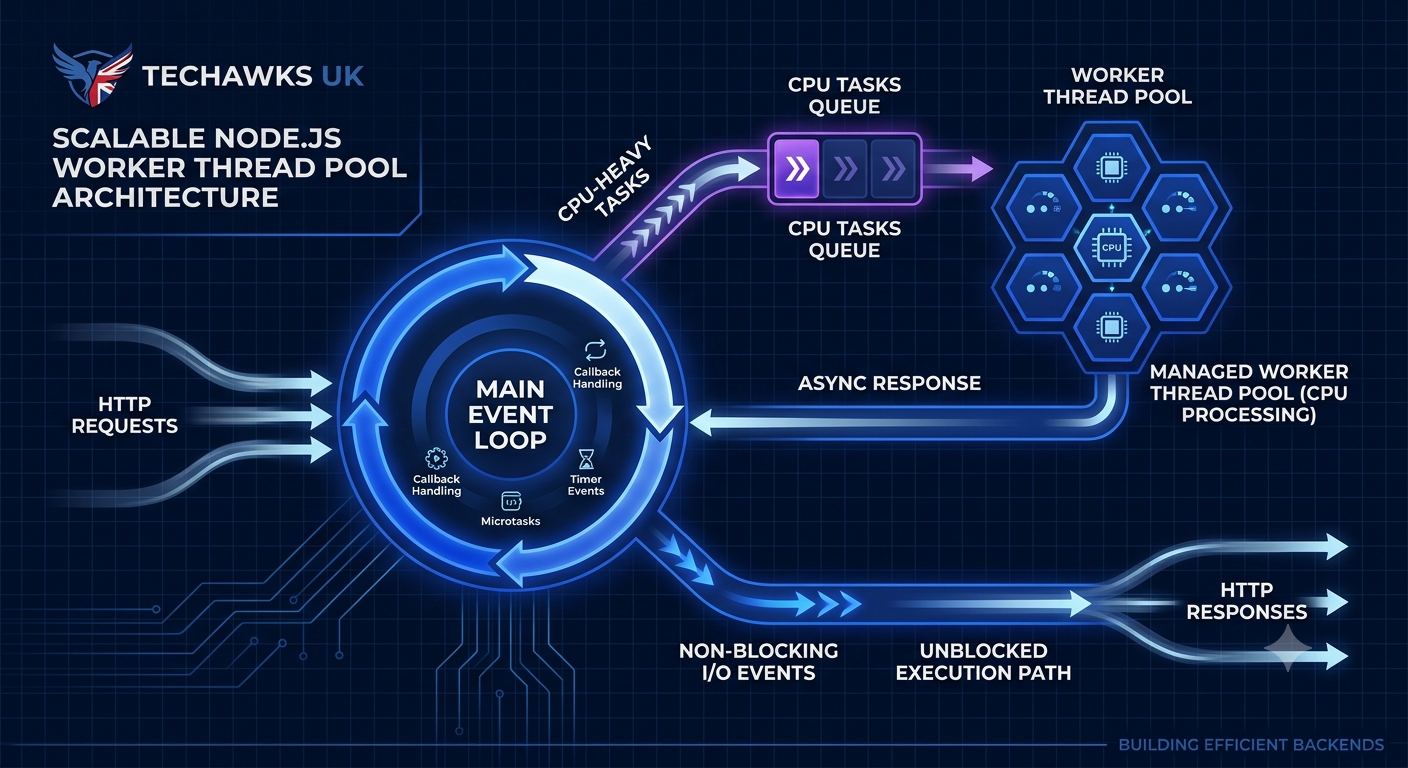
Node.js built its reputation on non-blocking I/O. However, as UK engineering teams scale backend systems for tasks like PDF generation, image processing, or complex data transformations, the event loop can quickly become choked by CPU-bound tasks.
When the event loop blocks, every other incoming HTTP request hangs—ruining response times across your application.
Here is a practical guide to offloading CPU-intensive workloads efficiently:
Identify Event Loop Lag Early
Don't guess where bottlenecks occur. Use the built-in perf_hooks module or packages like event-loop-lag to measure execution delays in production.
If lag regularly spikes past 50ms, CPU tasks are blocking your event loop.
Offload Heavy Work to Worker Threads (worker_threads)
For CPU-intensive operations, pass execution to Node’s native worker_threads module instead of blocking the main thread.
Use SharedArrayBuffer to share memory efficiently between the main thread and worker threads without incurring serialization overhead for large datasets.
Pool Your Workers
Spawning a new worker thread per request introduces high memory overhead.
Implement a thread pool (using libraries like piscina) to reuse a fixed number of threads matching your server's available CPU cores.
Offload Heavy Jobs to Async Queues
For non-real-time tasks (e.g., report generation), decouple processing completely using background task queues like BullMQ paired with Redis. This ensures API endpoints return instantly while processing runs safely out-of-band.
Key Takeaways
Protect the Event Loop: Keep heavy mathematical computations, parsing, and compression out of the main execution thread.
Pool Threads: Never instantiate worker threads on-demand per request; use thread pools to cap resource usage.
Zero-Copy Memory Sharing: Use SharedArrayBuffer to transfer data to workers without expensive cloning.
Async Queues for Long Jobs: Offload batch jobs to background workers using Redis-backed queues.
CTA
Want to sharpen your backend engineering skills and exchange architectural insights with senior developers across the UK?
[Join Techawks UK today] and be part of our growing community of tech professionals.
Node.js built its reputation on non-blocking I/O. However, as UK engineering teams scale backend systems for tasks like PDF generation, image processing, or complex data transformations, the event loop can quickly become choked by CPU-bound tasks.
When the event loop blocks, every other incoming HTTP request hangs—ruining response times across your application.
Here is a practical guide to offloading CPU-intensive workloads efficiently:
Identify Event Loop Lag Early
Don't guess where bottlenecks occur. Use the built-in perf_hooks module or packages like event-loop-lag to measure execution delays in production.
If lag regularly spikes past 50ms, CPU tasks are blocking your event loop.
Offload Heavy Work to Worker Threads (worker_threads)
For CPU-intensive operations, pass execution to Node’s native worker_threads module instead of blocking the main thread.
Use SharedArrayBuffer to share memory efficiently between the main thread and worker threads without incurring serialization overhead for large datasets.
Pool Your Workers
Spawning a new worker thread per request introduces high memory overhead.
Implement a thread pool (using libraries like piscina) to reuse a fixed number of threads matching your server's available CPU cores.
Offload Heavy Jobs to Async Queues
For non-real-time tasks (e.g., report generation), decouple processing completely using background task queues like BullMQ paired with Redis. This ensures API endpoints return instantly while processing runs safely out-of-band.
Key Takeaways
Protect the Event Loop: Keep heavy mathematical computations, parsing, and compression out of the main execution thread.
Pool Threads: Never instantiate worker threads on-demand per request; use thread pools to cap resource usage.
Zero-Copy Memory Sharing: Use SharedArrayBuffer to transfer data to workers without expensive cloning.
Async Queues for Long Jobs: Offload batch jobs to background workers using Redis-backed queues.
CTA
Want to sharpen your backend engineering skills and exchange architectural insights with senior developers across the UK?
[Join Techawks UK today] and be part of our growing community of tech professionals.
Building High-Throughput Node.js Applications: How to Solve Worker Thread Bottlenecks
Node.js built its reputation on non-blocking I/O. However, as UK engineering teams scale backend systems for tasks like PDF generation, image processing, or complex data transformations, the event loop can quickly become choked by CPU-bound tasks.
When the event loop blocks, every other incoming HTTP request hangs—ruining response times across your application.
Here is a practical guide to offloading CPU-intensive workloads efficiently:
Identify Event Loop Lag Early
Don't guess where bottlenecks occur. Use the built-in perf_hooks module or packages like event-loop-lag to measure execution delays in production.
If lag regularly spikes past 50ms, CPU tasks are blocking your event loop.
Offload Heavy Work to Worker Threads (worker_threads)
For CPU-intensive operations, pass execution to Node’s native worker_threads module instead of blocking the main thread.
Use SharedArrayBuffer to share memory efficiently between the main thread and worker threads without incurring serialization overhead for large datasets.
Pool Your Workers
Spawning a new worker thread per request introduces high memory overhead.
Implement a thread pool (using libraries like piscina) to reuse a fixed number of threads matching your server's available CPU cores.
Offload Heavy Jobs to Async Queues
For non-real-time tasks (e.g., report generation), decouple processing completely using background task queues like BullMQ paired with Redis. This ensures API endpoints return instantly while processing runs safely out-of-band.
Key Takeaways
Protect the Event Loop: Keep heavy mathematical computations, parsing, and compression out of the main execution thread.
Pool Threads: Never instantiate worker threads on-demand per request; use thread pools to cap resource usage.
Zero-Copy Memory Sharing: Use SharedArrayBuffer to transfer data to workers without expensive cloning.
Async Queues for Long Jobs: Offload batch jobs to background workers using Redis-backed queues.
CTA
Want to sharpen your backend engineering skills and exchange architectural insights with senior developers across the UK?
[Join Techawks UK today] and be part of our growing community of tech professionals.

 English
 Arabic
 French
 Spanish
 Portuguese
 Deutsch
 Turkish
 Dutch
Dutch
 Italiano
 Russian
 Portuguese (Brazil)
 Greek
Greek