


Remote, Hybrid, or In-Office: What is the Real Sweet Spot for UK Engineering Teams?
The debate around working models in the UK tech industry has shifted from emergency adaptation to long-term sustainability. While engineers heavily value flexibility, engineering managers often struggle with asynchronous communication breakdowns, fragmented team culture, and onboarding friction for junior developers.
Building a high-performing engineering culture isn't about counting days at a desk—it's about intentional collaboration.
Here is a practical framework for UK tech leaders to structure effective working models without sacrificing retention or output:
Optimize for Asynchronous-First Communication
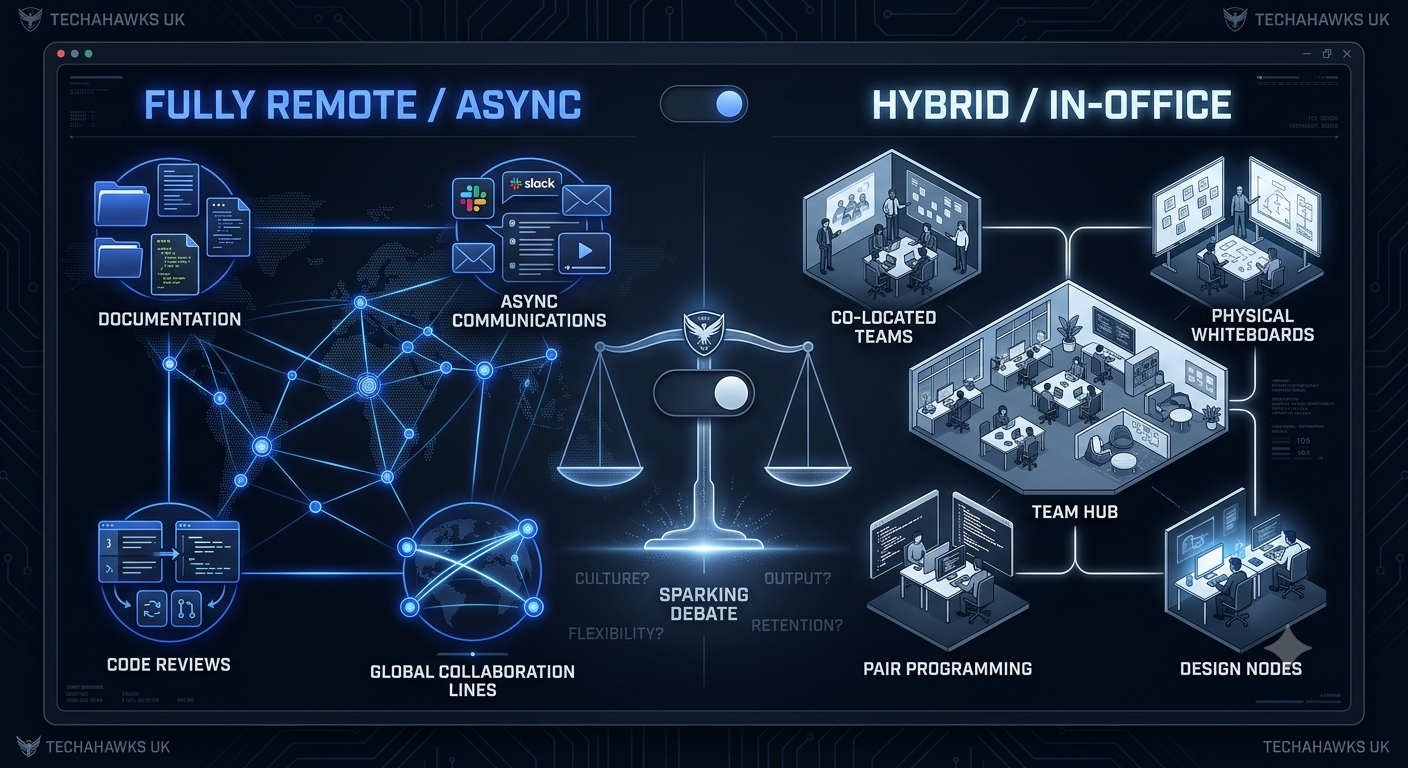
If your team’s productivity relies on spontaneous, real-time Slack threads or continuous Zoom calls, fully remote setups will fail.
Document decisions in centralized RFCs (Request for Comments) and technical design docs. Make asynchronous review the default, regardless of where your developers sit.
Reserve In-Person Time for High-Bandwidth Tasks
Avoid making developers commute to an office just to put on noise-canceling headphones and write code all day.
Use co-located days specifically for high-context activities: quarterly roadmap planning, complex system design whiteboarding, retrospectives, and team onboarding.
Establish Clear Core Working Hours
Flexible working shouldn't mean total unpredictability. Set a 3- to 4-hour daily overlap window (e.g., 10:00 AM – 2:00 PM GMT) for real-time code reviews, standups, and pair programming, allowing deep work to happen around it.
Focus on Outcomes, Not Presence
Replace proximity bias with objective performance indicators: PR review velocity, deployment frequency, cycle time, and system reliability.
Key Takeaways
Async by Default: Rely on thorough documentation and written RFCs rather than synchronous meetings.
Purposeful Co-Location: Use office time strictly for collaborative whiteboarding, planning, and relationship building.
Define Overlap Windows: Set core hours to enable real-time collaboration while protecting focus time.
Measure Outputs: Judge engineering performance on code delivery and system quality, not desk hours.
CTA
Where has your team landed on the remote vs. hybrid spectrum? Has your working model improved your team's velocity, or introduced new communication hurdles?
Share your thoughts in the comments below! [Join Techawks UK today] to connect with engineering leaders, senior developers, and tech pioneers across the United Kingdom.
The debate around working models in the UK tech industry has shifted from emergency adaptation to long-term sustainability. While engineers heavily value flexibility, engineering managers often struggle with asynchronous communication breakdowns, fragmented team culture, and onboarding friction for junior developers.
Building a high-performing engineering culture isn't about counting days at a desk—it's about intentional collaboration.
Here is a practical framework for UK tech leaders to structure effective working models without sacrificing retention or output:
Optimize for Asynchronous-First Communication
If your team’s productivity relies on spontaneous, real-time Slack threads or continuous Zoom calls, fully remote setups will fail.
Document decisions in centralized RFCs (Request for Comments) and technical design docs. Make asynchronous review the default, regardless of where your developers sit.
Reserve In-Person Time for High-Bandwidth Tasks
Avoid making developers commute to an office just to put on noise-canceling headphones and write code all day.
Use co-located days specifically for high-context activities: quarterly roadmap planning, complex system design whiteboarding, retrospectives, and team onboarding.
Establish Clear Core Working Hours
Flexible working shouldn't mean total unpredictability. Set a 3- to 4-hour daily overlap window (e.g., 10:00 AM – 2:00 PM GMT) for real-time code reviews, standups, and pair programming, allowing deep work to happen around it.
Focus on Outcomes, Not Presence
Replace proximity bias with objective performance indicators: PR review velocity, deployment frequency, cycle time, and system reliability.
Key Takeaways
Async by Default: Rely on thorough documentation and written RFCs rather than synchronous meetings.
Purposeful Co-Location: Use office time strictly for collaborative whiteboarding, planning, and relationship building.
Define Overlap Windows: Set core hours to enable real-time collaboration while protecting focus time.
Measure Outputs: Judge engineering performance on code delivery and system quality, not desk hours.
CTA
Where has your team landed on the remote vs. hybrid spectrum? Has your working model improved your team's velocity, or introduced new communication hurdles?
Share your thoughts in the comments below! [Join Techawks UK today] to connect with engineering leaders, senior developers, and tech pioneers across the United Kingdom.
Remote, Hybrid, or In-Office: What is the Real Sweet Spot for UK Engineering Teams?
The debate around working models in the UK tech industry has shifted from emergency adaptation to long-term sustainability. While engineers heavily value flexibility, engineering managers often struggle with asynchronous communication breakdowns, fragmented team culture, and onboarding friction for junior developers.
Building a high-performing engineering culture isn't about counting days at a desk—it's about intentional collaboration.
Here is a practical framework for UK tech leaders to structure effective working models without sacrificing retention or output:
Optimize for Asynchronous-First Communication
If your team’s productivity relies on spontaneous, real-time Slack threads or continuous Zoom calls, fully remote setups will fail.
Document decisions in centralized RFCs (Request for Comments) and technical design docs. Make asynchronous review the default, regardless of where your developers sit.
Reserve In-Person Time for High-Bandwidth Tasks
Avoid making developers commute to an office just to put on noise-canceling headphones and write code all day.
Use co-located days specifically for high-context activities: quarterly roadmap planning, complex system design whiteboarding, retrospectives, and team onboarding.
Establish Clear Core Working Hours
Flexible working shouldn't mean total unpredictability. Set a 3- to 4-hour daily overlap window (e.g., 10:00 AM – 2:00 PM GMT) for real-time code reviews, standups, and pair programming, allowing deep work to happen around it.
Focus on Outcomes, Not Presence
Replace proximity bias with objective performance indicators: PR review velocity, deployment frequency, cycle time, and system reliability.
Key Takeaways
Async by Default: Rely on thorough documentation and written RFCs rather than synchronous meetings.
Purposeful Co-Location: Use office time strictly for collaborative whiteboarding, planning, and relationship building.
Define Overlap Windows: Set core hours to enable real-time collaboration while protecting focus time.
Measure Outputs: Judge engineering performance on code delivery and system quality, not desk hours.
CTA
Where has your team landed on the remote vs. hybrid spectrum? Has your working model improved your team's velocity, or introduced new communication hurdles?
Share your thoughts in the comments below! [Join Techawks UK today] to connect with engineering leaders, senior developers, and tech pioneers across the United Kingdom.

 English
 Arabic
 French
 Spanish
 Portuguese
 Deutsch
 Turkish
 Dutch
Dutch
 Russian
 Romaian
 Portuguese (Brazil)
 Greek
Greek