


Architecting High-Availability Multi-Region Cloud Stacks for the UAE Market
As the UAE continues to cement its status as a global technology hub, enterprises and fast-growing tech companies face a dual challenge: delivering blazing-fast digital experiences while complying with local data protection laws (such as UAE Federal Decree-Law No. 45/2021).
Building a resilient, high-availability architecture across local Middle East cloud regions (e.g., AWS Middle East - UAE, Azure UAE North) requires deliberate design choices.
Here is a practical, step-by-step roadmap to build scalable, locally compliant cloud systems:
Deploy In-Region Primary Workloads
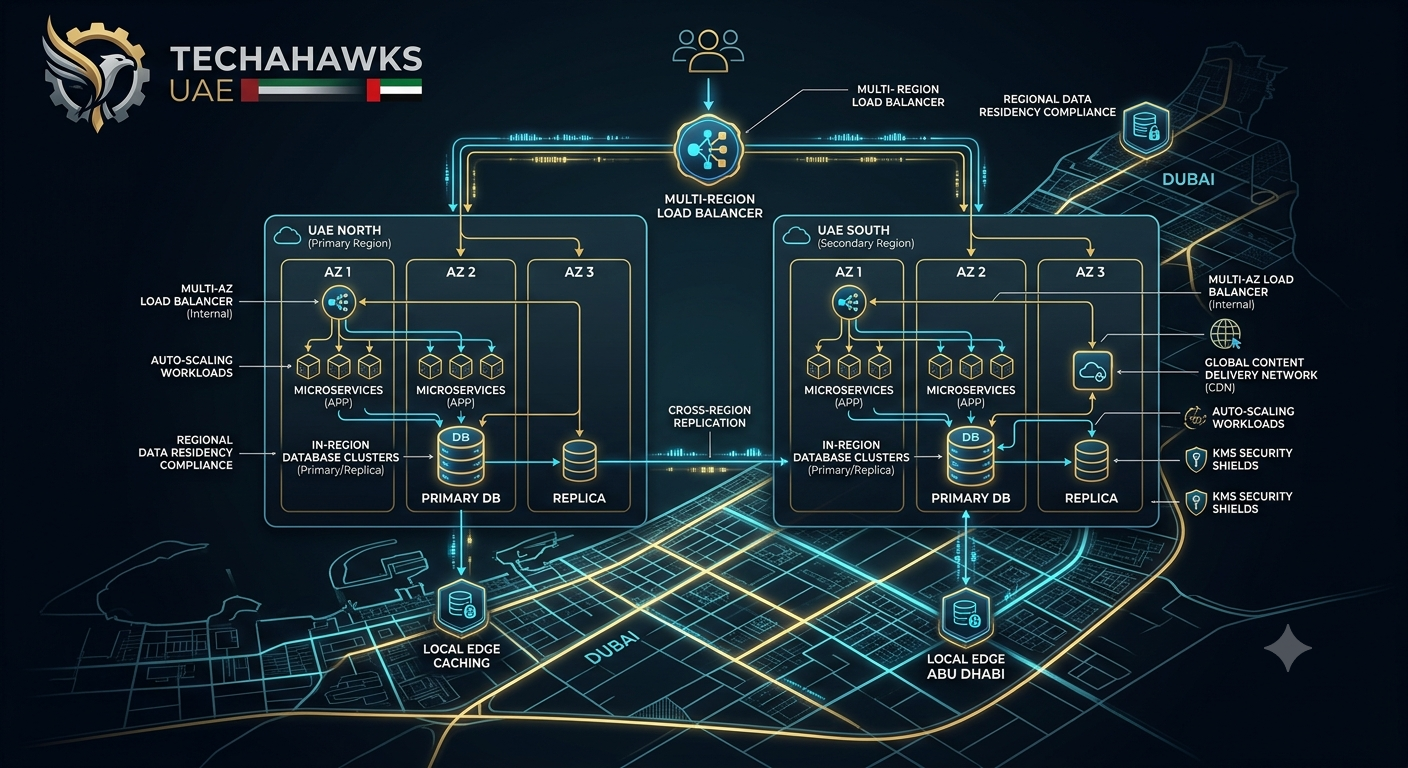
Keep active application instances and primary databases within UAE cloud data centers (e.g., me-central-1 on AWS or uaenorth on Azure). This guarantees ultra-low round-trip time (RTT) for local users while fulfilling data residency mandates.
Implement Multi-AZ High Availability (HA)
Avoid single-zone failures by deploying microservices across at least three Availability Zones (AZs) within the UAE region.
Use managed load balancers configured with automated health checks to instantly reroute traffic away from degraded zones.
Master Local Caching and Edge Acceleration
Offload static content and read-heavy queries using regional Edge Locations / CDNs located directly in Dubai or Abu Dhabi.
Pair edge acceleration with Redis Enterprise or Memcached clusters deployed in-region to serve dynamic data with sub-millisecond response times.
Enforce Encryption at Rest and in Transit
Ensure all customer data is encrypted at rest using regional Key Management Systems (KMS) where private encryption keys never leave the UAE boundaries.
Mandate TLS 1.3 for all external and internal microservice communication.
Key Takeaways
Local Data Residency: Store and process primary customer data within UAE cloud regions to meet regulatory standards.
Multi-AZ Resilience: Eliminate single points of failure by spanning workloads across multiple local availability zones.
Edge Optimization: Leverage UAE-based CDN edge locations to deliver sub-10ms user experiences.
In-Region Key Control: Manage KMS encryption keys strictly within local cloud boundaries.
CTA
Looking to master cloud architecture and exchange best practices with top engineers and CTOs across the Middle East?
[Join Techawks UAE today] and be part of the community shaping the region’s digital infrastructure.
As the UAE continues to cement its status as a global technology hub, enterprises and fast-growing tech companies face a dual challenge: delivering blazing-fast digital experiences while complying with local data protection laws (such as UAE Federal Decree-Law No. 45/2021).
Building a resilient, high-availability architecture across local Middle East cloud regions (e.g., AWS Middle East - UAE, Azure UAE North) requires deliberate design choices.
Here is a practical, step-by-step roadmap to build scalable, locally compliant cloud systems:
Deploy In-Region Primary Workloads
Keep active application instances and primary databases within UAE cloud data centers (e.g., me-central-1 on AWS or uaenorth on Azure). This guarantees ultra-low round-trip time (RTT) for local users while fulfilling data residency mandates.
Implement Multi-AZ High Availability (HA)
Avoid single-zone failures by deploying microservices across at least three Availability Zones (AZs) within the UAE region.
Use managed load balancers configured with automated health checks to instantly reroute traffic away from degraded zones.
Master Local Caching and Edge Acceleration
Offload static content and read-heavy queries using regional Edge Locations / CDNs located directly in Dubai or Abu Dhabi.
Pair edge acceleration with Redis Enterprise or Memcached clusters deployed in-region to serve dynamic data with sub-millisecond response times.
Enforce Encryption at Rest and in Transit
Ensure all customer data is encrypted at rest using regional Key Management Systems (KMS) where private encryption keys never leave the UAE boundaries.
Mandate TLS 1.3 for all external and internal microservice communication.
Key Takeaways
Local Data Residency: Store and process primary customer data within UAE cloud regions to meet regulatory standards.
Multi-AZ Resilience: Eliminate single points of failure by spanning workloads across multiple local availability zones.
Edge Optimization: Leverage UAE-based CDN edge locations to deliver sub-10ms user experiences.
In-Region Key Control: Manage KMS encryption keys strictly within local cloud boundaries.
CTA
Looking to master cloud architecture and exchange best practices with top engineers and CTOs across the Middle East?
[Join Techawks UAE today] and be part of the community shaping the region’s digital infrastructure.
Architecting High-Availability Multi-Region Cloud Stacks for the UAE Market
As the UAE continues to cement its status as a global technology hub, enterprises and fast-growing tech companies face a dual challenge: delivering blazing-fast digital experiences while complying with local data protection laws (such as UAE Federal Decree-Law No. 45/2021).
Building a resilient, high-availability architecture across local Middle East cloud regions (e.g., AWS Middle East - UAE, Azure UAE North) requires deliberate design choices.
Here is a practical, step-by-step roadmap to build scalable, locally compliant cloud systems:
Deploy In-Region Primary Workloads
Keep active application instances and primary databases within UAE cloud data centers (e.g., me-central-1 on AWS or uaenorth on Azure). This guarantees ultra-low round-trip time (RTT) for local users while fulfilling data residency mandates.
Implement Multi-AZ High Availability (HA)
Avoid single-zone failures by deploying microservices across at least three Availability Zones (AZs) within the UAE region.
Use managed load balancers configured with automated health checks to instantly reroute traffic away from degraded zones.
Master Local Caching and Edge Acceleration
Offload static content and read-heavy queries using regional Edge Locations / CDNs located directly in Dubai or Abu Dhabi.
Pair edge acceleration with Redis Enterprise or Memcached clusters deployed in-region to serve dynamic data with sub-millisecond response times.
Enforce Encryption at Rest and in Transit
Ensure all customer data is encrypted at rest using regional Key Management Systems (KMS) where private encryption keys never leave the UAE boundaries.
Mandate TLS 1.3 for all external and internal microservice communication.
Key Takeaways
Local Data Residency: Store and process primary customer data within UAE cloud regions to meet regulatory standards.
Multi-AZ Resilience: Eliminate single points of failure by spanning workloads across multiple local availability zones.
Edge Optimization: Leverage UAE-based CDN edge locations to deliver sub-10ms user experiences.
In-Region Key Control: Manage KMS encryption keys strictly within local cloud boundaries.
CTA
Looking to master cloud architecture and exchange best practices with top engineers and CTOs across the Middle East?
[Join Techawks UAE today] and be part of the community shaping the region’s digital infrastructure.

 Arabic
 French
 Spanish
 Portuguese
 Deutsch
 Turkish
 Dutch
Dutch
 Italiano
 Russian
 Romaian
 Portuguese (Brazil)
 Greek
Greek