


Mastering RAG Architectures: How to Optimize Vector Search for Arabic & Multilingual AI Systems
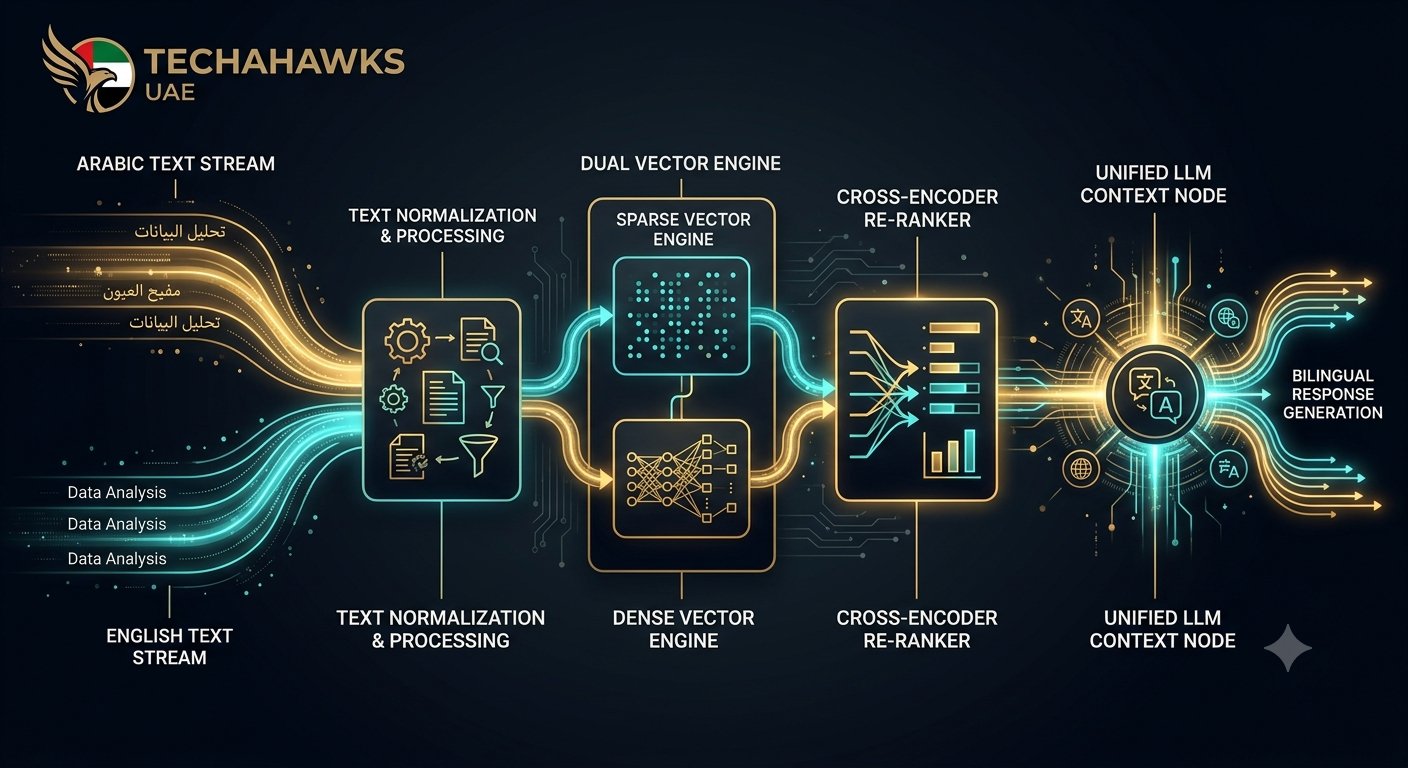
Building production-ready AI applications in the UAE requires seamless handling of both Modern Standard Arabic (MSA) and English. Standard tokenizers and naive chunking strategies frequently fragment Arabic root words, leading to low semantic retrieval accuracy and bloated vector database costs.
To build robust, high-precision RAG pipelines for regional applications, engineering teams must implement specialized text processing and indexing techniques.
Here is a practical, step-by-step engineering guide to optimizing bilingual RAG pipelines:
Implement Root-Aware Arabic Tokenization
Avoid generic whitespace or character-based chunking. Use Arabic-native preprocessing tools (such as Farasa or camel-tools) to handle lemmatization, prefix stripping, and root extraction before generating embeddings.
Proper normalization (e.g., unifying Alef, Yeh, and removing diacritics/Tashkeel) prevents duplicate or missed matches in vector space.
Leverage Multilingual & Domain-Specific Embedding Models
Replace English-first embedding models with multilingual architectures optimized for cross-lingual alignment (such as bge-m3 or specialized regional models).
Ensure the model maps Arabic queries and English documentation into a shared vector space so users can query in Arabic and retrieve relevant English technical specs (and vice versa).
Deploy Hybrid Search (Sparse + Dense Retrieval)
Dense vector search (cosine similarity) can struggle with specific Arabic jargon, proper nouns, or legal/regulatory terms.
Combine dense semantic retrieval with sparse keyword search (BM25 or SPLADE). Use a Reciprocal Rank Fusion (RRF) algorithm to re-rank top hits from both retrieval paths before feeding context to the LLM.
Incorporate Cross-Encoder Re-Ranking
To maximize context window efficiency and lower token latency, pass your top 20 retrieved chunks through a multilingual cross-encoder re-ranker (e.g., Cohere Rerank or bge-reranker-large).
Select only the top 3–5 highest-scoring passages for final generation.
Key Takeaways
Normalize Early: Strip diacritics and normalize Arabic letter variants before tokenization to maintain embedding quality.
Bridge Languages: Use cross-lingual embedding models that project English and Arabic concepts into a unified semantic space.
Hybrid Is Essential: Merge sparse keyword matching with dense vector search to preserve exact matches for technical terms.
Re-Rank for Precision: Apply a cross-encoder pass to filter out noise and cut LLM token costs.
CTA
Building AI workloads in the Middle East and looking to connect with regional AI engineers, data scientists, and solutions architects?
[Join Techawks UAE today] and collaborate with the community driving AI innovation across the GCC.
Building production-ready AI applications in the UAE requires seamless handling of both Modern Standard Arabic (MSA) and English. Standard tokenizers and naive chunking strategies frequently fragment Arabic root words, leading to low semantic retrieval accuracy and bloated vector database costs.
To build robust, high-precision RAG pipelines for regional applications, engineering teams must implement specialized text processing and indexing techniques.
Here is a practical, step-by-step engineering guide to optimizing bilingual RAG pipelines:
Implement Root-Aware Arabic Tokenization
Avoid generic whitespace or character-based chunking. Use Arabic-native preprocessing tools (such as Farasa or camel-tools) to handle lemmatization, prefix stripping, and root extraction before generating embeddings.
Proper normalization (e.g., unifying Alef, Yeh, and removing diacritics/Tashkeel) prevents duplicate or missed matches in vector space.
Leverage Multilingual & Domain-Specific Embedding Models
Replace English-first embedding models with multilingual architectures optimized for cross-lingual alignment (such as bge-m3 or specialized regional models).
Ensure the model maps Arabic queries and English documentation into a shared vector space so users can query in Arabic and retrieve relevant English technical specs (and vice versa).
Deploy Hybrid Search (Sparse + Dense Retrieval)
Dense vector search (cosine similarity) can struggle with specific Arabic jargon, proper nouns, or legal/regulatory terms.
Combine dense semantic retrieval with sparse keyword search (BM25 or SPLADE). Use a Reciprocal Rank Fusion (RRF) algorithm to re-rank top hits from both retrieval paths before feeding context to the LLM.
Incorporate Cross-Encoder Re-Ranking
To maximize context window efficiency and lower token latency, pass your top 20 retrieved chunks through a multilingual cross-encoder re-ranker (e.g., Cohere Rerank or bge-reranker-large).
Select only the top 3–5 highest-scoring passages for final generation.
Key Takeaways
Normalize Early: Strip diacritics and normalize Arabic letter variants before tokenization to maintain embedding quality.
Bridge Languages: Use cross-lingual embedding models that project English and Arabic concepts into a unified semantic space.
Hybrid Is Essential: Merge sparse keyword matching with dense vector search to preserve exact matches for technical terms.
Re-Rank for Precision: Apply a cross-encoder pass to filter out noise and cut LLM token costs.
CTA
Building AI workloads in the Middle East and looking to connect with regional AI engineers, data scientists, and solutions architects?
[Join Techawks UAE today] and collaborate with the community driving AI innovation across the GCC.
Mastering RAG Architectures: How to Optimize Vector Search for Arabic & Multilingual AI Systems
Building production-ready AI applications in the UAE requires seamless handling of both Modern Standard Arabic (MSA) and English. Standard tokenizers and naive chunking strategies frequently fragment Arabic root words, leading to low semantic retrieval accuracy and bloated vector database costs.
To build robust, high-precision RAG pipelines for regional applications, engineering teams must implement specialized text processing and indexing techniques.
Here is a practical, step-by-step engineering guide to optimizing bilingual RAG pipelines:
Implement Root-Aware Arabic Tokenization
Avoid generic whitespace or character-based chunking. Use Arabic-native preprocessing tools (such as Farasa or camel-tools) to handle lemmatization, prefix stripping, and root extraction before generating embeddings.
Proper normalization (e.g., unifying Alef, Yeh, and removing diacritics/Tashkeel) prevents duplicate or missed matches in vector space.
Leverage Multilingual & Domain-Specific Embedding Models
Replace English-first embedding models with multilingual architectures optimized for cross-lingual alignment (such as bge-m3 or specialized regional models).
Ensure the model maps Arabic queries and English documentation into a shared vector space so users can query in Arabic and retrieve relevant English technical specs (and vice versa).
Deploy Hybrid Search (Sparse + Dense Retrieval)
Dense vector search (cosine similarity) can struggle with specific Arabic jargon, proper nouns, or legal/regulatory terms.
Combine dense semantic retrieval with sparse keyword search (BM25 or SPLADE). Use a Reciprocal Rank Fusion (RRF) algorithm to re-rank top hits from both retrieval paths before feeding context to the LLM.
Incorporate Cross-Encoder Re-Ranking
To maximize context window efficiency and lower token latency, pass your top 20 retrieved chunks through a multilingual cross-encoder re-ranker (e.g., Cohere Rerank or bge-reranker-large).
Select only the top 3–5 highest-scoring passages for final generation.
Key Takeaways
Normalize Early: Strip diacritics and normalize Arabic letter variants before tokenization to maintain embedding quality.
Bridge Languages: Use cross-lingual embedding models that project English and Arabic concepts into a unified semantic space.
Hybrid Is Essential: Merge sparse keyword matching with dense vector search to preserve exact matches for technical terms.
Re-Rank for Precision: Apply a cross-encoder pass to filter out noise and cut LLM token costs.
CTA
Building AI workloads in the Middle East and looking to connect with regional AI engineers, data scientists, and solutions architects?
[Join Techawks UAE today] and collaborate with the community driving AI innovation across the GCC.

 English
 Arabic
 French
 Spanish
 Portuguese
 Deutsch
 Turkish
 Dutch
Dutch
 Russian
 Romaian
 Portuguese (Brazil)
 Greek
Greek