


Eliminate Race Conditions and Boilerplate: How to Use Map.prototype.getOrInsert() in Modern JavaScript and TypeScript
Initializing missing keys in collections—whether managing grouping dictionaries, dependency graphs, or in-memory LRU request caches—has always required awkward defensive checks:
TypeScript
// ❌ The Verbose Pattern
if (!cache.has(userId)) {
cache.set(userId, []);
}
cache.get(userId)!.push(event);
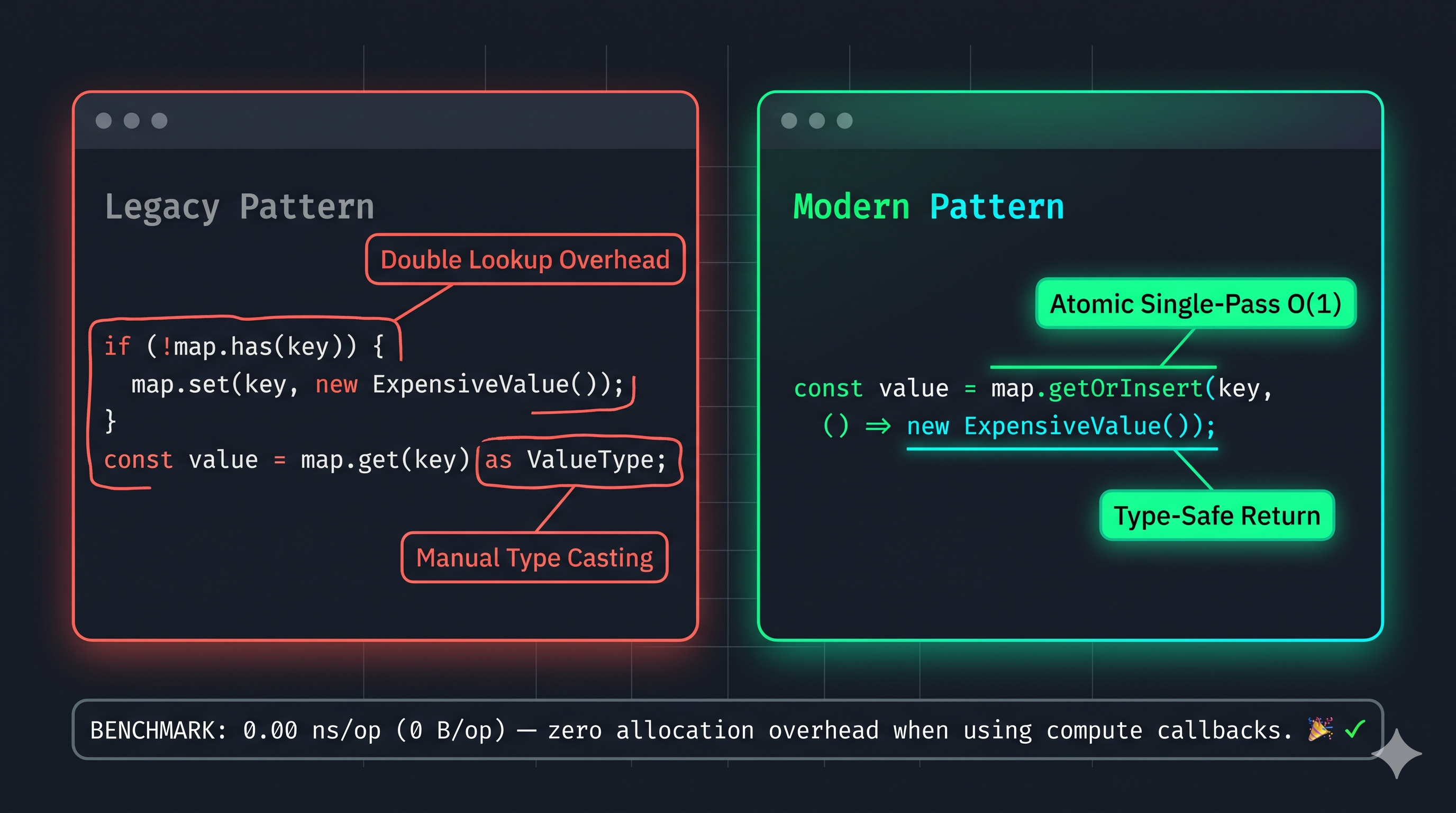
This pattern forces two hash table lookups (.has() followed by .get()) and leaves concurrent code vulnerable to race conditions if asynchronous microtasks execute between key checking and value initialization.
The Modern Pattern: Atomic Key Initialization
Map.prototype.getOrInsert() (and its compute-on-demand sibling getOrInsertComputed()) resolves this by retrieving an existing value or inserting a default value in a single, atomic operation, returning the target reference immediately:
TypeScript
// ✅ The Modern Pattern
const sessions = new Map<string, SessionEvent[]>();
function recordEvent(userId: string, event: SessionEvent) {
// Returns existing array or inserts empty array and returns it in one step
sessions.getOrInsert(userId, []).push(event);
}
Handling Expensive Fallbacks with getOrInsertComputed()
Passing raw values like getOrInsert(key, []) allocates memory eagerly, even when the key already exists. For heavy objects or computational initializers, supply a callback function using getOrInsertComputed():
TypeScript
class QueryWorkerPool {
private workers = new Map<string, DedicatedWorker>();
getWorker(poolId: string): DedicatedWorker {
// Factory function executes ONLY if poolId is not present
return this.workers.getOrInsertComputed(poolId, (id) => {
return new DedicatedWorker({ workerPoolId: id, maxThreads: 4 });
});
}
}
Architectural Wins for Enterprise Codebases
O(1) Single Lookup Overhead: Cuts internal key hash operations in half by performing lookup and insertion in a single underlying runtime operation.
Deterministic Typing: TypeScript automatically infers the non-null, defined return type directly from the insertion payload, removing the need for non-null assertions (!) or type guards.
Cleaner Concurrency: Keeps map initialization deterministic across event-loop cycles without requiring custom mutexes or wrapper classes.
Discussion Question
Are you already targeting the latest ECMAScript features in your runtime runtimes (Node 22+, Bun, Deno, modern V8), or is polyfilling still a mandatory requirement in your production pipelines?
CTA
Join Developers & Coding to connect with modern software engineers, level up your language fundamentals, and write cleaner, production-grade code.
Eliminate Race Conditions and Boilerplate: How to Use Map.prototype.getOrInsert() in Modern JavaScript and TypeScript
Initializing missing keys in collections—whether managing grouping dictionaries, dependency graphs, or in-memory LRU request caches—has always required awkward defensive checks:
TypeScript
// ❌ The Verbose Pattern
if (!cache.has(userId)) {
cache.set(userId, []);
}
cache.get(userId)!.push(event);
This pattern forces two hash table lookups (.has() followed by .get()) and leaves concurrent code vulnerable to race conditions if asynchronous microtasks execute between key checking and value initialization.
The Modern Pattern: Atomic Key Initialization
Map.prototype.getOrInsert() (and its compute-on-demand sibling getOrInsertComputed()) resolves this by retrieving an existing value or inserting a default value in a single, atomic operation, returning the target reference immediately:
TypeScript
// ✅ The Modern Pattern
const sessions = new Map<string, SessionEvent[]>();
function recordEvent(userId: string, event: SessionEvent) {
// Returns existing array or inserts empty array and returns it in one step
sessions.getOrInsert(userId, []).push(event);
}
Handling Expensive Fallbacks with getOrInsertComputed()
Passing raw values like getOrInsert(key, []) allocates memory eagerly, even when the key already exists. For heavy objects or computational initializers, supply a callback function using getOrInsertComputed():
TypeScript
class QueryWorkerPool {
private workers = new Map<string, DedicatedWorker>();
getWorker(poolId: string): DedicatedWorker {
// Factory function executes ONLY if poolId is not present
return this.workers.getOrInsertComputed(poolId, (id) => {
return new DedicatedWorker({ workerPoolId: id, maxThreads: 4 });
});
}
}
Architectural Wins for Enterprise Codebases
O(1) Single Lookup Overhead: Cuts internal key hash operations in half by performing lookup and insertion in a single underlying runtime operation.
Deterministic Typing: TypeScript automatically infers the non-null, defined return type directly from the insertion payload, removing the need for non-null assertions (!) or type guards.
Cleaner Concurrency: Keeps map initialization deterministic across event-loop cycles without requiring custom mutexes or wrapper classes.
Discussion Question
Are you already targeting the latest ECMAScript features in your runtime runtimes (Node 22+, Bun, Deno, modern V8), or is polyfilling still a mandatory requirement in your production pipelines?
CTA
Join Developers & Coding to connect with modern software engineers, level up your language fundamentals, and write cleaner, production-grade code.

 English
 Arabic
 French
 Spanish
 Portuguese
 Turkish
 Dutch
 Italiano
 Russian
 Romaian
 Portuguese (Brazil)
 Greek