


Beyond Algorithmic Grinding: How to Pass the Modern 2026 Code Review & Debugging Interview
The highest-signal technical screening format across tech companies today is no longer generating algorithmic puzzles from an empty canvas. It is the Live Code Review and Architectural Refactoring Interview.Interviewers drop you into an existing codebase—often featuring code generated by an AI assistant or written by an offsite engineer—and ask you to identify structural flaws, memory leaks, and concurrency bottlenecks.Candidates who fail this round typically fall into the same trap: they focus purely on micro-syntax styling instead of reasoning through systemic failure modes.[❌ The Flawed Junior Approach: Syntax Nitpicking]
Candidate scans line-by-line: "Variable name should be camelCase. Missing semicolon here."
Outcome: ZERO signal on architectural judgment, concurrency, or cost awareness.
[✅ The Production Engineer Framework: Structural Diagnostics]
1. Blast Radius & State --> Is this mutate-in-place? Are there unhandled exceptions?
2. Resource Lifecycle --> Are DB connections, event listeners, or streams leaking?
3. Concurrency & Locking --> Can two concurrent promises access this shared state simultaneously?
4. Observability & Cost --> Is this triggering an N+1 query or unbounded memory growth?
Here is the exact 4-step diagnostic protocol to use when handed a broken PR or unfamiliar service during an interview:
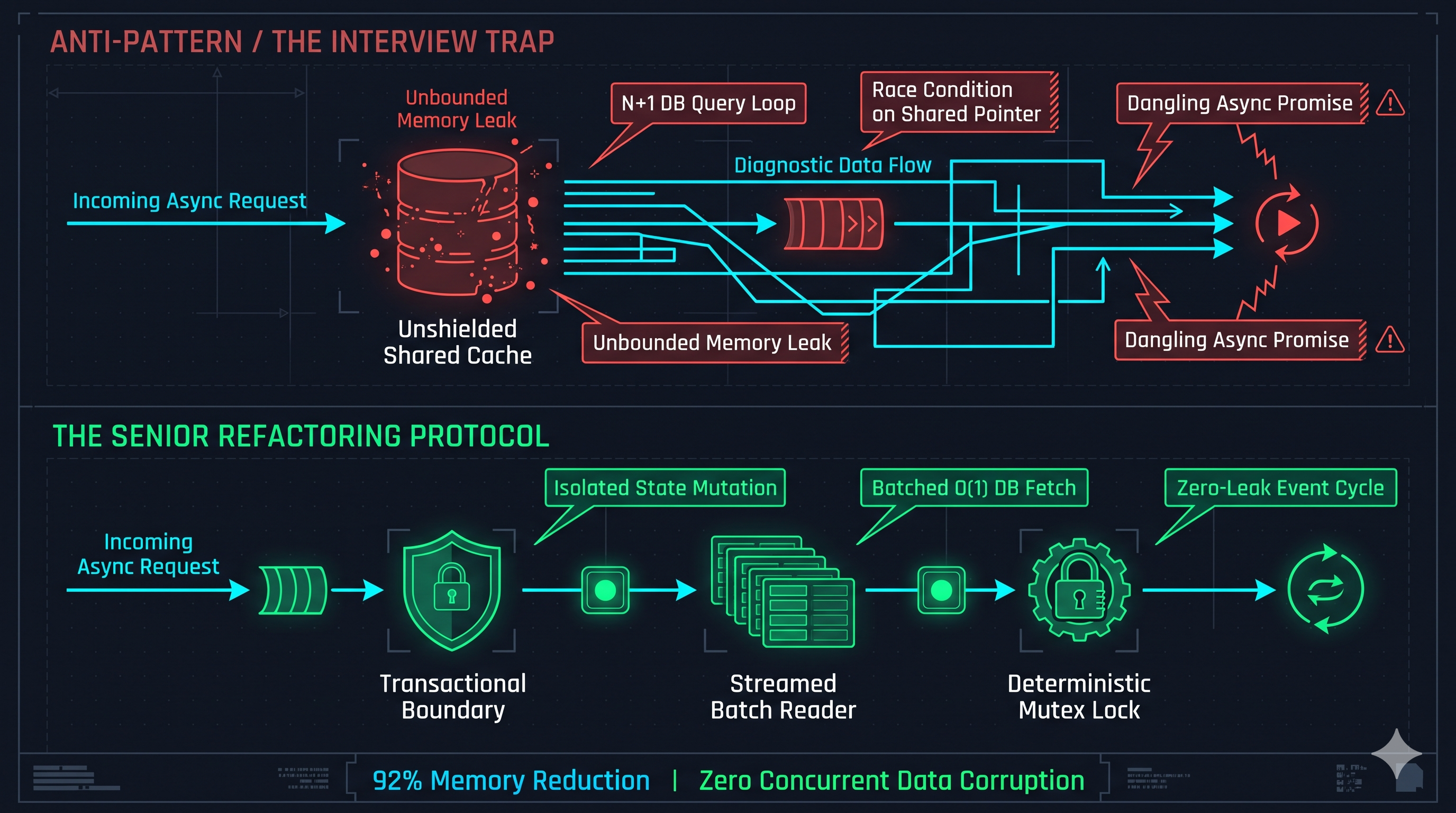
1. Audit the Asynchronous Lifecycles and Shared StateLook immediately for race conditions and leaked event listeners. When reading Node.js, Go, or Python async blocks, ask:Can this promise/goroutine remain dangling if an upstream timeout fires?Is state mutation isolated, or can concurrent workers overwrite shared cache slots?
2. Trace the Worst-Case Memory & I/O BoundSenior candidates immediately evaluate memory footprints rather than average-case runtime:Does an array accumulator hold references indefinitely in memory instead of flushing to a stream?Does a database call run inside a loop ($N+1$ query pattern) rather than executing as a batched read?
3. Propose Incremental Refactoring, Not a Total RewriteJunior engineers often suggest trashing the code and starting over. Staff-level candidates say:"To keep production stable, we should first isolate the mutation inside a transaction boundary. Once that is safe, we can refactor this monolithic handler into an event-driven worker."Demonstrating that you think about downtime, rollback strategies, and operational risk tells the hiring committee you can be trusted with production systems on Day 1.
Discussion Question
What is the most subtle production bug or anti-pattern you have ever encountered in a live interview or a peer's pull request?
CTA
Join Tech Jobs & Opportunities to master real-world interview formats, access curated technical career playbooks, and land senior roles in modern engineering teams.
Beyond Algorithmic Grinding: How to Pass the Modern 2026 Code Review & Debugging Interview
The highest-signal technical screening format across tech companies today is no longer generating algorithmic puzzles from an empty canvas. It is the Live Code Review and Architectural Refactoring Interview.Interviewers drop you into an existing codebase—often featuring code generated by an AI assistant or written by an offsite engineer—and ask you to identify structural flaws, memory leaks, and concurrency bottlenecks.Candidates who fail this round typically fall into the same trap: they focus purely on micro-syntax styling instead of reasoning through systemic failure modes.[❌ The Flawed Junior Approach: Syntax Nitpicking]
Candidate scans line-by-line: "Variable name should be camelCase. Missing semicolon here."
Outcome: ZERO signal on architectural judgment, concurrency, or cost awareness.
[✅ The Production Engineer Framework: Structural Diagnostics]
1. Blast Radius & State --> Is this mutate-in-place? Are there unhandled exceptions?
2. Resource Lifecycle --> Are DB connections, event listeners, or streams leaking?
3. Concurrency & Locking --> Can two concurrent promises access this shared state simultaneously?
4. Observability & Cost --> Is this triggering an N+1 query or unbounded memory growth?
Here is the exact 4-step diagnostic protocol to use when handed a broken PR or unfamiliar service during an interview:
1. Audit the Asynchronous Lifecycles and Shared StateLook immediately for race conditions and leaked event listeners. When reading Node.js, Go, or Python async blocks, ask:Can this promise/goroutine remain dangling if an upstream timeout fires?Is state mutation isolated, or can concurrent workers overwrite shared cache slots?
2. Trace the Worst-Case Memory & I/O BoundSenior candidates immediately evaluate memory footprints rather than average-case runtime:Does an array accumulator hold references indefinitely in memory instead of flushing to a stream?Does a database call run inside a loop ($N+1$ query pattern) rather than executing as a batched read?
3. Propose Incremental Refactoring, Not a Total RewriteJunior engineers often suggest trashing the code and starting over. Staff-level candidates say:"To keep production stable, we should first isolate the mutation inside a transaction boundary. Once that is safe, we can refactor this monolithic handler into an event-driven worker."Demonstrating that you think about downtime, rollback strategies, and operational risk tells the hiring committee you can be trusted with production systems on Day 1.
Discussion Question
What is the most subtle production bug or anti-pattern you have ever encountered in a live interview or a peer's pull request?
CTA
Join Tech Jobs & Opportunities to master real-world interview formats, access curated technical career playbooks, and land senior roles in modern engineering teams.

 English
 French
 Spanish
 Portuguese
 Deutsch
 Turkish
 Dutch
 Italiano
 Russian
 Romaian
 Portuguese (Brazil)
 Greek