


The Death of the Chat Box: Designing Reversible Affordances for Agentic AI Workflows
Traditional UX assumes deterministic interaction: clicking a button always triggers an identical, predictable state mutation.
Agentic AI breaks this paradigm. Because multi-step agents are non-deterministic, open-ended, and act directly on external environments (executing API calls, sending communications, modifying database records), applying conventional form validations or linear dialog boxes creates dangerous UX failure modes:
The Interruption Bottleneck: Forcing users to approve every tiny autonomous step completely ruins the agent's core value proposition.
The Blind-Approval Anti-Pattern: Generic modal dialogues ("Agent wants to proceed: OK / Cancel") obscure the underlying payload, training users to skim and accept without verifying.
Product managers and product designers must transition from "Chat Interfaces" to Tiered Autonomy and Reversibility Affordances.
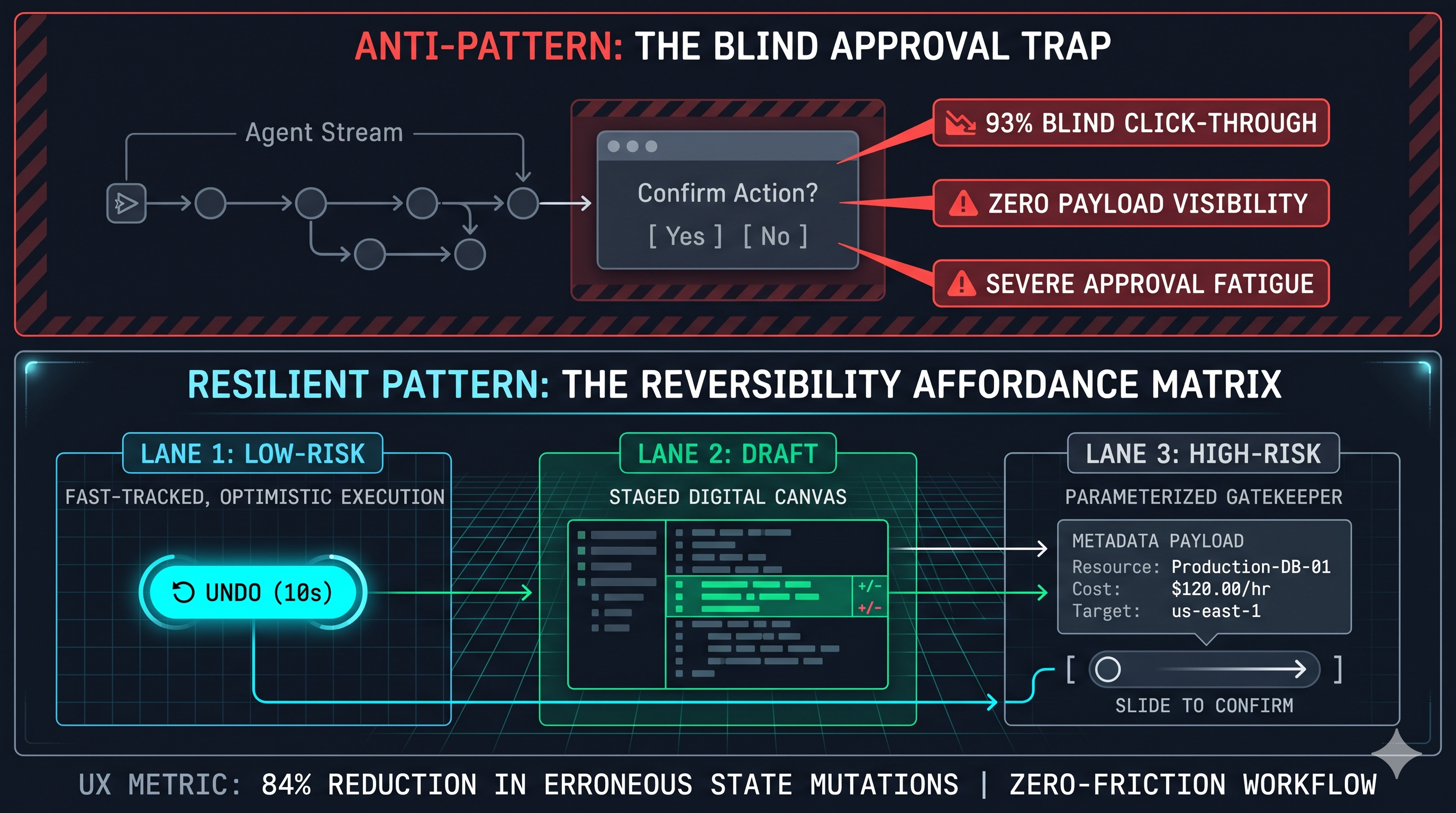
[❌ The Broken Interaction: Generic Confirmation Modal]
Agent Action ──> [Modal: "Are you sure you want to proceed? [Yes/No]"]
Outcome: 93% blind approval rate; user fatigue; high disaster blast radius.
[✅ Modern Agentic UX: The Reversibility Matrix]
Action Type Interaction Pattern UX Affordance
────────────────────────────────────────────────────────────────────────────────────────
Low-Risk / Reversible │ Optimistic Execution + Undo │ Temporary Toast (5-10s) + Rollback
Draft / Staged Artifact │ Inline Diff & Direct Canvas Edit │ Shaded Canvas + Single-Key Accept
High-Risk / Irreversible │ Parameterized Gatekeeper │ Explicit Payload Diff + Dual Approver
To build agentic products users can genuinely rely on, apply this 3-step UX framework:
1. Categorize Every Tool Action by Blast Radius and Reversibility
Never treat all agent tool invocations equally:
Low Blast Radius / High Reversibility: Tagging tickets, reordering lists, generating draft summaries. Pattern: Execute optimistically without blocking the user, while surfacing a persistent 10-second undo toast.
High Blast Radius / Irreversible: Transacting payments, altering production infrastructure, deleting customer datasets. Pattern: Full execution freeze with explicit payload inspections.
2. Design Structured Staging Canvases, Not Conversational Transcripts
Users cannot parse complex structural changes inside a narrow scrolling chat transcript.
When an agent drafts a workflow, document, or architecture, render it inside a dedicated Staging Canvas using inline diffing (visual green/red delta highlighting).
Provide Inline Tweak Affordances: allow the user to click and edit specific hallucinated parameters directly on the canvas without reprompting the agent from scratch.
3. Transform "Confirmation Modals" into "Parameterized Gatekeepers"
Eliminate generic alert dialogues. An enterprise approval checkpoint must clearly display:
The explicit external target (e.g., "Deploying branch 'staging-v2' to AWS us-east-1").
The exact financial or state delta (e.g., "Estimated monthly compute: +$340/mo").
A granular fallback toggle allowing the user to approve a subset of actions while rejecting risky tool parameters.
Designing for autonomous systems is not about getting out of the user's way completely; it is about calibrating load-bearing friction so human oversight feels empowering rather than bureaucratic.
Discussion Question
In your product, what criteria separates an action executed autonomously with an "Undo" affordance from one that mandates a blocking Human-in-the-Loop approval gate?
CTA
Join Product, UX & Design to unpack real-world design systems, agentic interaction patterns, and product frameworks with designers and product leaders building next-generation interfaces.
The Death of the Chat Box: Designing Reversible Affordances for Agentic AI Workflows
Traditional UX assumes deterministic interaction: clicking a button always triggers an identical, predictable state mutation.
Agentic AI breaks this paradigm. Because multi-step agents are non-deterministic, open-ended, and act directly on external environments (executing API calls, sending communications, modifying database records), applying conventional form validations or linear dialog boxes creates dangerous UX failure modes:
The Interruption Bottleneck: Forcing users to approve every tiny autonomous step completely ruins the agent's core value proposition.
The Blind-Approval Anti-Pattern: Generic modal dialogues ("Agent wants to proceed: OK / Cancel") obscure the underlying payload, training users to skim and accept without verifying.
Product managers and product designers must transition from "Chat Interfaces" to Tiered Autonomy and Reversibility Affordances.
[❌ The Broken Interaction: Generic Confirmation Modal]
Agent Action ──> [Modal: "Are you sure you want to proceed? [Yes/No]"]
Outcome: 93% blind approval rate; user fatigue; high disaster blast radius.
[✅ Modern Agentic UX: The Reversibility Matrix]
Action Type Interaction Pattern UX Affordance
────────────────────────────────────────────────────────────────────────────────────────
Low-Risk / Reversible │ Optimistic Execution + Undo │ Temporary Toast (5-10s) + Rollback
Draft / Staged Artifact │ Inline Diff & Direct Canvas Edit │ Shaded Canvas + Single-Key Accept
High-Risk / Irreversible │ Parameterized Gatekeeper │ Explicit Payload Diff + Dual Approver
To build agentic products users can genuinely rely on, apply this 3-step UX framework:
1. Categorize Every Tool Action by Blast Radius and Reversibility
Never treat all agent tool invocations equally:
Low Blast Radius / High Reversibility: Tagging tickets, reordering lists, generating draft summaries. Pattern: Execute optimistically without blocking the user, while surfacing a persistent 10-second undo toast.
High Blast Radius / Irreversible: Transacting payments, altering production infrastructure, deleting customer datasets. Pattern: Full execution freeze with explicit payload inspections.
2. Design Structured Staging Canvases, Not Conversational Transcripts
Users cannot parse complex structural changes inside a narrow scrolling chat transcript.
When an agent drafts a workflow, document, or architecture, render it inside a dedicated Staging Canvas using inline diffing (visual green/red delta highlighting).
Provide Inline Tweak Affordances: allow the user to click and edit specific hallucinated parameters directly on the canvas without reprompting the agent from scratch.
3. Transform "Confirmation Modals" into "Parameterized Gatekeepers"
Eliminate generic alert dialogues. An enterprise approval checkpoint must clearly display:
The explicit external target (e.g., "Deploying branch 'staging-v2' to AWS us-east-1").
The exact financial or state delta (e.g., "Estimated monthly compute: +$340/mo").
A granular fallback toggle allowing the user to approve a subset of actions while rejecting risky tool parameters.
Designing for autonomous systems is not about getting out of the user's way completely; it is about calibrating load-bearing friction so human oversight feels empowering rather than bureaucratic.
Discussion Question
In your product, what criteria separates an action executed autonomously with an "Undo" affordance from one that mandates a blocking Human-in-the-Loop approval gate?
CTA
Join Product, UX & Design to unpack real-world design systems, agentic interaction patterns, and product frameworks with designers and product leaders building next-generation interfaces.

 English
 Arabic
 French
 Spanish
 Portuguese
 Deutsch
 Turkish
 Dutch
 Italiano
 Russian
 Romaian
 Greek